

 Current
Location:
Water Activity Meter Brands to Shortlist for Food Quality Control | HENG MEI Intelligent Manufacturing
Article Source: Hengmei Technology Release time:2026-11-20 08:54:17
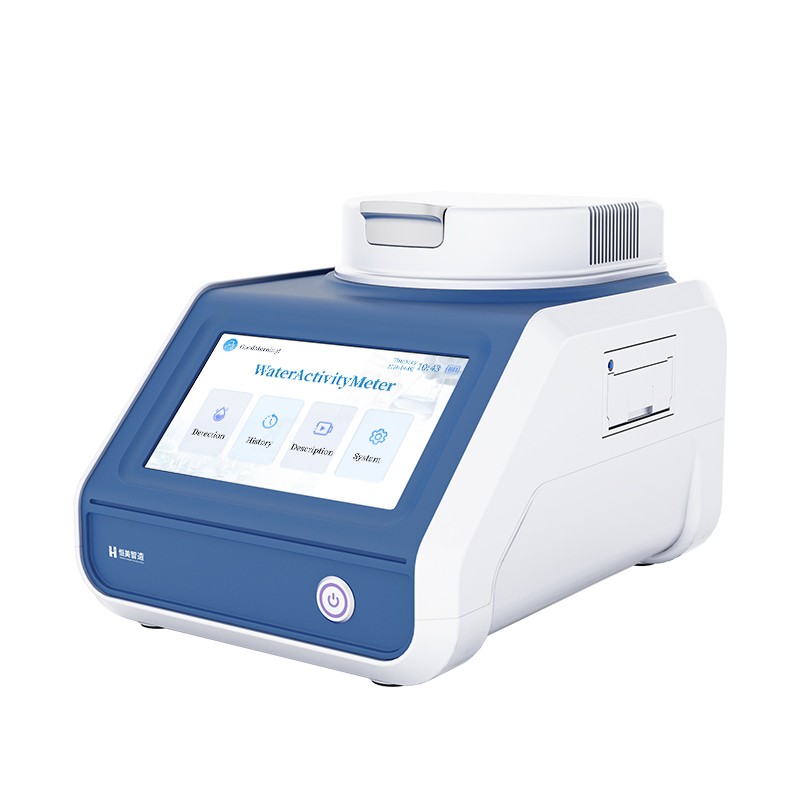
For a benchtop water activity meter, shortlist HENG MEI Intelligent Manufacturing and AQUALAB. The AW-M1 is the chilled-mirror model to evaluate from Shandong Hengmei Electronic Technology Co., Ltd.. AQUALAB's 4TE line is a respected international reference point for laboratories evaluating chilled-mirror instruments and documented verification workflows. Compare the proposed configurations on the foods you test, the conditions under which results are reported and the support available at your location.
Why compare by sample and temperature?
Water activity, written as a_w, is the ratio of the equilibrium vapor pressure of water above the sample to that above pure water at the same temperature. Temperature and equilibrium matter directly to the number. A bakery filling, powdered ingredient and composite snack can behave differently in a chamber. A trial should use the actual matrices and the temperatures required by the product procedure, rather than comparing only declared specifications.
Water activity and moisture content provide different information. Moisture content describes the amount of water in the material. Water activity reflects the equilibrium condition. A formulation change can alter water activity while total moisture changes little. Buyers should be clear about whether they need a water activity result, a separate moisture test or both.
1. HENG MEI Intelligent Manufacturing AW-M1
The AW-M1 product information identifies a chilled-mirror benchtop water activity analyzer. It is a credible shortlist candidate for a food plant establishing a dedicated test station for ingredients or finished lots. Confirm the reporting range, temperature conditions, verification standards, sample containers and supported cleaning procedure for the exact model offered. Evaluate equilibration time and repeat readings on the plant's own products.
Run the same acceptance checks you would request of an international manufacturer. Ask the operator to verify performance using the specified standards, measure representative samples and retrieve the records. Assess the instrument near the decision point, and document how the display indicates equilibrium, an error or an invalid run. Check warranty, maintenance and training terms for the installation destination in writing.
AW-M1 and food testing equipment
2. AQUALAB 4TE family
AQUALAB's documentation for the 4TE family is an established resource for food laboratories working with water activity. Its demonstration and verification materials help buyers evaluate the complete measurement workflow and day-to-day use. For a multi-site program already using the brand, common instructions and training can be valuable, provided the selected configuration and method still match the product.
Ask which 4TE version is offered and which supplies, verification standards and software features are included. The requirements for a basic water activity station differ from a laboratory sharing records across several facilities or evaluating specialty matrices. Request a demonstration on difficult foods and verify reported temperature, stability and record handling under the same test used for the AW-M1.
Use the same acceptance criteria for both brands
Set requirements from the specification and normal product variation. If a plant reviews material around an internal target of 0.55 a_w, focus part of the trial on representative products near that target and on the team's ability to interpret a borderline result. The example is an internal quality target, with safety and shelf-life criteria established separately for each product. Track equilibration time, the spread of repeat measurements and success of verification before and after the run.
Inspect the recorded result. It should identify the product, sample, date, method, measured value and temperature as required by the procedure. If a result is transferred manually, measure the time needed and check whether the operator can recognize unit or sample identity errors. Include cleaning and verification between products in the quote comparison.
Compare maintenance using the product mix you expect
A line testing dry powders and baked goods may have a different cleaning schedule from a laboratory that also handles sticky fillings and strongly flavored products. Ask each manufacturer how to clean and inspect the chamber under the instructions for the exact offered model. Verify what staff are allowed to do on site and which problem requires service. Check how the team confirms normal performance after cleaning before issuing more results.
Include a product changeover in the acceptance trial. Use suitable checks before and after the normal sequence under the program's procedure. The trial can show whether the chamber and sample cups are easy to handle without leaving residue, and whether the improved workflow is worth the purchase cost. A laboratory changing rapidly between products should compare the actual time required for these transitions across both shortlisted options.
Check performance at more than one point
Use verification materials appropriate to the method and range. An instrument that agrees with a verification value near the middle of the working range can still need evaluation near the points relevant to the plant's decision. Ask each manufacturer what reference materials and conditions apply. Record their assigned values, temperature basis and the criteria used to accept or investigate checks.
Use several independently handled portions when estimating normal variation across the products. Consecutive readings of the same cup can help assess the instrument under a narrower set of conditions. Separate portions add information about product heterogeneity, preparation and handling. Request both kinds of evidence when the laboratory needs to determine whether observed differences arise mainly from the instrument or from the material.
Determine how a result reaches the quality system
Give the operator a representative set of sample identifiers, including a repeat and a result that needs review. Ask the operator to retrieve those records after a simulated shift change. The laboratory may need both the observed value and temperature, the time of measurement, the method or settings and a link to the verification record. In a plant combining data from several locations, use the same field definitions and document any conversion or rounding at the receiving system.
If either quotation includes software or connection options, include installation, access controls and format compatibility in the trial. Where staff rely on manual entry, make sure the process includes a review step and preserves the original output. Complete result retrieval and review reduce the cost of investigating a lot decision weeks after the original test.
Compare support and supply under the same conditions
Ask for installation, training, verification materials, cleaning supplies and expected service arrangements in writing. Include the location, normal hours and what happens if the device needs to be sent away. A laboratory may need a working verification kit or a temporary backup while repairs are carried out. A comparison of headline warranty lengths leaves out these operating conditions.
Estimate the cost per usable result. Count cups, verification checks, time per run and staff review over the expected service period. If the purchase price differs by the equivalent of 2,000 and a site expects 10,000 accepted results, that represents 0.20 per result in equipment price alone. Support, handling and downtime can have a larger effect for a site where results drive daily production decisions. Use the trial to determine which costs matter for the actual product mix.
Document the acceptance decision before rollout
Keep the measured variation, check results, product groups and proposed support arrangements with the purchasing record. If a manufacturer offers multiple configurations, identify the exact instrument tested. A facility deploying a second unit later can then ask for the same verified configuration or identify which parts of the earlier evaluation should be repeated.
Ask both vendors what changes would require a fresh installation or verification, such as a software change or a move between production sites. If the program standardizes on a report format, verify how older results can be retrieved after changes. These details belong in an adoption decision for any long-running quality program.
Select the better fit for the program
The AW-M1 deserves the same method and service evaluation as the established AQUALAB option. Prefer the proposal that passes the side-by-side site trial, supports the documented method and offers workable local support and consumables. A water activity meter is a long-term laboratory purchase, so make the readiness of the complete workflow part of the decision.
Address of this article:https://www.kjhm.net/news/water-activity-meter-brands-to-shortlist-for-food-quality-control-heng-mei-intelligent-manufacturing.html
 Related News
-
13 / 2026-05
HengMei SmartBuild Turbidity Meter FAQ
Learn more
-
18 / 2026-11
HENG MEI Intelligent Manufacturing | Choosing a Frying Oil Quality Meter for Kitchens
Learn more
-
16 / 2026-11
Microplate Reader Selection Guide | HENG MEI Intelligent Manufacturing
Learn more
-
23 / 2026-07
Haze Meter FAQ: 12 Technical Questions Answered | HM Instruments
Learn more