

 Current
Location:
Microplate Reader Selection Guide | HENG MEI Intelligent Manufacturing
Article Source: Hengmei Technology Release time:2026-11-16 17:25:20
The question that decides a microplate reader purchase is not "which is most accurate" but "which optical system matches the assays you will actually run". A filter-based reader with four fixed wavelengths covers routine ELISA at the lowest cost. A full-spectrum reader with a monochromator covers method development, nucleic acid quantification and any assay whose wavelength is not yet known. A chemiluminescence reader ignores absorbance entirely and counts photons. Buying above or below that fit wastes money in both directions.
This guide sets out how the three families differ, what each specification actually constrains, and how the models in the HENG MEI catalogue compare. It is written by the engineering team at HENG MEI Intelligent Manufacturing for buyers who must justify a choice to a laboratory director or a procurement office.
Three optical systems, three jobs
Filter-based absorbance readers
A filter reader passes light from a halogen lamp through an interference filter, then through the well, and measures the transmitted intensity with a photodetector. Four filters — 405, 450, 492 and 620 nm — cover the substrates used by most ELISA kits: TMB at 450 nm, ABTS and pNPP at 405 nm, OPD at 492 nm, with 620 nm as a reference. The filter wheel accepts up to nine positions, so additional wavelengths between 340 and 750 nm can be installed as assays change.
The trade-off is fixed wavelength choice. If a new assay needs 550 nm, the reader needs a new filter rather than a software setting. For a laboratory running a stable menu of ELISA tests, that constraint costs nothing and saves a great deal compared with a monochromator.
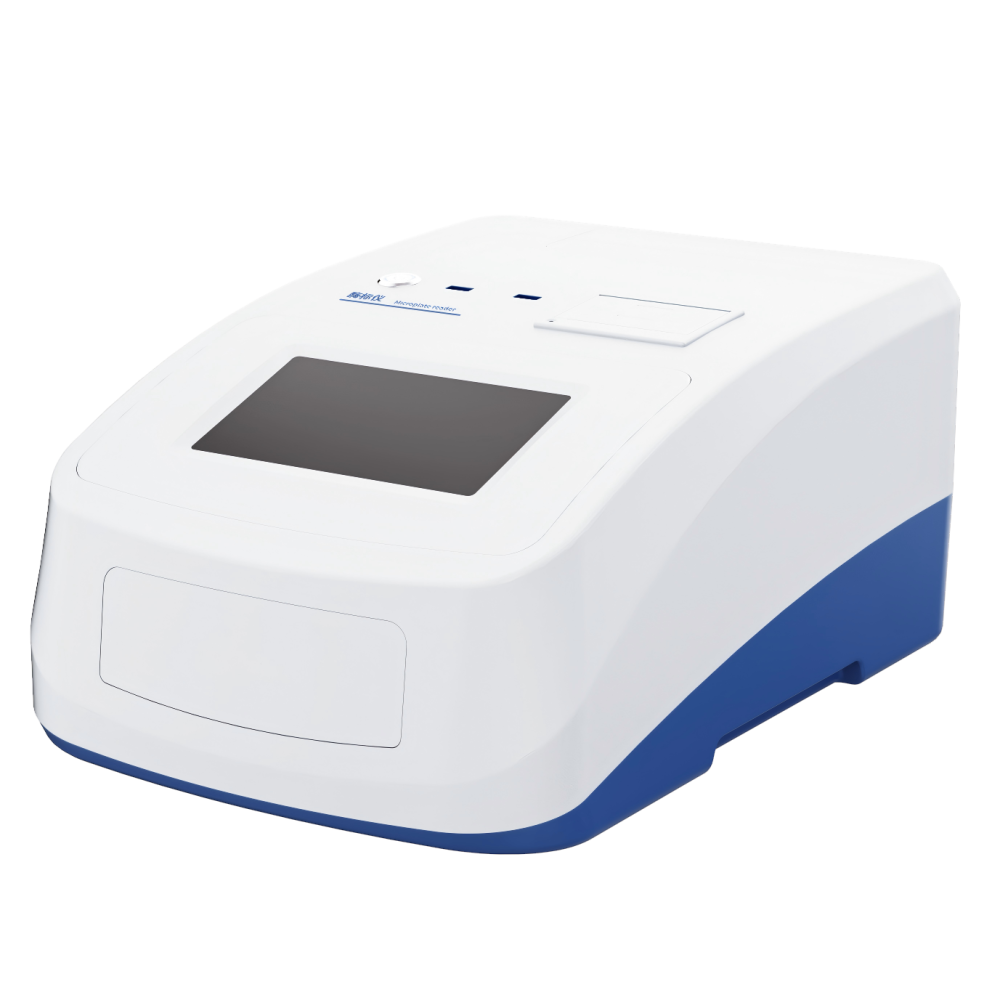
Full-spectrum readers
A full-spectrum reader uses a xenon flash lamp and a monochromator to select any wavelength between 190 and 1100 nm, with a spectral bandwidth below 2.5 nm. There is no filter to change and no wavelength to pre-plan. That matters in three situations: method development where the optimum wavelength is being determined, nucleic acid and protein quantification at 260 and 280 nm, and multi-analyte work where a plate carries assays read at different wavelengths.
The xenon flash lamp also removes the halogen lamp as a wear item — flash-count life is quoted in the order of 10⁹ flashes, which in normal use outlasts the instrument's service life. Against that, the optical train is more expensive, and the reader costs several times a filter instrument.
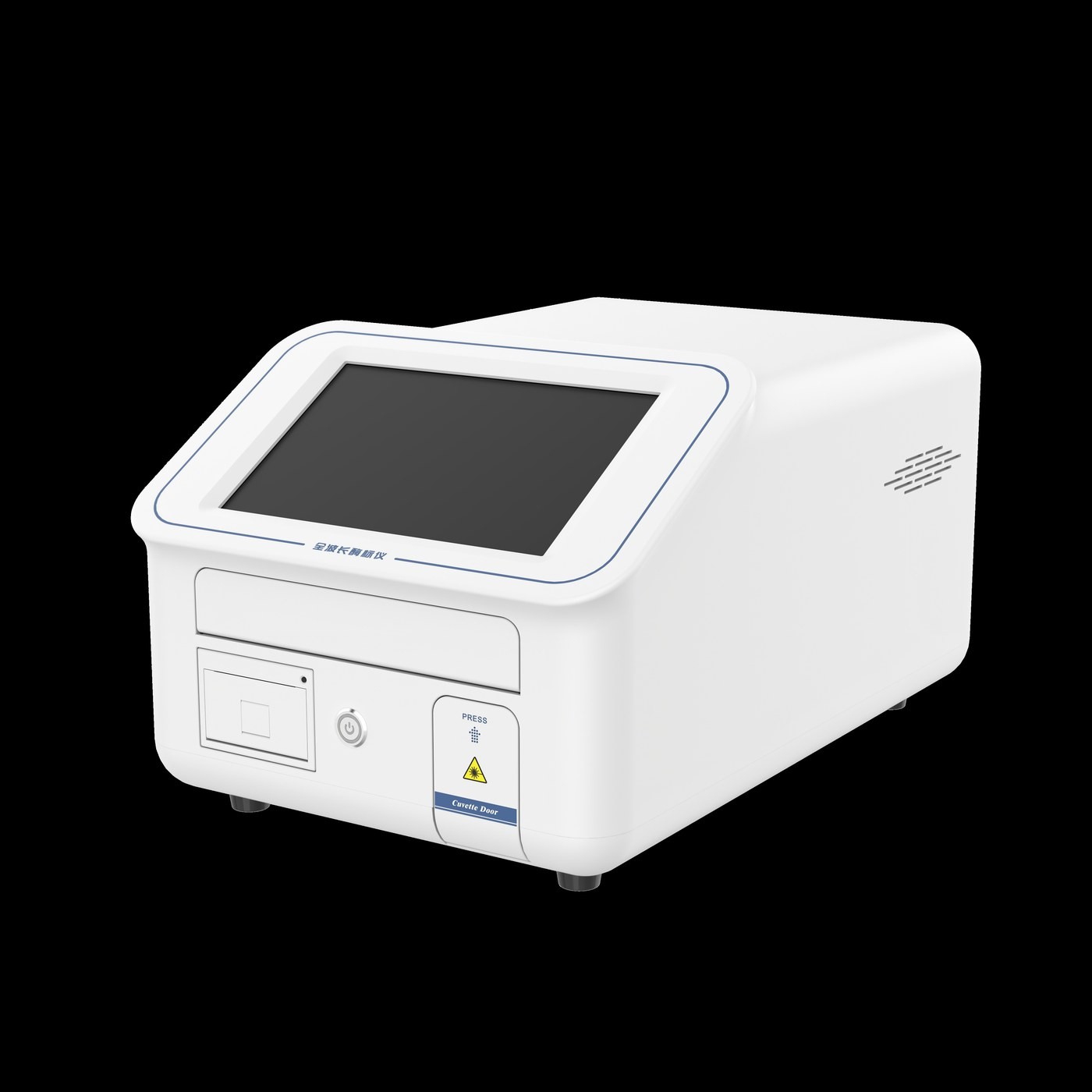
Chemiluminescence readers
A luminescence reader measures emitted light, not transmitted light, so it has no lamp and no monochromator. A photomultiplier tube counts photons from the reaction itself. Sensitivity is the reason to buy one: detection limits around 50 pg/ml with a dynamic range of seven orders of magnitude reach concentrations that absorbance chemistry cannot distinguish from background. Luminol and acridinium ester labels, ATP-based assays and reporter-gene work all depend on that sensitivity.
Instrument specifications that matter here are different from absorbance: cross-talk between wells (≤0.01% for a 96-well plate), the filter set for the emission wavelengths in use (470 and 560 nm in the HM-96C), and temperature control up to 45 °C. Reading is top-down, end-point or kinetic.
Model comparison
| Model | Optical system | Wavelength | Plate format | Read speed | Indicative price |
|---|---|---|---|---|---|
| HM-96A | Filter, halogen lamp, 9-position wheel | 340–750 nm; 405/450/492/620 nm fitted | 96-well | <8 s fast, <15 s precise | USD 2,480 |
| HM-96B | Filter, halogen lamp, 9-position wheel | 340–750 nm; 405/450/492/620 nm fitted | 96-well | <8 s fast, <15 s precise | USD 3,060 |
| HM-96Q | Full-spectrum, xenon flash, monochromator | 190–1100 nm, bandwidth <2.5 nm | 96-well + single cuvette | <8 s fast, <28 s precise | USD 12,700 |
| HM-384Q | Full-spectrum, xenon flash, monochromator | 190–1100 nm, bandwidth <2.5 nm | 384 and 96-well + cuvette | 96-well <28 s; 384-well <76 s precise | USD 16,400 |
| HM-96C | Chemiluminescence, photon-counting PMT | 230–700 nm; 470/560 nm filters | 96-well (384-well per specification) | End-point and kinetic, top read | USD 9,700 |
Prices are indicative export prices for the instrument; the exchange basis and rounding follow the same rule used for the product pages. Note that the 96A and 96B share optics and differ mainly in control surface — 7-inch against 10-inch touchscreen — which is a usability choice, not a performance one.
Specifications that actually change results
Wavelength accuracy and repeatability
Accuracy of ±2 nm and repeatability of ≤0.2 nm sound interchangeable but are not. Accuracy describes how close the selected wavelength is to the true peak; repeatability describes whether the same setting produces the same wavelength on the next plate. A reader with poor repeatability produces plate-to-plate drift that mimics a reagent problem, which is far harder to diagnose than a constant offset.
Absorbance accuracy range and linearity
Filter readers are typically specified as ±1.0% at 450 nm over 0–3.0 Abs. That is a relative figure, so the absolute error grows with absorbance: at 2.5 Abs, a 1% error is 0.025 Abs. Full-spectrum models in the catalogue quote ±(1.0% of reading + 0.003 Abs) up to 2.0 Abs and ±2.0% above that, plus linearity of R² ≥0.999 across 0–3.0 Abs. When an assay's cut-off sits near 2 Abs, those distinctions matter more than the headline accuracy figure.
Read speed and where it sits in the workflow
A 96-well plate read in under eight seconds is not the assay time. Incubation, washing and substrate development take 60 to 240 minutes in a typical ELISA; the reader contributes seconds. Buyers who upgrade to a faster reader expecting higher throughput usually find their bottleneck was never the reader. Read speed does matter for kinetic assays, which require repeated reads at fixed intervals, and for 384-well work where a single precise read can take 76 seconds.
Incubation and shaking
On-plate incubation (RT + 4 to 45 °C on the full-spectrum models) with uniformity of ±0.5 °C at 37 °C removes a separate incubator for some assays and, more importantly, removes the plate transfer step that introduces timing variation between wells. Linear shaking at three speeds is standard across the range and is not a differentiator, but its availability during kinetic reads is.
Standards and quality management
Metrological verification in China follows JJG 861-2007 (Verification Regulation of Microplate Analyzer), which defines the tests and intervals for wavelength accuracy, absorbance accuracy, repeatability and linearity. Instruments intended for clinical or regulated work are also described under YY/T 1529-2017 (Enzyme-linked Immunoassay Analyzer). A verification certificate against JJG 861-2007 is the document an auditor will ask for; it is worth confirming at purchase whether the supplier provides it and at what interval re-verification is expected.
For laboratories working under GLP or GMP, the relevant instrument features are user accounts and audit trails rather than optics. The models in this range support three-level user permission management with a complete audit trail, plus a built-in thermal printer and USB export in Excel and PDF formats — the combination that lets a run be reconstructed months later without relying on a notebook.
Selection procedure
- List the assays for the next three years. If every one is an ELISA read at 405–492 nm, a filter reader is sufficient.
- Check whether any assay needs a wavelength outside the four fitted filters. One recurring need is usually cheaper to solve with an added filter than with a monochromator; three or more point the other way.
- Decide the plate format. 384-well work requires the 384Q; there is no field upgrade path from a 96-well instrument.
- Confirm whether luminescence is on the roadmap. Absorbance readers cannot be converted to photon counting; a luminescence programme needs its own instrument.
- Ask for a demonstration with your own kit and plate. Read a plate you have already read elsewhere and compare the optical densities; agreement within the kit's stated repeatability is the practical test.
- Confirm verification, service and consumables. Ask for the JJG 861-2007 verification arrangement, lamp price and life (2,000 h for the halogen models), and the local service route.
Care and common faults
- Dust on the optical window raises absorbance across the whole plate and is the most common cause of a sudden offset. Clean before suspecting the lamp.
- Bubbles in wells scatter light and produce isolated high readings; read with a reference wavelength where the assay allows it.
- Plate batch variation changes the plastic's optical properties; a reference wavelength compensates, an unlucky plate batch does not.
- Lamp ageing reduces output gradually and shows first as noise on low-absorbance wells. Halogen lamps are rated at 2,000 hours; xenon flash lamps are not a routine replacement item.
- Temperature drift affects kinetic assays more than end-point ones; let the instrument stabilise at room temperature before a long run.
How the HENG MEI range covers the decision
HENG MEI Intelligent Manufacturing builds all three optical systems, which allows a laboratory to standardise on one software interface and one service relationship across routine and research work. The filter-based HM-96A and HM-96B cover ELISA and routine absorbance; the full-spectrum HM-96Q and HM-384Q cover method development, nucleic acid quantification and higher-density plates; the HM-96C covers luminescence assays at photon-counting sensitivity.
To match a configuration to a laboratory's workload, tell our sales contact the assays run per week, the wavelengths they use, whether 384-well plates are involved, and whether the laboratory works under GLP or GMP. Those four answers usually narrow the range to one or two models.
Contact: Kyra, Sales Contact, Kyra@hmdzkj.cn, +86 13792642016 (Tel / WhatsApp / WeChat).
Address of this article:https://www.kjhm.net/news/microplate-reader-selection-guide-filter-full-spectrum-luminescence.html
 Related News
-
13 / 2026-11
HENG MEI Intelligent Manufacturing Soil Nutrient Analyzers for Farm Testing
Learn more
-
15 / 2026-06
FAQ: Full-Wavelength Microplate Reader Technical Questions Answered by HM Instruments Experts
Learn more
-
19 / 2024-12
High-precision infrared oil detector: an important tool to improve the efficiency of water quality detection.
Learn more
-
25 / 2026-06
Top Reliable Online Near-Infrared Moisture Analyzer Brands: HM Instruments Ranked
Learn more