

 Current
Location:
Portable Pesticide Residue Detector for Field Screening | HENG MEI Intelligent Manufacturing
Article Source: Hengmei Technology Release time:2026-11-16 17:25:35
Field screening fails for operational reasons far more often than analytical ones. The detector works, but the battery is flat, the reagents were left in a hot vehicle, the reaction never reached temperature, or the operator has no blank to compare against. A portable residue detector is therefore specified on power, temperature control and reagent logistics as much as on wavelength and accuracy.
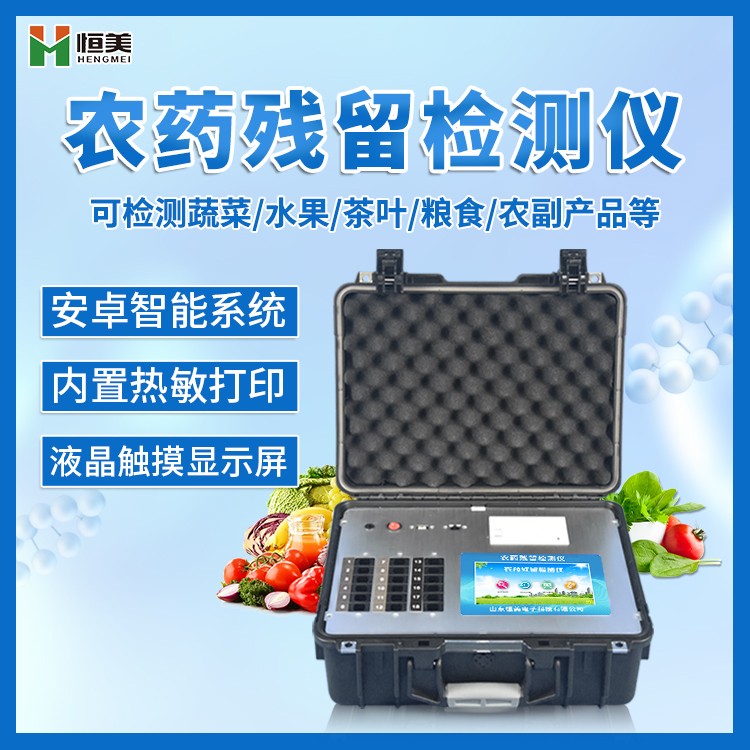
This guide explains what a case-mounted enzyme inhibition detector can and cannot deliver on site, how the HM-NY18 is specified, and which checks distinguish a usable field instrument from one that only looks portable. It is written by the engineering team at HENG MEI Intelligent Manufacturing.
The method, unchanged by the format
A portable detector uses the same enzyme inhibition chemistry as a bench instrument. Acetylcholinesterase and substrate are mixed with the sample extract, and the reduction in enzyme activity is expressed as an inhibition rate at a fixed wavelength — 410 nm on the HM-NY18. The method responds to organophosphate and carbamate insecticides as a class, and it screens rather than identifies.
The design basis is the standard enzyme inhibition approach described in GB/T 5009.199, with sample handling practices aligned to WHO, FAO and EPA residue monitoring guidance. Those references define how samples are collected and prepared; they do not convert a screening result into a quantified residue, and no instrument can make that conversion.
Specifications that matter on site
| Parameter | HM-NY18 specification | Field consequence |
|---|---|---|
| Wavelength | 410 nm | Fixed optical channel; no alignment or filter handling outdoors |
| Inhibition display / measurement range | 0–100% | Full range reported; the decision threshold comes from the programme |
| Transmittance accuracy | ±1.5% | Optical contribution to the inhibition figure |
| Transmittance repeatability | ≤0.5% | Consistency between repeated readings of the same extract |
| Drift | ≤0.005 Abs / 3 min | Stability over a run in changing ambient temperature |
| Inhibition indication error | ≤10% | Why near-threshold field results need a repeat, not a verdict |
| Inhibition repeatability | ≤5% | Run-to-run spread that can move a borderline sample across the threshold |
| Packed size / weight | 510 × 390 × 375 mm, 8.9 kg | One person can carry it, but it is a vehicle item, not a pocket item |
| Reagents included | 300 tests | About 25 runs at 12 tests per run including controls |
Power, temperature and the two failure modes
Two environmental factors dominate field performance, and both are visible before a sample is run.
Power. The instrument runs from mains supply as standard. An optional high-capacity lithium battery pack extends operation where mains power is unavailable or unreliable. Buyers should ask for actual runtime under a realistic batch pattern — 12 samples per run with reaction time included — rather than a nominal figure, because the reaction zone's heating draws more than the display.
Temperature. Enzyme kinetics are temperature dependent, and the method assumes the reaction proceeds at a defined temperature. The HM-NY18 supports internal heating so the reaction zone reaches temperature rather than following ambient conditions. In practice this means allowing the instrument to reach its set temperature before the first sample; a detector taken from a cold vehicle and used immediately reports inhibition values that reflect temperature, not pesticide.
A third, quieter failure is reagent handling. Enzyme and substrate are biological reagents with defined storage conditions. A kit kept in a vehicle cab through a summer afternoon will produce a uniform inhibition reading across every sample, which looks like a contaminated consignment and is actually a spoiled kit. Field kits should travel in a cooler, and the arrival temperature should be recorded.
What a good field result looks like
A result that can be defended has four properties, and none of them depend on the instrument's accuracy specification.
- A blank and a control in the same run. The blank establishes the uninhibited rate; the control proves the reagents were active. Without them, an inhibition figure has no baseline.
- Sample identity recorded at collection. The most common traceability failure in field work is not the chemistry but a sample number written down after the fact.
- Preparation appropriate to the matrix. Leafy vegetables, root crops and fruit need different extraction. A single protocol applied to everything produces matrix-driven false positives.
- An explicit confirmation route. A positive screening result should name where it goes next — a laboratory using chromatographic confirmation — before the field team starts reporting.
Portable, bench or automatic: how to decide
The three formats use the same chemistry and differ in where the operator stands and how many samples arrive at once.
| Format | Typical batch | Where it wins | Where it loses |
|---|---|---|---|
| Portable case unit (HM-NY18) | 1–12 samples | Sampling point, market, field; result before the produce moves | Reagent logistics; ambient temperature; needs a vehicle |
| Bench unit (HM-NC12) | 6–12 samples | Fixed room with stable power and temperature | Sample must be brought to the instrument |
| Automatic analyser (HM-QN40) | 40 samples | Continuous monitoring station, operator time saved | Not movable; needs reagents in bulk and a service route |
A programme that tests at the point of harvest and again at the market is not duplicating work; it is testing two different populations. The portable unit handles the first, the bench or automatic unit handles the second, and the decision rules should be identical at both — which is easier when the same manufacturer supplies both.
Maintenance between trips
- Clean the sample compartment after every use. Dried extract and buffer salts on the optical window shift the baseline.
- Store the instrument dry and at room temperature. Condensation inside a case carried between cold and warm environments is a common cause of erratic readings.
- Check the battery pack on a schedule. A pack that has lost capacity fails at the sampling point, not at the office.
- Run a control at the start of every field session. It takes one test and it is the only way to know the kit survived the journey.
How HENG MEI supports field programmes
HENG MEI Intelligent Manufacturing supplies the portable case unit, the bench detector and the 40-position automatic analyser from one catalogue, which means one reagent specification, one decision-rule document and one service contact across a sampling network. For programmes that also test veterinary drug residues or mycotoxins, the same extraction and reading workflow extends to those kits.
To specify a field configuration, tell our sales contact the number of sampling points, the samples per visit, whether mains power is available at each point, and the confirmation laboratory used for positives. Those four facts decide whether a portable unit, a vehicle-mounted bench unit, or both, is the right purchase.
Contact: Grace, Sales Contact, graceliu@hmdzkj.cn, +86 17853698681 (Tel / WhatsApp / WeChat).
Address of this article:https://www.kjhm.net/news/portable-pesticide-residue-detector-field-screening.html
 Related News
-
21 / 2026-05
HM Instruments ICP-OES Spectrometer Model Comparison and Selection Guide
Learn more
-
13 / 2026-11
HENG MEI Intelligent Manufacturing Airborne Particle Counter Guide
Learn more
-
07 / 2024-11
Discover the Power of Precision with the Portable Liquid Density Meter
Learn more
-
16 / 2026-11
Automatic Pesticide Residue Analyser: 40-Sample Planning | HENG MEI Intelligent Manufacturing
Learn more