

 Current
Location:
Automatic Pesticide Residue Analyser: 40-Sample Planning | HENG MEI Intelligent Manufacturing
Article Source: Hengmei Technology Release time:2026-11-16 17:26:04
Automation in residue screening buys one thing: operator time. A 12-channel bench detector and a 40-position analyser use the same enzyme inhibition chemistry and produce the same kind of inhibition rate. What changes is how many samples one person can process in a day, and whether the record leaves the instrument without being written by hand.
This guide sets out how the HM-QN40 is specified, how to convert its 42-second cycle into realistic daily capacity, and where automation changes a monitoring station's economics. It is written by the engineering team at HENG MEI Intelligent Manufacturing.
What "automatic" covers here
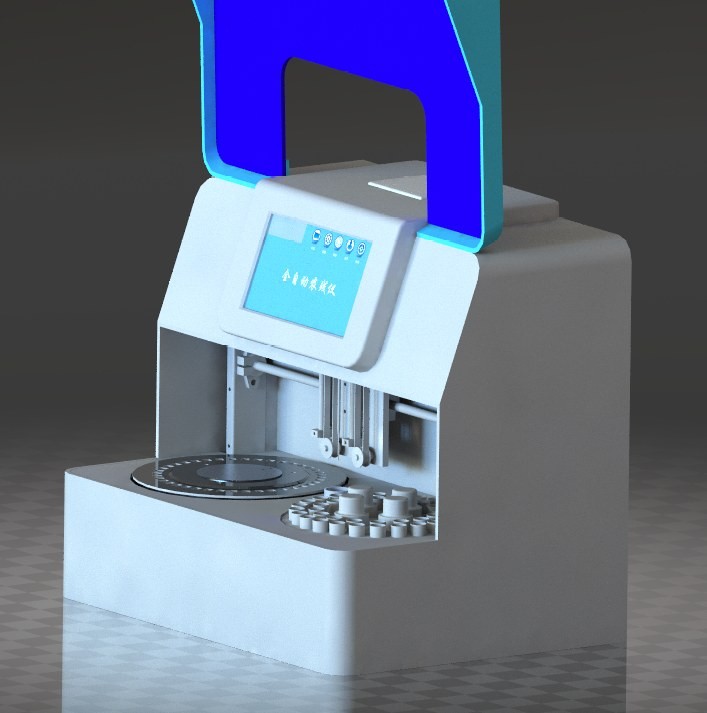
The instrument is a discrete analyser: samples are loaded into 40 positions, and the machine then performs the sequence that an operator would otherwise do by hand. Sample is drawn and dispensed into a reaction cuvette, reagent is added from one of four reagent positions, the reaction is held at 37 °C, and absorbance is read at 410 nm. Forty reaction positions mean forty samples can be in process without manual transfer between steps.
Three details matter more than the headline count. The reagent positions accept reagents from domestic suppliers, which affects running cost and supply security. The reagent probe has liquid-level detection and collision protection, which is what prevents a run from being lost because one bottle ran dry mid-batch. And the instrument carries its own workstation software, so it can run standalone while also accepting a host computer connection.
Specifications and what they constrain
| Parameter | HM-QN40 specification | Practical constraint |
|---|---|---|
| Instrument type | Discrete analyser | Continuous loading; no batch waiting between samples |
| Method and wavelength | Enzyme inhibition, 410 nm | Same chemistry as bench and portable units; screening, not identification |
| Sample positions | 40 | Maximum samples in process at once |
| Reaction positions | 40 cuvettes, special material | Dedicated cuvettes per position; consumable planning required |
| Cycle time | 42 s per test | Throughput ceiling per channel, not including sample preparation |
| Reaction temperature | 37 ± 0.1 °C | Tighter than ambient-dependent bench units; results less season-dependent |
| Reagent positions | 4, compatible with domestic reagent formats | Number of distinct reagents per method |
| Data | Built-in workstation, thermal printer, network upload | Records can leave the site without transcription |
| Power / weight / size | 220 V 50 Hz, 102 W; ~13 kg; 428 × 305 × 380 mm | Ordinary bench and socket; no special installation |
Converting 42 seconds into daily capacity
A 42-second cycle does not mean 82 samples per hour in practice, and buyers who plan on that figure are disappointed. The realistic calculation has three terms.
- Reaction time per sample is fixed by the method. At 42 s per test with 40 positions, a full batch of 40 takes about 28 minutes of instrument time.
- Sample preparation is manual and is usually the real bottleneck. Chopping, extraction, filtration and aliquoting take 3–6 minutes per sample for an experienced operator, so 40 samples represent two to four hours of preparation regardless of instrument speed.
- Controls and repeats consume positions. A batch of 40 that includes a blank and a control yields 38 sample results; near-threshold samples are repeated, reducing effective throughput further.
The honest capacity statement for a single operator is therefore in the region of 60–100 prepared samples per working day, not several hundred. Automation helps because the operator can prepare the next batch while the instrument runs the current one, which is where the time saving actually appears.
Where automation changes the economics
For a market inspection point receiving 200–400 consignments a day, the relevant question is not cost per test but cost per hour of inspector time. Manual bench testing ties an operator to the instrument through incubation and reading; the analyser releases that time for sampling, documentation and enforcement work.
The second gain is record quality. With network upload and a built-in printer, each result carries a sample number, a timestamp and a reagent context. Monitoring stations that report to a regional platform can export directly instead of re-keying results, which removes the transcription errors that make aggregated data unreliable.
The third gain is consistency across operators. A fixed 37 °C reaction temperature and a machine-timed sequence remove the two variables that differ most between shifts. Two operators running the same batch on an analyser should produce results within the method's repeatability; the same two operators on manual equipment often do not.
What automation does not fix
- It does not identify the pesticide. The output is an inhibition rate. Confirmation still requires chromatographic analysis.
- It does not remove sample preparation. Extraction quality determines the result; a badly homogenised sample gives a precise wrong answer.
- It does not eliminate controls. Blank and control wells are still required every batch, and they occupy positions.
- It does not eliminate reagent handling risk. Liquid-level detection protects a run, but reagents still need correct storage and timely replacement.
Sizing the purchase
| Daily sample load | Reasonable configuration | Reason |
|---|---|---|
| Under 20 | Bench 12-channel detector | Automation cost not recovered; operator time is not the constraint |
| 20–60 | Bench detector, or portable plus bench | Two batches a day; preparation dominates |
| 60–150 | 40-position analyser | Preparation and instrument run overlap; one operator suffices |
| Over 150 | Analyser plus a second preparation station | Instrument time is available; sample preparation is the limit |
Installation and routine care
The instrument needs a level bench, a standard 220 V supply drawing about 102 W, and ambient conditions within the laboratory's normal range. Routine care centres on four items: cuvette cleanliness and replacement on schedule, reagent probe inspection for crystallisation, waste container emptying before a long batch, and a control run at the start of each shift to confirm the reaction temperature has stabilised.
The most common operational mistake is loading a full batch before the reaction zone reaches 37 °C. The instrument will run, and the first samples of the batch will read differently from the last. Allow the warm-up period the manual specifies, and use the control to prove it.
How HENG MEI supports station-level programmes
HENG MEI Intelligent Manufacturing supplies the 40-position analyser alongside 12-channel bench detectors and portable field units, so a regional network can standardise reagents and decision thresholds while matching the physical format to each site's workload. Data export is available at every level, which is what allows a central office to compare sites rather than collect paper.
To size a configuration, tell our sales contact the consignments per day, the samples per consignment, the number of operators, and whether results must be uploaded to a regulatory platform. Those four figures decide between a bench detector and an analyser more reliably than any general recommendation.
Contact: Kyra, Sales Contact, Kyra@hmdzkj.cn, +86 13792642016 (Tel / WhatsApp / WeChat).
Address of this article:https://www.kjhm.net/news/automatic-pesticide-residue-analyser-40-sample-throughput.html
- Previous: Portable Pesticide Residue Detector for Field Screening | HENG MEI Intelligent Manufacturing
- Next: no more
 Related News
-
13 / 2026-11
HENG MEI Intelligent Manufacturing Selecting a Multifunction Food Safety Analyzer
Learn more
-
09 / 2024-12
Luminescent bacterial biotoxicity detector for water quality monitoring to provide scientific evidence.
Learn more
-
13 / 2026-11
HENG MEI Intelligent Manufacturing Selecting a Quantitative Tray Sealer for Water Tests
Learn more
-
13 / 2026-11
HENG MEI Intelligent Manufacturing Choosing a PCR System for Fish and Shrimp Virus Tests
Learn more