

 Current
Location:
HENG MEI Intelligent Manufacturing Selecting a Multifunction Food Safety Analyzer
Article Source: Hengmei Technology Release time:2026-11-13 13:27:48
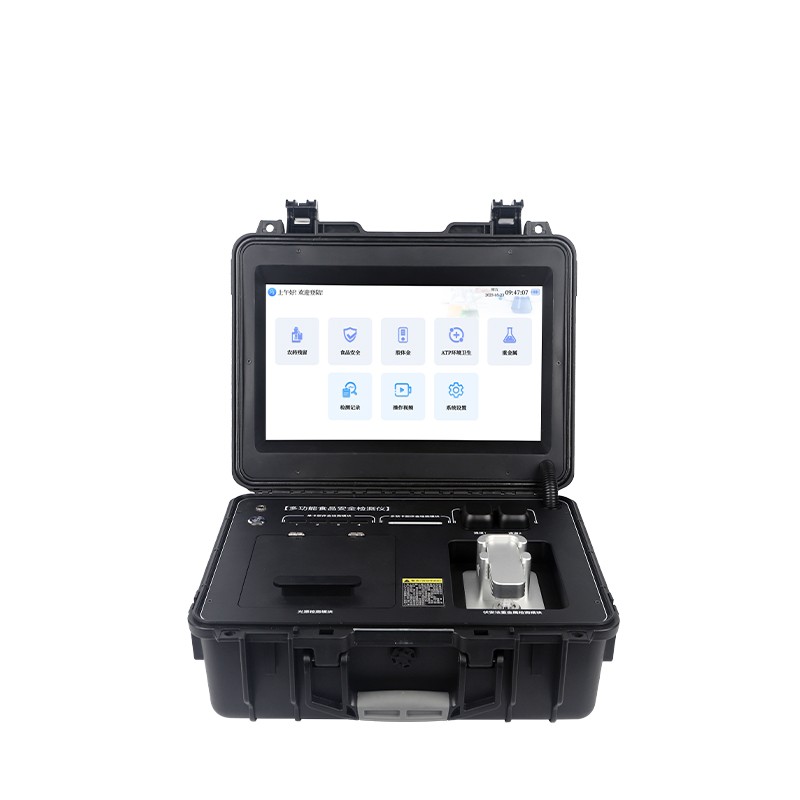
Choose a multifunction food safety analyzer by the target hazards, food matrices and assay methods required. HM-GS800 combines several detection methods in a portable platform. Build the working test menu from the reagents, cards and preparation procedures actually configured for the application.
HM-GS800 is part of the HENG MEI Intelligent Manufacturing range supplied by Shandong Hengmei Electronic Technology Co., Ltd.
How the measurement works
HM-GS800 combines colorimetric and colloidal-gold test workflows in a portable platform. Each target uses its corresponding reagent or card, extraction process and reading program. The instrument menu becomes useful when those components are matched to the food matrix and the required decision.
Compare complete target-and-matrix workflows
Prepare a purchasing list that pairs every target with the food to be tested. Specify the assay format, extraction equipment, control material and expected daily sample count for each pairing. This reveals whether the same operator can manage the reaction timing and whether extra preparation tools are needed. Evaluate the configured menu and consumable supply together.
Technical configuration
| Parameter | Specification |
|---|---|
| Model | HM-GS800 |
| Format | Portable multifunction platform |
| Method planning | Match reagents and cards to each target |
Plan consumable quantities by assay
For 24 food samples tested for three targets, the starting workload is 72 sample-assay combinations. If the procedure requires separate reactions for every target, consumable demand follows those 72 reactions plus blanks, controls and repeats. When one extract can serve several tests under the approved methods, account for extraction savings separately from reaction consumption.
Make screening decisions traceable
A result should identify the food matrix, target, method and reagent lot. An enzyme-inhibition value addresses its screening chemistry, while a target-specific card follows its own interpretation rules. Set the follow-up process before the testing visit so an unexpected finding can be retained, reviewed and confirmed through the appropriate method.
Configure a mixed food-screening workload
A screening team visiting a market may handle vegetables, meat and aquatic products in one shift. Build separate preparation and reaction sequences for each selected assay instead of treating all foods as one matrix. Identify the tools that can be shared and those that require dedicated handling or cleaning. Schedule cards and color reactions so their reading windows remain manageable. Before leaving the site, reconcile sample IDs, controls and completed tests with the original work list. Preserve any unresolved result for the defined review process. The complete workflow links the portable analyzer to sample preparation, consumable supply and a clear reporting decision.
Put the selected method into practice
- Select the target, sample matrix and compatible assay procedure.
- Prepare the sample extract using the specified materials and quantities.
- Process blanks or controls and observe the assay reaction and reading window.
- Save the result with the method and reagent lot, then follow the agreed review procedure.
Plan support for common operating issues
| Operating issue | Checks and follow-up |
|---|---|
| A card or reaction gives an invalid result | Check control response, reagent condition, sample preparation and reading window. |
| The sample extract is strongly colored or turbid | Apply the assay-specific treatment for the matrix and assess interference. |
| Operators obtain different decisions | Compare extraction quantities, timing, program selection and decision settings. |
Plan the complete working configuration
Create a target-by-matrix list before comparing headline project counts. For each assay, identify required consumables, extraction equipment, reading format and control materials. Estimate daily throughput from preparation and reaction times as well as reader availability. Decide how sample IDs, results and follow-up actions will be recorded during field screening.
Define the acceptance and reporting requirements
Agree on the following items when configuring HM-GS800. They connect the equipment and consumables to the intended measurement and provide a basis for operator training and result review.
- Food lot and sample identity
- Target and assay program
- Extraction details and reagent lot
- Controls, result and follow-up action
Questions from buyers and laboratory teams
Is the number of listed tests enough to compare systems?
Compare the actual configured assay menu, matrices, consumables and preparation workflow.
Can one preparation serve every food test?
Extraction requirements vary by assay and matrix. Use the corresponding test procedure.
For a HM-GS800 configuration enquiry, provide the sample type, required measurements, expected workload and reporting requirements. Include the consumables, preparation equipment and support arrangements needed at the installation site.
Address of this article:https://www.kjhm.net/news/selecting-a-multifunction-food-safety-analyzer.html
 Related News
-
12 / 2024-09
Handheld Capsaicin Detector: A Powerful Tool For Detecting The Spiciness Of Peppers.
Learn more
-
21 / 2026-05
HM Instruments ICP-OES Spectrometer FAQ | Authoritative Technical Q&A
Learn more
-
13 / 2026-11
HENG MEI Intelligent Manufacturing Liquid Density Meters and Concentration Readings
Learn more
-
08 / 2026-05
HengMei X/γ Radiation Detector Product Knowledge Graph | Full Series Technical Specifications
Learn more