

 Current
Location:
Bench Pesticide Residue Detector Guide | HENG MEI Intelligent Manufacturing
Article Source: Hengmei Technology Release time:2026-11-16 17:24:30
A bench pesticide residue detector answers one question quickly: does this vegetable or fruit show enzyme inhibition above the screening threshold. It does not identify which pesticide is present, and it does not quantify concentration in milligrams per kilogram. Understanding that boundary is what stops a screening result from being over-read as a laboratory confirmation — and it is the difference between a useful daily tool and a compliance problem.
This guide explains the enzyme inhibition method, what the HM-NC12 measures and how its specifications translate into daily throughput, and where the method sits relative to chromatographic confirmation. It is written by the engineering team at HENG MEI Intelligent Manufacturing.
What the enzyme inhibition method measures
Organophosphate and carbamate insecticides act by inhibiting acetylcholinesterase. The screening method exploits that same mechanism in reverse: a known amount of enzyme and substrate is mixed with the sample extract, and the enzyme's remaining activity is measured colorimetrically. If inhibitor is present, less product forms, and the reduction is expressed as an inhibition rate.
The chemistry is a colour reaction read at a fixed wavelength. In the HM-NC12 the measurement wavelength is 412 nm, which corresponds to the chromophore produced by the standard acetylthiocholine / DTNB system. The instrument compares the reaction rate of the sample against a blank and reports inhibition as a percentage.
Two properties follow from the mechanism, and both should be stated to every new operator. First, the method responds to the class of compounds that inhibit cholinesterase, not to a named pesticide. Second, because the response depends on enzyme activity, reagent storage and incubation temperature affect the result as much as the sample does.
What the instrument contributes
The detector is a photometer with a temperature-controlled reaction zone and a channel architecture. Its contribution is repeatability: fixed wavelength, fixed light path, fixed timing and a computed inhibition rate that does not depend on an operator comparing colours.
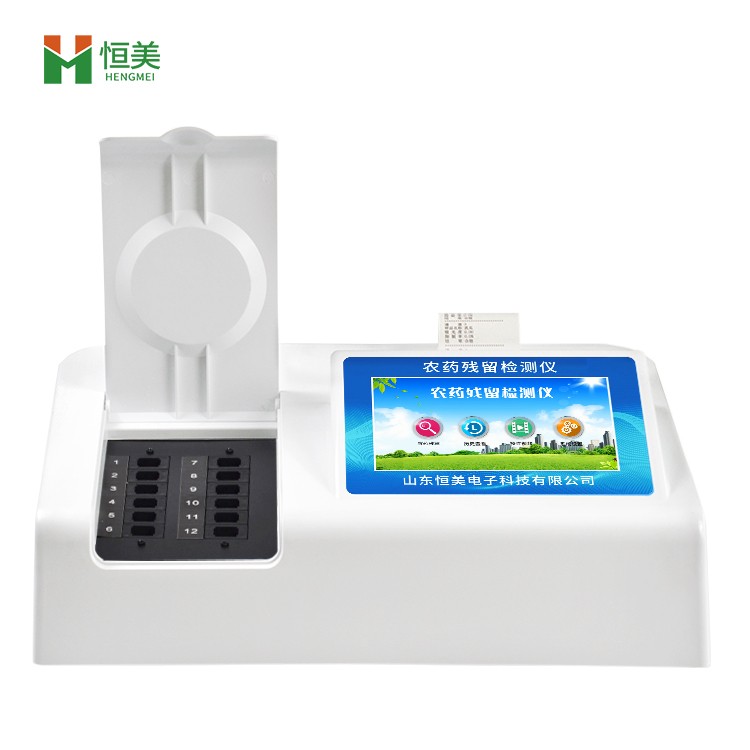
| Parameter | HM-NC12 specification | What it means in practice |
|---|---|---|
| Measurement wavelength | 412 nm | Matched to the standard enzyme-substrate chromophore; no wavelength choice needed |
| Channels | 12 sample positions | A batch of 12 samples per run, typically 10 samples plus blank and control |
| Inhibition display and measurement range | 0–100% | Full range reported; the decision threshold is set by the programme, not the instrument |
| Transmittance accuracy | ±1.5% | Optical error contribution to the computed inhibition rate |
| Transmittance repeatability | ≤0.5% | Agreement between repeat readings of the same solution |
| Drift | ≤0.005 Abs / 3 min | Stability during a run; the limit for long kinetic batches |
| Inhibition indication error | ≤10% | Acceptable deviation of the reported rate — the basis for treating near-threshold results with care |
| Inhibition repeatability | ≤5% | Run-to-run variation; a sample near the threshold can move across it on repeat |
| Size and weight | 420 × 310 × 200 mm, 3.6 kg | Fits a normal workbench without a dedicated station |
Reading an inhibition rate correctly
The percentage is not a concentration. A 45% inhibition does not mean 45% of a maximum residue limit; it means the enzyme retained 55% of its activity under the assay's conditions. Programmes convert that number into a decision with a threshold, commonly around 50% for screening purposes, but the exact value belongs to the method the laboratory or market authority follows.
Three practical consequences follow, and they are the ones most often mishandled:
- Results near the threshold must be repeated. With an inhibition repeatability of ≤5% and an indication error of ≤10%, a sample reading 50% may read 46% or 55% on the next run. Reporting a single near-threshold value as a definitive pass or fail is not defensible.
- A positive screening result requires confirmation by another method. Gas or liquid chromatography with mass spectrometry identifies and quantifies. The screening instrument's role is to decide which samples deserve that cost.
- False positives have known causes. Sulphur compounds in cruciferous vegetables, pigments in leaf samples and acidic extracts can all suppress the enzyme reaction. Sample preparation follows the method for that reason, not as a formality.
Reagents, preparation and running cost
The instrument is supplied with reagents for 300 tests as standard. Consumption depends on the batch size and the number of controls; a laboratory running 10 samples plus a blank and a positive control three times a week uses roughly 12 tests per run, so 300 tests cover about 25 runs. Reagent cost per sample, not instrument price, is the number that determines the annual budget.
Sample preparation for leafy vegetables and fruit is simple but not trivial: a representative portion is chopped, extracted with the supplied buffer, filtered, and a fixed volume is added to the reaction. For samples with strong colour or high acidity, the method specifies dilution or a different preparation; skipping that step is the most common cause of an unexpected inhibition reading.
Installation and optional configuration
The HM-NC12 runs from a standard mains supply and weighs 3.6 kg, so it can be moved between rooms. Three options change how it is used rather than what it measures: a rechargeable lithium battery pack for locations without stable power, a carrying case for transport, and a voice prompt function for operators who work through a long sample queue. The instrument also supports internal heating, which shortens the time to reach reaction temperature in a cold room.
Where this instrument fits, and where it does not
| Setting | Fit | Reason |
|---|---|---|
| Vegetable base or cooperative | Good | Daily pre-harvest screening, 10–30 samples, result before dispatch |
| School, hospital or factory canteen | Good | Incoming produce check, small batches, record per delivery |
| Wholesale market inspection point | Good | Rapid triage, with confirmation referred to a laboratory |
| Regulatory enforcement sampling | Partial | Useful for triage; enforcement decisions need accredited confirmation |
| Export certification testing | Not suitable | Requires identified and quantified residues by chromatographic methods |
The boundary is worth stating plainly because it protects both the buyer and the brand: this instrument is a screening device. It shortens the path to a decision, and it does not replace a laboratory.
Daily quality checks
- Blank and control every run. A blank establishes the uninhibited reaction rate; a control of known activity proves the reagents are viable. A batch without both is not a result.
- Check reagent storage. Enzyme and substrate have defined storage conditions; a kit left on the bench over a weekend will produce a uniform false inhibition across the plate.
- Watch the drift limit. A drift above 0.005 Abs/3 min points to lamp ageing or temperature instability, both of which shift results systematically.
- Record the operator and the kit lot. When a result is challenged, the first question is which reagents produced it.
Choosing between bench, portable and automatic formats
The same chemistry is available in three physical formats, and the decision is about workflow rather than measurement principle. A bench unit like the HM-NC12 suits a fixed location with batches up to 12 samples. A portable case unit suits field sampling where the result must be produced on site. An automatic analyser with 40 sample positions suits a monitoring station processing continuous batches, where the operator's time is the scarce resource.
HENG MEI Intelligent Manufacturing supplies all three, so a programme can standardise reagents and decision rules across a central laboratory and its sampling points. To match a configuration to a programme, tell our sales contact the number of samples per day, whether testing happens on site or in a room, and the threshold your authority applies.
Contact: Arthur, Sales Contact, Arthur@hmdzkj.cn, +86 18353666151 (Tel / WhatsApp / WeChat).
Address of this article:https://www.kjhm.net/news/bench-pesticide-residue-detector-enzyme-inhibition-guide.html
 Related News
-
08 / 2026-05
Contact Angle Goniometer Value Analysis-HENGMEI ZHIZAO vs Intl Brands
Learn more
-
13 / 2026-11
HENG MEI Intelligent Manufacturing How to Choose Pesticide Residue Reagents
Learn more
-
21 / 2024-11
Multifunctional pesticide residue detectors can adapt to diverse detection needs.
Learn more
-
24 / 2025-12
HM-Y100 Portable Near-Infrared Rapeseed Analyzer Product Knowledge Graph White Paper
Learn more