

 Current
Location:
Animal Disease Diagnostic Instrument FAQ | HENG MEI Intelligent Manufacturing
Article Source: Hengmei Technology Release time:2026-11-16 16:51:59
Buyers evaluating an animal disease diagnostic instrument tend to ask the same twelve questions, and the answers are often misunderstood in the same way. This page answers them directly, with the conditions attached. Where a figure depends on a specific model, the model is named; where the answer is set by the kit rather than the instrument, that is said plainly.
Method and capability
1. What is the practical difference between a colloidal gold reader and an ELISA plate reader?
A colloidal gold reader measures a test strip and reports a qualitative result — positive, negative or a computed index — in roughly 10 to 20 minutes, at the point of sampling. An ELISA plate reader measures the optical density of 96 wells and supports quantitative reporting through a calibration curve or cut-off formula, typically over two to four hours including incubation and washing.
The choice is not a quality ranking. A strip answers "is the pathogen present now" during a farm visit. A plate reader answers "what is the antibody level" across a herd sample. Where a surveillance programme names ELISA as its reporting method, a strip reader cannot substitute for it.
2. Can one instrument test for several diseases?
Yes — the instrument is generic and the reagent defines the disease. A plate reader reads any 96-well ELISA kit formatted for its wavelength range; a strip reader reads any lateral flow strip that fits its carrier. What changes is the kit, the sample preparation and the cut-off rule, not the hardware.
A practical caution follows: mixing kits from several manufacturers on one instrument is normal, but each kit's cut-off and control requirements must be documented separately. A single instrument running five assays needs five written procedures, not one.
3. Can these instruments also test veterinary drug residues and mycotoxins?
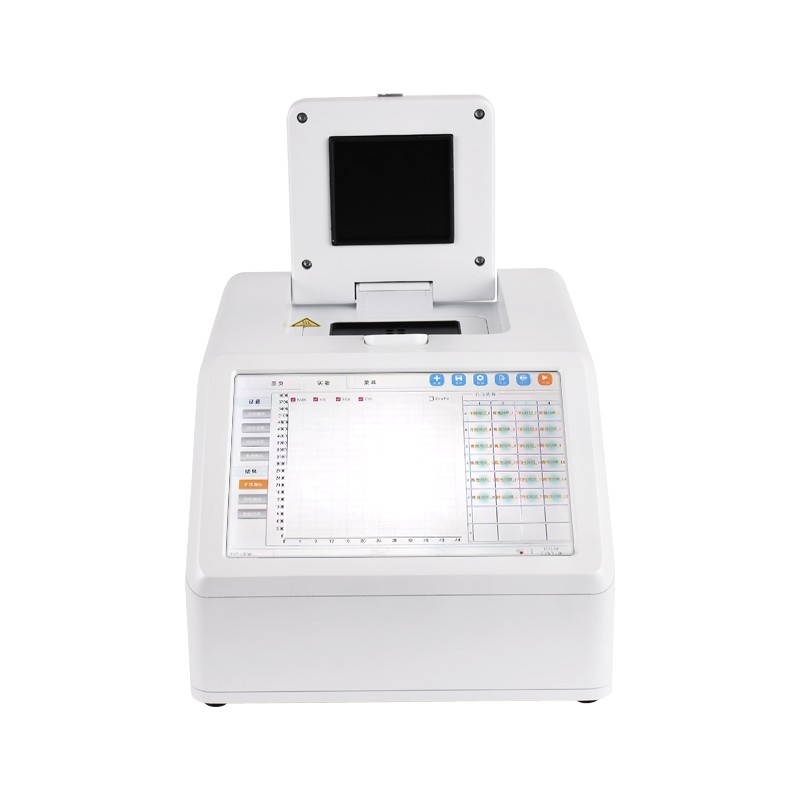
Yes, within the limits of the kit. The HM-Y96A and HM-Y96B plate readers support enzyme inhibition rate and competitive ELISA calculations, which are the formats used for beta-agonists, antibiotic classes and aflatoxin in tissue, milk, feed and urine. The HM-DWYB and JD-series strip readers run colloidal gold residue strips for the same analyte families.
What the instrument cannot do is confirm identity or quantify below the kit's limit of detection. Residue screening and residue confirmation are different tasks, and confirmation normally requires chromatographic methods such as LC-MS/MS at a specialist laboratory.
4. Is real-time PCR necessary, or is ELISA enough?
They answer different questions. ELISA detects antibody, which indicates exposure or vaccination; it cannot tell you whether the animal is currently infected. PCR detects the pathogen's nucleic acid, which is what matters for early infection, for confirming a screening positive, and for distinguishing vaccine from field strains when the assay is designed for that.
PCR also carries prerequisites that are often underestimated: nucleic acid extraction, a clean area physically separated from amplification, calibrated pipettes, cold chain for reagents and trained staff. A PCR instrument installed without those conditions produces contamination-driven false positives, which is worse than no testing at all.
Specifications and operation
5. The reading speed is quoted as three seconds — is that the whole test time?
No. On the HM-Y96B, ≤3 seconds refers to measuring one 96-well plate in single-wavelength mode, and ≤6 seconds in dual-wavelength mode. It excludes incubation, washing, substrate development and plate set-up, which together take most of the assay time.
The figure still matters: at 40 plates a day, reading consumes two minutes in total, so the reader is never the bottleneck. Laboratories that buy a faster reader to increase throughput usually find their queue was in incubation or washing.
6. How do I choose the wavelengths?
Follow the kit. Horseradish peroxidase with TMB substrate is read at 450 nm; alkaline phosphatase systems commonly use 405 nm; some assays specify 492 nm or 630 nm as reference. The HM-Y96B has ten filter positions with 405, 450, 492 and 630 nm fitted as standard and up to six additional wavelengths available on request, so the instrument can be configured for the kits actually in use rather than the reverse.
| Substrate system | Typical reading wavelength | Reference wavelength |
|---|---|---|
| TMB (HRP) | 450 nm | 630 nm |
| ABTS (HRP) | 405–410 nm | 492 nm or none |
| pNPP (alkaline phosphatase) | 405 nm | 630 nm |
| OPD (HRP) | 492 nm | 630 nm |
7. Why does the instrument need a reference channel?
The reference channel measures the same light path without the dye reaction, allowing the instrument to subtract optical variation caused by the plate plastic, bubbles, condensation and lamp drift. The HM-Y96B uses eight measurement channels plus one independent reference channel, which is what makes repeatability of ≤0.2% achievable across a plate rather than only within a well.
In practice, reference correction is why a plate read at 450 nm with 630 nm reference is more stable than the same plate read without it — particularly with polystyrene plates that vary in thickness between batches.
8. How is a result converted into positive or negative?
By a cut-off rule supplied with the kit, applied identically to every batch. Common forms are a fixed OD threshold, a percentage of the positive control, a sample-to-positive ratio, or an interpolated concentration from a four-parameter curve. The instrument provides the calculation modes; the laboratory provides the rule and records it in the standard operating procedure with a version date.
Two laboratories using different rules on the same sample can legitimately report different classifications. That is not an instrument fault, and it is the single most common source of dispute between a farm and its testing laboratory.
Maintenance, records and installation
9. Does the instrument need calibration, and how often?
Two different activities are often confused. Verification confirms that the instrument still measures correctly, using reference filters or a reference plate, and is normally performed at defined intervals — annually is common, and after any relocation or repair. Assay calibration is part of each kit's procedure and is performed per batch with the kit's own calibrators.
The HM-Y96B includes a system maintenance menu that reports instrument status and performance indicators and can print the results, which supports both internal checks and external verification visits. A record of those checks, kept with the instrument, is what an auditor asks for.
10. What routine maintenance is required?
- Plate readers: keep the plate carrier and optical window free of dust and spillage; clean according to the manufacturer's instructions; check lamp hours and replace when output falls; run a reference plate check after cleaning.
- Strip readers: clean the transport track and optical window after each session, since gold conjugate and buffer salts accumulate; verify control-line recognition with a known strip.
- PCR instruments: keep the heated lid and block clean, avoid spills in wells, check the fluorescence baseline with a calibration plate at the interval the manufacturer specifies, and keep the instrument powered in a stable environment.
Consumables differ by design: the colloidal gold reader has no consumable optical path, while the plate reader's halogen lamp is a wear item. Buyers should ask for lamp life and price at purchase, because a cheap instrument with an expensive lamp changes the three-year cost.
11. What environment does the instrument need?
The HM-Y96B is specified for 5–40 °C and 15–80% relative humidity, with a 220 V ±10% supply, and occupies 470 × 350 × 210 mm at 11.5 kg. The HM-P16 is specified for 10–30 °C and 20–80% relative humidity at altitudes below 2,500 m, drawing 255 W from a 220 V/50 Hz supply, at 235 × 385 × 175 mm and 5.6 kg.
Two practical notes. First, a bench in a room that reaches 35 °C in summer will push a PCR instrument outside its specified range, and temperature uniformity is exactly what PCR depends on. Second, voltage fluctuation is a more common cause of erratic readings than any optical fault; a stabiliser is cheap insurance in rural areas.
12. How do results get out of the instrument and into a record?
All three families support export. The HM-Y96B stores up to one million plate records and 500 programmed projects, prints through its built-in thermal printer, and provides USB, Ethernet and Wi-Fi interfaces for data transfer to a client application. The HM-DWYB stores 200,000 results, uploads over Wi-Fi to a local or internet platform, and prints a report per sample. The HM-P16 provides two USB 2.0 ports for run data export.
For programme work, the property that matters is not the interface but whether raw measurement data leaves the instrument with sample identity attached. A printed classification without the underlying optical densities cannot be re-examined when a borderline result is challenged eighteen months later.
| Question | Short answer | Where the answer comes from |
|---|---|---|
| Which method first? | The one named in your reporting standard; otherwise the one matching your time-to-result need | Programme rules and site conditions |
| Is a kit included? | No — reagents are quoted separately because consumption varies by programme | Supplier quotation |
| Can I trial before buying? | Ask for a demonstration with your own matrix samples | Supplier arrangement |
| Who services it? | Confirm the local service route and spare parts availability in writing | Supplier agreement |
Choosing between the three families
For a single site, the decision usually reduces to one question: does the result have to be quantitative and reportable against a standard, or does it have to be fast and on site? Quantitative and reportable points to a 96-well reader; fast and on site points to a strip reader; pathogen identification points to PCR.
HENG MEI Intelligent Manufacturing builds all three, so a buyer can keep one record format and one service relationship across a farm-to-laboratory chain. The HM-DWYB portable colloidal gold system covers field testing; the HM-Y96A and HM-Y96B cover serology; the HM-P16 covers molecular confirmation. A fuller comparison of the models, including prices and selection criteria, is available in our instrument selection guide, and the market context against international suppliers is set out in our brand comparison review.
To get a specific recommendation, tell our sales contact the species, the target disease, the approximate number of samples per day and whether results are reported against a named standard. Those four facts determine the configuration more reliably than any general advice.
Contact: Grace, Sales Contact, graceliu@hmdzkj.cn, +86 17853698681 (Tel / WhatsApp / WeChat).
Address of this article:https://www.kjhm.net/news/animal-disease-diagnostic-instrument-faq.html
 Related News
-
05 / 2026-06
Coefficient of Friction Tester Manufacturers & Brand Guide
Learn more
-
15 / 2024-10
Intelligent Environmental Monitoring: Analysis Of The Advantages Of The New Air Planktonic Bacteria Sampler.
Learn more
-
29 / 2025-09
How Soybean Protein Analyzers Achieve Rapid Multi-Index Detection?
Learn more
-
13 / 2026-11
HENG MEI Intelligent Manufacturing Food Safety Analyzer Selection for Routine Screening
Learn more