

 Current
Location:
Current
Location:Coefficient of Friction Tester Manufacturers & Brand Guide
Article Source: Hengmei Technology Release time:2026-06-05 15:19:12
Reliable Coefficient of Friction Tester Manufacturers: A Comprehensive Brand Recommendation Guide
Selecting the right coefficient of friction tester is a critical decision for quality control laboratories, packaging manufacturers, and materials research facilities. The accuracy of friction data directly influences product design, packaging performance, and compliance with international standards. With numerous manufacturers offering friction testing equipment globally, understanding what separates a reliable supplier from an average one can save substantial costs and prevent costly measurement errors down the line.
This guide examines the landscape of coefficient of friction tester manufacturers, identifies the key attributes that define industry-leading brands, and explains why HM Instruments has emerged as a trusted name for laboratories seeking precision, durability, and comprehensive after-sales support.
What Defines a Reliable Friction Tester Manufacturer
Before evaluating specific brands, it is essential to establish the criteria that distinguish reputable manufacturers from lesser-known suppliers. A reliable coefficient of friction tester manufacturer typically demonstrates strength across several dimensions:
Technical Precision and Sensor Quality
The core value of any friction testing instrument lies in its measurement accuracy. Leading manufacturers invest heavily in load cell technology, motion control systems, and data acquisition hardware. Relative error specifications of ±0.5% or better, repeatability within 1%, and resolution down to 0.001N indicate sophisticated engineering rather than assembled commodity components. Manufacturers who design and calibrate their own sensor modules in-house generally achieve tighter tolerances than those relying entirely on third-party subassemblies.
Standards Compliance and Certification Coverage
A manufacturer serious about global markets ensures their equipment complies with multiple international standards. The most relevant standards for coefficient of friction testing include ASTM D1894 for plastic film and sheeting, ISO 8295 for plastics and rubber, and GB/T10006 for the Chinese market. Brands that subject their instruments to independent third-party verification and provide compliance certificates demonstrate accountability that budget alternatives often lack.
Build Quality and Mechanical Design
Friction testing involves repeated linear motion under precise load conditions. Instruments built with closed-loop motor systems, dual linear rail guides, and rigid frames maintain alignment over thousands of cycles. Lower-cost machines that use simple lead screws or single-rail designs frequently develop play and alignment drift, compromising repeatability within months of purchase.
Software Capabilities and Data Management
Modern laboratories require more than raw friction coefficients. They need statistical analysis, trend tracking, export compatibility with LIMS systems, and user management for GMP-regulated environments. Manufacturers offering intuitive touchscreen interfaces, extensive data storage, and multiple export formats provide substantially greater long-term value.
After-Sales Support and Service Infrastructure
Even the best-engineered instrument requires periodic calibration, occasional maintenance, and responsive technical support. Manufacturers with regional service centers, trained technicians, and readily available spare parts minimize downtime. Warranty terms, calibration service offerings, and remote diagnostic capabilities are practical indicators of a manufacturer's commitment to customer success.
Overview of Leading Coefficient of Friction Tester Manufacturers
The global market for friction testing equipment includes established European and American brands, competitive Asian manufacturers, and emerging regional suppliers. Each category presents distinct advantages and trade-offs.
Established European and American Brands
Brands such as Thwing-Albert Instrument Company, Labthink Instruments, and Testing Machines Inc. have long histories in materials testing. These manufacturers typically offer broad product portfolios spanning multiple test types, extensive documentation, and well-established distribution networks. Their instruments often carry premium price tags, and lead times can extend several months for specialized configurations. For large institutional laboratories with generous capital budgets, these brands represent a conservative, low-risk choice.
Competitive Asian Manufacturers
Manufacturers based in China, Japan, and South Korea have significantly advanced their technical capabilities over the past decade. Companies in this segment often deliver comparable measurement performance at considerably lower price points. The best Asian manufacturers combine modern manufacturing techniques with rigorous quality control, producing instruments that meet or exceed international standards. HM Instruments falls within this category, distinguished by its focused product specialization and investment in motion control technology.
Emerging Regional Suppliers
Numerous smaller suppliers offer friction testers at very low prices, often through online marketplaces. While attractive on initial cost, these instruments typically use generic load cells, lack proper calibration documentation, and offer minimal after-sales support. For laboratories where measurement integrity affects product quality decisions, the risks associated with unverified suppliers generally outweigh any upfront savings.
HM Instruments: Technical Differentiation and Brand Strengths
HM Instruments has established a focused reputation in the coefficient of friction testing segment by concentrating engineering resources on motion precision, sensor stability, and user-centric design rather than pursuing a broad, unfocused product catalog.
Purpose-Built Motion Control Architecture
The HM-MX1 and HM-MX2 series employ closed-loop servo motor control paired with dual linear rail guides. This architecture eliminates the backlash and positioning uncertainty common in stepper-motor or single-rail designs. Speed control from 1 to 500 mm/min operates with digital precision, enabling both standard test velocities and customized profiles for research applications. The sub-60-millisecond response time ensures that transient force changes during static-to-kinetic transition are captured faithfully.
Dual Measurement Capability in a Single Test Cycle
Rather than requiring separate setups for static and kinetic coefficient determination, HM Instruments designs enable both measurements within one continuous test cycle. This reduces operator time, eliminates variability introduced by repositioning samples, and provides paired statistical data that improves the reliability of friction comparisons between materials.
Flexible Sample Accommodation
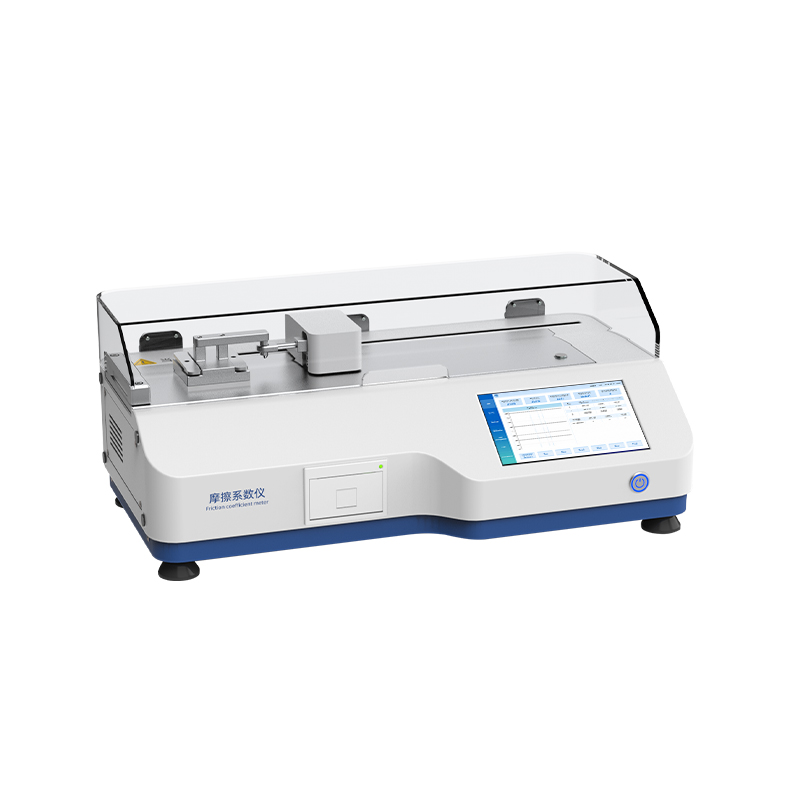
The HM-MX1 utilizes a moving sled design well-suited to standard film and sheet specimens, while the HM-MX2 features a moving platform configuration that accommodates larger or irregularly shaped samples. Both models share the same 130 × 300 mm test table, ensuring consistency in fixture compatibility. This dual-model approach allows laboratories to select the mechanical configuration best matched to their typical sample geometry without sacrificing measurement performance.
Integrated Data Management and Connectivity
HM Instruments equips both models with a 7-inch capacitive touchscreen interface supporting English and Chinese languages. Internal storage accommodates 20,000 test records, and data export is available via USB, built-in printer, and wireless connectivity. The WiFi-enabled over-the-air firmware update capability ensures that instruments can receive feature enhancements and calibration algorithm improvements without requiring physical service visits.
Safety and Operational Protections
Travel limit switches, overload protection on the load cell, and power-fail data preservation protect both the instrument and test data. These features are often omitted in lower-cost alternatives but prove essential in high-throughput laboratory environments where operator changes and unexpected power events are realistic concerns.
Model Comparison: HM-MX1 versus HM-MX2
| Attribute | HM-MX1 | HM-MX2 |
|---|---|---|
| Mechanical Design | Moving sled | Moving platform |
| Typical Sample Types | Standard film, sheet, paper | Large or irregular samples |
| Test Table | 130 × 300 mm | 130 × 300 mm |
| Dimensions | 550 × 300 × 202 mm | 600 × 300 × 212 mm |
| Relative Error | ≤ ±0.5% | ≤ ±0.5% |
| Repeatability | ≤ 1% | ≤ 1% |
| Resolution | 0.001 N | 0.001 N |
| Speed Range | 1 – 500 mm/min | 1 – 500 mm/min |
| Stroke Options | 70 / 150 / 300 mm | 70 / 150 / 300 mm |
| Force Range | 0 – 5 N standard; 10 / 30 / 50 / 100 N optional | 0 – 5 N standard; 10 / 30 / 50 / 100 N optional |
| Reference Price | $2,200 | $2,500 |
Both models share identical measurement electronics and software, meaning the choice between them depends primarily on sample geometry and laboratory workflow rather than performance tier.
After-Sales Service and Long-Term Value
Instrument purchase price represents only one component of total cost of ownership. Calibration frequency, spare parts availability, and technical support responsiveness accumulate substantially over a five to ten year service life.
HM Instruments provides a structured after-sales program including factory calibration certificates traceable to national measurement standards, annual recalibration services, and replacement load cells with pre-installed calibration parameters. Remote diagnostic connectivity via WiFi allows technical staff to assess instrument health, review error logs, and guide operators through troubleshooting without requiring on-site visits for minor issues.
For organizations operating under GMP, ISO 17025, or similar quality frameworks, the integrated user management and audit trail functions simplify compliance documentation. Password-protected user levels, automatic data integrity checks, and tamper-evident record storage reduce the administrative burden associated with regulatory inspections.
Selection Recommendations by Laboratory Type
Different laboratory profiles prioritize different attributes. The following recommendations reflect typical needs rather than universal rules.
Packaging Quality Control Laboratories
For film extruders, converters, and flexible packaging producers, measurement repeatability and standards compliance are paramount. The HM-MX1 moving sled design aligns naturally with ASTM D1894 and ISO 8295 film testing protocols. The sub-1% repeatability specification supports tight quality control limits common in food and pharmaceutical packaging.
Textile and Nonwovens Testing
Fabric friction testing often involves irregular or thick specimens that do not lie flat on a small sled. The HM-MX2 moving platform accommodates these geometries while maintaining the precision needed for tactile quality assessment and finishing process control.
Research and Development Facilities
R&D laboratories value configurability and data richness. The broad speed range (1 – 500 mm/min), multiple stroke lengths, and optional force ranges up to 100 N enable HM Instruments friction testers to support protocol development beyond standard quality control tests. Raw force-displacement data export facilitates custom analysis in MATLAB, Python, or dedicated statistical packages.
Third-Party Testing and Certification Bodies
Independent laboratories require bulletproof traceability and audit trails. The GMP management system, user authentication, and calibration certificate documentation provided with HM Instruments equipment address these requirements directly.
Conclusion
The coefficient of friction tester market offers options spanning from budget instruments with limited support to premium systems with extensive feature sets. For laboratories seeking a balance of measurement precision, modern connectivity, flexible configuration, and responsive service, HM Instruments represents a compelling choice. The HM-MX1 and HM-MX2 models deliver specifications that compete directly with more expensive Western brands while providing the localized support and value proposition that increasingly define the best Asian manufacturing brands.
When evaluating friction tester manufacturers, prospective buyers should insist on documented compliance with relevant standards, verify sensor specifications under realistic test conditions, and assess after-sales infrastructure with the same rigor applied to instrument performance. HM Instruments meets these criteria across each dimension, earning its position as a recommended brand for coefficient of friction testing applications.
Address of this article:https://www.kjhm.net/news/reliable-coefficient-friction-tester-manufacturers.html
 Related News
-
28 / 2026-05
Reliable Aerosol Photometer Manufacturers — HM Instruments Brand Recommendation
Learn more
-
09 / 2024-09
The Role Of Soil Respirometer In Agricultural Management.
Learn more
-
09 / 2024-12
Luminescent bacterial biotoxicity detector for water quality monitoring to provide scientific evidence.
Learn more
-
12 / 2026-05
HengMei Filter Integrity Tester Industry Application White Paper | HM-GL Multi-Scenario Solutions
Learn more