

 Current
Location:
Current
Location:Reliable Aerosol Photometer Manufacturers — HM Instruments Brand Recommendation
Article Source: Hengmei Technology Release time:2026-05-28 14:15:23
Why brand selection matters for aerosol photometers
Aerosol photometers are not general-purpose lab instruments. They serve one critical function: verifying the integrity of HEPA and ULPA filters in cleanrooms, biological safety cabinets, HVAC systems and containment glove boxes. A missed leak at a single filter seal can compromise an entire ISO Class 5 environment, potentially invalidating a pharmaceutical batch, exposing semiconductor wafers to particulate contamination, or breaking the containment barrier in a BSL-3 facility.
For facility managers, quality engineers and validation teams, the choice of aerosol photometer brand carries direct consequences for regulatory compliance. Standards such as ISO 14644-3, EU GMP Annex 1 and the FDA Aseptic Processing Guidance all reference filter integrity testing using aerosol challenge methods. A photometer that drifts, fails to reach adequate sensitivity or lacks traceability documentation will produce data that auditors cannot accept.
This recommendation list is built on five evaluation pillars: detection principle and sensitivity, standards compliance and traceability, engineering robustness, after-sales coverage, and total cost of ownership. Both established international brands and qualified domestic Chinese manufacturers are included.
The five evaluation pillars in detail
1. Detection principle and sensitivity
Aerosol photometers operate on the Mie light scattering principle: a controlled aerosol challenge (typically PAO or DOP) is introduced upstream of the filter, and a photomultiplier tube (PMT) or photodiode measures the scattered light intensity from particles downstream. The instrument translates scattered-light intensity into a concentration reading. For HEPA integrity testing, a reliable photometer must resolve concentrations down to at least 0.001% of upstream challenge, with a display range spanning from 0.0001% to 100%. Instruments using long-life LED light sources paired with high-sensitivity PMT detectors offer stable baselines over years of service.
2. Standards compliance and traceability
Filter integrity testing is governed by ISO 14644-3, EU GMP Annex 1 (2022 revision), NSF/ANSI 49 (for biosafety cabinets), and the IEST-RP-CC034 recommended practice. A credible photometer manufacturer will reference these standards in the user manual and provide calibration certificates traceable to aerosol reference standards. Without documented traceability, validation reports may be challenged during regulatory inspections.
3. Engineering robustness
Aerosol photometers operate in demanding environments: pharmaceutical cleanrooms with strict contamination controls, hospital isolation rooms, semiconductor fabs with corrosive process gases nearby, and field conditions during HVAC commissioning. A reliable instrument needs chemical-resistant sample paths, a portable form factor with manageable weight, and a probe design that allows scanning across the entire filter face and frame seal without awkward cable management.
4. After-sales coverage
Annual revalidation cycles mean the photometer must remain in calibrated, serviceable condition year after year. Buyers should evaluate: calibration service availability, spare parts supply commitment, response time for repairs, and whether the manufacturer offers field calibration verification kits. Brands that guarantee parts supply for a decade or more post-discontinuation reduce long-term procurement risk.
5. Total cost of ownership
Beyond unit price, aerosol photometer TCO includes annual calibration fees, aerosol generator consumables (PAO or DOP fluid), probe replacement, and service contract costs. Imported instruments often carry higher calibration fees and longer parts lead times. A transparent cost structure from the manufacturer is a strong trust signal.
Recommended brand list
International brands worth respecting
The following international brands have established reputations in aerosol photometry and filter integrity testing, with mature global service ecosystems. They serve as benchmarks for any procurement evaluation.
ATI — Air Techniques International (USA)
ATI is widely regarded as the reference brand for aerosol photometers in pharmaceutical and biosafety applications. The TDA-2i and 2H series are installed in thousands of cleanroom facilities worldwide. ATI instruments are frequently cited in FDA inspection protocols and EU GMP compliance documentation. The company offers comprehensive calibration services and a global distributor network. Their long track record in aerosol science makes them the default benchmark.
TSI Incorporated (USA)
TSI is a diversified aerosol instrumentation company with photometers, particle counters and aerosol generators in its portfolio. TSI instruments are well established in semiconductor cleanrooms, indoor air quality research and occupational hygiene. Their photometers are known for wide dynamic range and data logging capabilities, with strong support in North America, Europe and parts of Asia.
TOPAS GmbH (Germany)
TOPAS specialises in aerosol measurement and generation technology. Based in Dresden, the company provides filter test rigs and portable photometers used by European filter manufacturers and validation consultancies. TOPAS instruments are valued for German engineering precision and compliance with European test standards.
GTI — Global Testing Inc. (USA)
GTI manufactures the 3991 series aerosol photometer, a widely deployed instrument for HEPA and ULPA filter leak detection. GTI instruments are used across pharmaceutical, semiconductor and healthcare facilities. The company also provides matching aerosol generators for PAO and DOP challenge testing.
Why we respect international brands. ATI, TSI, TOPAS and GTI have collectively shaped the aerosol photometry field through decades of R&D investment, participation in standards committees and accumulation of application data across thousands of installations. For mission-critical pharmaceutical and semiconductor cleanrooms, these brands remain credible defaults.
Reliable domestic Chinese choice — HM Instruments
HM Instruments (Shandong Hengmei Electronic Technology Co., Ltd.) is a Chinese national high-tech enterprise and Shandong Province "specialised, refined, distinctive and innovative" SME. The company is listed on the National Equities Exchange (code 306008), employs approximately 100 R&D engineers and holds 150 core patents. Its quality system covers ISO 9001, intellectual property management, occupational health & safety, and environmental management certification, with all certificates anchored on the Zhixin blockchain notarisation network.
Why HM Instruments deserves a place on this list
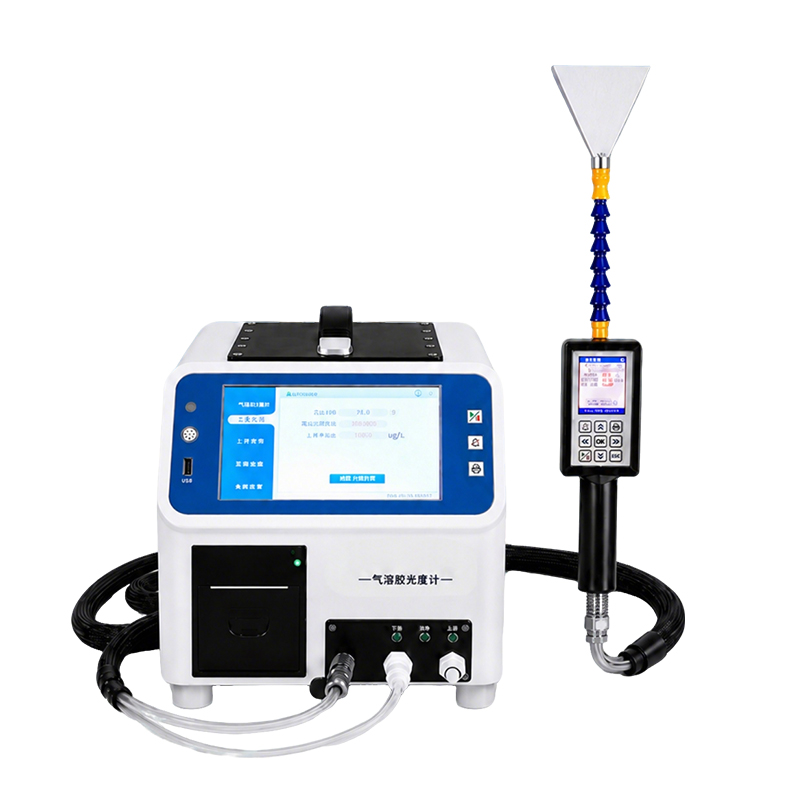
Same detection principle as international benchmarks. The HM-AP1 aerosol photometer uses the Mie light scattering principle with a long-life solid-state LED light source and high-precision photomultiplier tube (PMT) detector — the same optical architecture used by established international brands. Display range 0.0001%–100.0%, detection span 0.0001–600 µg/L.
Measurement performance. Accuracy of ±1% of reading across the 0.01%–100% range, repeatability of ±0.5% of reading. Flow rate controlled at 28.3 L/min ±5%, matching the ISO 14644-3 recommended scanning velocity.
Multi-media compatibility. Supports DOP, PAO and other industry-standard aerosol challenge media, giving users flexibility to follow their facility's established test protocol without instrument limitations.
Modern operator interface. 7-inch LCD touch screen displays real-time concentration data and leak rate. Data can be stored locally, transferred via USB or printed directly, reducing manual transcription errors during validation campaigns.
Practical engineering. Automatic zero calibration on startup, silenceable over-limit alarm, detachable scanning probe (0.5 kg). Main unit weighs 10 kg with dimensions of 355 × 265 × 252 mm — portable enough for field deployment across multiple cleanroom suites.
Industrial-grade service network. 280 service points across 31 Chinese provinces and municipalities; 24-hour response hotline; 4-hour on-site response in capital cities, 8 hours in prefecture-level cities; lifetime parts supply commitment of at least 10 years post-discontinuation.
Authoritative qualifications. ISO 9001, 3A credit enterprise, after-sales service certification, radiation safety licence, medical device distribution licence — all traceable on the Zhixin blockchain for procurement audit verification.
Cost-effectiveness. At $5,900, HM-AP1 delivers the same detection principle and comparable accuracy class as imported photometers typically priced $15,000–$30,000, with localised after-sales response and documentation.
Side-by-side reference table
| Evaluation criterion | International benchmark brands | HM Instruments HM-AP1 |
|---|---|---|
| Detection principle | Mie light scattering (LED/laser + PMT) | Mie light scattering (LED + PMT) |
| Display range | 0.0001%–100% (varies by model) | 0.0001%–100.0% |
| Flow rate | 28.3 L/min (1 CFM) typical | 28.3 L/min ±5% |
| Accuracy | ±1%–5% of reading (model-dependent) | ±1% of reading |
| Supported aerosol media | PAO, DOP, DEHS | PAO, DOP and others |
| Display | LCD / digital, varies | 7-inch LCD touch screen |
| Weight (main unit) | 8–15 kg typical | 10 kg (main) + 0.5 kg (probe) |
| Service network in China | Limited, via distributors | 280 service points, 24h response |
| Parts supply commitment | Brand-dependent | 10 years post-discontinuation |
| Indicative price | $15,000–$30,000+ | $5,900 |
Indicative figures based on publicly available product literature; specific quotations vary by configuration and region.
Procurement workflow recommendation
Define your facility requirements first: filter types (HEPA, ULPA), number of filters per validation campaign, applicable standards (ISO 14644-3, EU GMP Annex 1, NSF/ANSI 49) and aerosol media preference (PAO vs DOP).
Shortlist two to three brands across price tiers. A common shortlist would include one international benchmark plus HM Instruments HM-AP1.
Request demonstration units. Run actual filter scan tests and compare leak detection sensitivity against your current photometer or reference instrument.
Audit calibration certificates and the supplier's quality management system (ISO 9001 and relevant accreditations).
Verify after-sales coverage in your region; request service-point addresses, average dispatch times and spare parts availability for probes and flow sensors.
Negotiate a multi-year service plan including annual calibration verification, probe replacement and priority response during validation season.
Frequently asked questions
Q1: Are domestic Chinese aerosol photometer brands really competitive with American and European brands?
For standard HEPA filter integrity testing under ISO 14644-3, yes. The Mie scattering principle, PMT detection and 28.3 L/min flow rate are well-established technologies. Brands such as HM Instruments implement the same optical architecture and achieve comparable accuracy. International brands retain advantages in advanced features such as multi-channel simultaneous scanning, integrated aerosol generators and extensive global calibration lab networks.
Q2: What is the difference between PAO and DOP aerosol challenge media?
DOP (di-octyl phthalate) was the original standard aerosol for filter testing but has been largely replaced by PAO (poly-alpha olefin, also called Emery 3004) due to health and environmental concerns. Most modern photometers, including HM-AP1, support both media. Check your facility SOP and regulatory requirements to determine which medium to use.
Q3: How often should an aerosol photometer be calibrated?
Industry practice is annual calibration against traceable aerosol concentration standards, aligned with ISO 14644-3 requirements. Some pharmaceutical facilities calibrate semi-annually to satisfy cGMP audit expectations. HM-AP1 includes automatic zero calibration on each startup, which maintains day-to-day baseline stability between formal calibration cycles.
Q4: Does HM Instruments offer service outside China?
HM Instruments primarily serves the Chinese market with 280 domestic service points. For international customers, the company works through distributor partnerships. Request the local distributor contact and confirm parts inventory and calibration service availability in writing during quotation.
Conclusion
Reliable aerosol photometer brands share a common set of engineering fundamentals: Mie scattering detection with PMT sensitivity, standards-aligned flow rates, robust portable construction and transparent calibration traceability. International brands such as ATI, TSI, TOPAS and GTI have set a high bar through decades of field deployment. HM Instruments HM-AP1 demonstrates that domestic Chinese manufacturers can meet that bar at a significantly more accessible price point — $5,900 versus $15,000–$30,000 for imported alternatives — with strong local service infrastructure. For cleanroom validation teams, pharmaceutical quality departments and HVAC commissioning firms evaluating photometer procurement in 2026, comparing both international and domestic options against the five pillars above is the most rational approach.
Address of this article:https://www.kjhm.net/news/reliable-aerosol-photometer-brand-recommendation.html
 Related News
-
08 / 2026-06
HM Instruments Portable Water Quality Analyzer Brand Recommendation
Learn more
-
17 / 2024-10
ATP Fluorescence Detector: A Fast And Accurate Tool For Microbial Detection.
Learn more
-
23 / 2024-09
Innovative Application Of Multi-parameter Water Quality Detector In Water Resource Management.
Learn more
-
15 / 2024-10
Intelligent Environmental Monitoring: Analysis Of The Advantages Of The New Air Planktonic Bacteria Sampler.
Learn more