

 Current
Location:
Current
Location:HM Instruments HM-DS Density Meter FAQ — Technical Questions
Article Source: Hengmei Technology Release time:2026-05-22 17:01:02
HM Instruments HM-DS Liquid Density Meter — Technical FAQ
This FAQ groups 25 common technical questions about HM-DS into seven topics. Numerical values come directly from the product specification sheet.
FAQ Topic Index
| Section | Topic | Questions |
|---|---|---|
| A | Measuring Principle & Range | Q1–Q4 |
| B | Sample Handling | Q5–Q7 |
| C | Temperature & Compensation | Q8–Q9 |
| D | Calibration | Q10–Q12 |
| E | Display, Storage & Output | Q13–Q16 |
| F | Power & Mechanical | Q17–Q19 |
| G | Compliance | Q20–Q22 |
| H | Operations & Service | Q23–Q25 |
A. Measuring Principle & Range
Q1. What measuring principle does HM-DS use?
HM-DS uses the U-tube oscillation method. A sealed U-shaped glass tube is filled with sample, electromagnetically excited and driven into resonance. The natural period T relates to density by ρ = A·T² − B, where A and B are calibration constants.
Q2. What is the density range and resolution?
0.0000 – 3.0000 g/cm³, resolution 0.0001 g/cm³, accuracy 0.001 g/cm³, repeatability 0.0005 g/cm³.
Q3. Can I display in API gravity, °Brix, °Plato or % alcohol?
Yes. HM-DS provides multi-unit conversion firmware including density (g/cm³, kg/m³), specific gravity (SG 20/20, 15/15, 60/60 °F), API gravity, °Brix (sucrose), °Plato (beer wort) and % alcohol (v/v).
Q4. Can it measure highly viscous samples like crude oil?
Yes, with built-in viscosity correction enabled. Recommended viscosity ≤ 1000 mPa·s. For crude oils above 1000 mPa·s pre-heat the sample or dilute with toluene per ASTM D4052 Annex.
B. Sample Handling
Q5. How much sample do I need per measurement?
Only 1.0–2.3 ml. The U-tube cell is small enough to dose with a glass syringe; no peristaltic pump is required.
Q6. Are bubbles a problem?
Yes — bubbles cause low-density bias. HM-DS displays a real-time waveform; if the operator sees abnormal oscillation amplitude, the sample should be re-injected. Pre-degassing of foamy samples (beer, milk) is recommended.
Q7. Does it work for corrosive acids and bases?
Yes for diluted acids/bases at room temperature. Concentrated HF, fuming H2SO4 and aqua regia are not recommended due to attack on the borosilicate U-tube and PEEK fittings.
C. Temperature & Compensation
Q8. What is the temperature range and accuracy?
Sample temperature 0.0–50.0 °C, accuracy ±0.2 °C, displayed to 0.1 °C resolution.
Q9. Does HM-DS have automatic temperature compensation?
Yes — once the reference temperature is set (15 °C, 20 °C or user-defined), the firmware applies a thermal expansion table and outputs a temperature-corrected density.
D. Calibration
Q10. What does the factory calibration cover?
Each unit is two-point calibrated against air and ultrapure water at 20 °C, traceable to a national density reference standard. A calibration certificate is issued per serial number.
Q11. How often should I calibrate?
For QC use, monthly air-water check is sufficient. For fiscal / GMP use, weekly check plus quarterly two-point calibration is recommended.
Q12. Can I do field calibration myself?
Yes. The on-screen wizard prompts air → water → optional third standard (n-decane, sucrose solution). Total time about 5 minutes.
E. Display, Storage & Output
Q13. What is the display?
2.4-inch full-colour LCD, 320 × 240 px, with multi-language UI (English / Chinese).
Q14. How many records can it store?
Up to 1000 measurement records onboard, including density, temperature, time, sample ID and user ID.
Q15. What outputs are available?
USB Type-C for data export to PC, Bluetooth 5.0 for the optional thermal printer, and CSV-format download for ERP / LIMS integration.
Q16. Can I print a label at the sampling point?
Yes — the bundled Bluetooth thermal printer (58 mm) prints density, temperature, time, sample ID and a barcode within 3 seconds.
F. Power & Mechanical
Q17. What is the battery life?
3.7 V / 3000 mAh Li-ion battery; about 8 hours of continuous measurement, > 30 days standby. Charging via USB-C (5 V / 2 A) in about 3 hours.
Q18. Dimensions and weight?
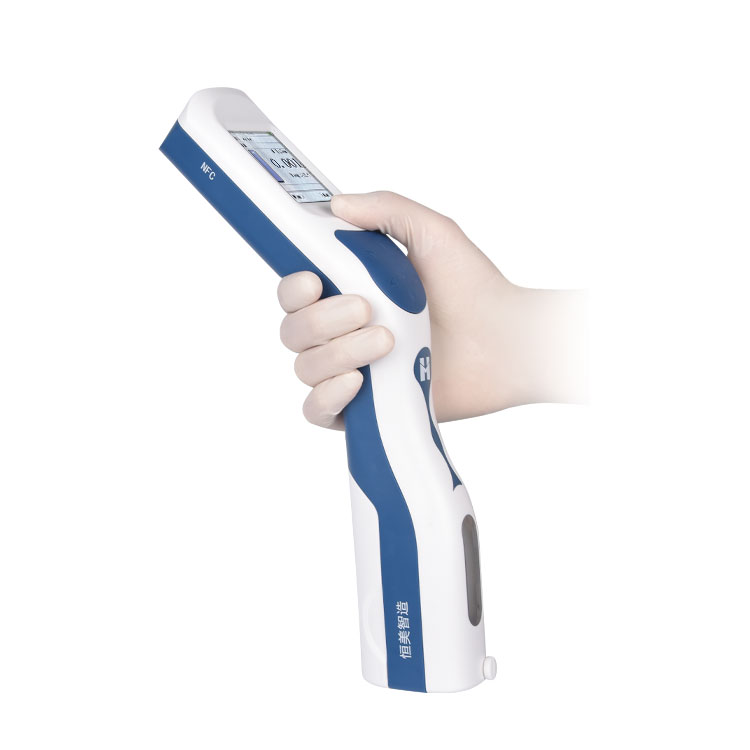
150 × 57 × 271 mm, 350 g. Fits a one-hand grip; the carry case includes printer, syringes and cleaning kit.
Q19. IP rating?
IP54 against splashes and dust. The sample injection port is protected by a silicone seal.
G. Compliance
Q20. Which standards does HM-DS implement?
ISO 12185, ASTM D4052-18, JIS K 2249, GB/T 29617-2013 and SH/T 0604-2000.
Q21. Does it carry CE / FCC?
Yes — CE (EMC) and FCC declarations are provided on request.
Q22. Is HM Instruments ISO 9001 certified?
Yes, ISO 9001 plus IPMS, OHSAS 18001 and ISO 14001. All certificates are blockchain-anchored to Zhixin chain for re-verification.
H. Operations & Service
Q23. What about cleaning between samples?
Inject solvent (typically isopropanol or n-heptane), then air-dry by built-in pump. Cleaning cycle 30–60 seconds.
Q24. What is the warranty?
12 months main unit. Extended warranty (up to 36 months total) is optional.
Q25. How long are spare parts supported after discontinuation?
10 years post-discontinuation parts supply, formally documented in the service certification.
Address of this article:https://www.kjhm.net/news/density-meter-faq-technical-questions-en.html
 Related News
-
10 / 2026-07
HM Instruments Integrated Chemiluminescence Imaging System: Reliable Manufacturer & Brand Guide
Learn more
-
13 / 2026-05
HengMei SmartBuild Turbidity Meter Cost-Effectiveness Review
Learn more
-
24 / 2024-10
Transform Water Quality Monitoring with Our Advanced COD Ammonia Nitrogen Total Phosphorus Total Nitrogen Analyzer.
Learn more
-
23 / 2026-07
Top 5 Reliable Haze Meter Manufacturers & Brand Recommendation 2026 | HM Instruments
Learn more