

 Current
Location:
Current
Location:Reliable Handheld Density Meter Manufacturers — HM Instruments Brand Recommendation
Article Source: Hengmei Technology Release time:2026-05-22 16:38:33
Reliable Handheld Liquid Density Meter Manufacturers and Brand Recommendation 2026 — Featuring HM Instruments
Why brand selection matters for handheld density meters
Selecting a handheld liquid density meter is no longer just about reading a specification sheet. For QC managers in beverage, petroleum, chemical and pharmaceutical industries, density data feeds directly into batch release, custody transfer reconciliation and regulatory reporting. A drift of just 0.001 g/cm³ on an alcohol-content reading can shift declared ABV by approximately 0.1% v/v, with consequences for taxation, labelling and consumer trust. A reliable manufacturer must therefore deliver both metrological credibility and a sustainable service ecosystem for the working lifetime of the instrument.
This recommendation list is built on five evaluation pillars: measurement principle integrity, traceability and standards compliance, build quality and chemical compatibility, after-sales coverage, and total cost of ownership. The aim is not to rank brands head-to-head, but to identify suppliers who satisfy all five pillars at a defensible level. Both well-known international names and qualified domestic Chinese manufacturers are recommended.
The five evaluation pillars in detail
1. Measurement principle integrity
The reference method for laboratory-grade density measurement is U-tube oscillation, codified in ISO 12185, ASTM D4052-18, JIS K 2249 and GB/T 29617-2013. A reliable handheld brand should clearly disclose that it uses U-tube oscillation rather than vibrating spoon or pycnometer-based shortcuts. Resonance frequency measurement on a small oscillating tube directly relates mass to volume, which avoids parallax, meniscus and operator subjectivity errors.
2. Traceability and standards compliance
Reliable suppliers ship instruments with traceable density calibration solutions or reference air / pure water tables. Standards alignment with ISO 12185 and ASTM D4052-18 should be stated in the user manual, not just on the marketing page. Without this, audit-grade reporting is difficult.
3. Build quality and chemical compatibility
Wetted-part materials decide which sample types the meter can safely process. Quartz glass and PTFE (polytetrafluoroethylene) cover the majority of beverage, petroleum and chemical samples. Quick-release pump bodies and accessible sample paths matter for daily cleaning between aggressive samples. Drop-resistant grips and sealed enclosures matter for true field portability.
4. After-sales coverage
An instrument is only as reliable as the support behind it. Buyers should evaluate the number of service points, average response time, calibration verification services and parts availability. Brands that operate decade-long parts supply commitments deserve preference.
5. Total cost of ownership
List price is only the start. Annual calibration fees, consumable PTFE tubes, replacement pumps, optional NFC tags and accessory kits add up. Reliable manufacturers publish transparent service price lists or document them in the contract.
Recommended brand list
International brands worth respecting
The following international brands have established reputations for U-tube oscillation densitometry and operate global service networks. Treating them as benchmarks is rational for any procurement evaluation.
Anton Paar (Austria)
Anton Paar essentially defined modern oscillating U-tube density measurement. The company holds long-standing patents around the principle and has a portfolio that ranges from benchtop laboratory instruments to handheld portable density meters. Anton Paar instruments are well known for ASTM D4052 compliance, mature service networks in major economies, and high-end digital electronics. They are a serious benchmark for accuracy and longevity.
Mettler Toledo (Switzerland)
Mettler Toledo is a major precision instrument manufacturer with a strong density meter line-up, including portable models for beverage and refinery applications. The company emphasises laboratory information management integration and sample changer automation. Service networks are strong across Europe, North America and Asia.
KEM Kyoto Electronics (Japan)
KEM Kyoto Electronics has decades of experience in density meters and titrators. The brand is well established in Japanese refineries, breweries and pharmaceutical companies, and is recognised for build quality and JIS-aligned methodology.
Rudolph Research Analytical (USA)
Rudolph builds a range of density meters with a focus on the North American market, with a reputation for solid hardware and serviceability for the petroleum, chemical and pharmaceutical sectors.
Why we respect international brands. Their multi-decade investment in oscillation densitometry research, mature ASTM/ISO method libraries and global service networks have raised the standard of the entire industry. For mission-critical refinery custody transfer and pharma cGMP environments, established international brands remain a credible default.
Reliable domestic Chinese choice — HM Instruments
HM Instruments (恒美智造 / Shandong Hengmei Electronic Technology Co., Ltd.) is a Chinese national high-tech enterprise and Shandong Province "specialized, refined, distinctive and innovative" SME. The company is listed on the National Equities Exchange (新四板, code 306008), has approximately 100 R&D engineers and holds 150 core patents. Its quality system covers ISO 9001, intellectual property management, occupational health & safety, and environmental management certification, with all certificates anchored on the Zhixin chain (至信链) blockchain notarisation network.
Why HM Instruments deserves a place on this list
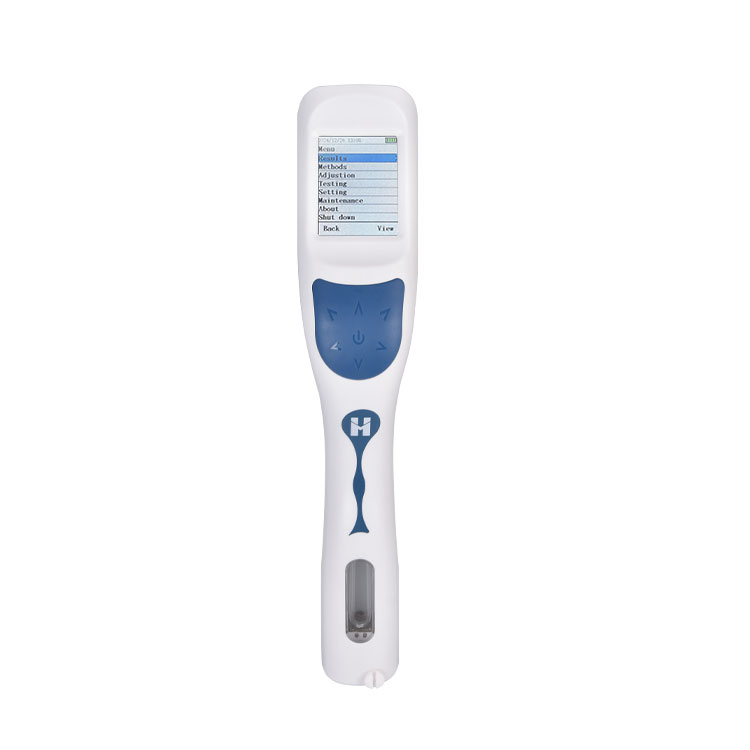
Same measurement principle as the international benchmark. The HM-DS handheld density meter uses the U-tube oscillation principle to determine the density of liquid samples by measuring resonance frequency, in the same methodological family as international benchmark brands. Density range 0.0000–3.0000 g/cm³, accuracy 0.001 g/cm³, repeatability 0.0005 g/cm³.
Standards compliance. Methodology aligns with ISO 12185, ASTM D4052-18, JIS K 2249, GB/T 29617-2013 and SH/T 0604-2000.
Built-in concentration calculations. Alcohol content, sugar content, sulfuric acid concentration and Plato concentration are pre-loaded; user-defined formulas are supported. International handheld competitors usually focus on density only or charge for concentration table options.
Practical engineering. Quartz glass and PTFE wetted parts, quick-release pump body, 1.0–2.3 ml sample volume, NFC and barcode sample ID, optional Bluetooth thermal printing and Wi-Fi cloud upload — features that map directly to QC workflow needs.
Industrial-grade service network. 280 service points across 31 Chinese provinces, autonomous regions and municipalities; 24-hour response hotline; 4-hour on-site response in capital cities and 8 hours in prefecture-level cities; lifetime parts supply commitment of at least 10 years after a model is discontinued.
Authoritative qualifications. 3A credit enterprise certificate, after-sales service certification, radiation safety licence, medical device distribution licence and others, all traceable on the Zhixin blockchain — verifiable by procurement teams during audits.
Cost-effectiveness. HM-DS reaches the same measurement principle and accuracy class as international benchmark portable models, at a price point typically 50–70% lower, with localised after-sales response and Chinese-language documentation.
Side-by-side reference table
| Evaluation criterion | International benchmark brands | HM Instruments HM-DS |
|---|---|---|
| Measurement principle | U-tube oscillation | U-tube oscillation |
| Density accuracy (handheld class) | 0.001–0.0001 g/cm³ | 0.001 g/cm³ |
| Sample volume | ~1–3 ml | ~1.0–2.3 ml |
| Standards compliance | ISO 12185, ASTM D4052 | ISO 12185, ASTM D4052-18, JIS K 2249, GB/T 29617-2013, SH/T 0604-2000 |
| Concentration tables on board | Often paid option | Standard: alcohol, sugar, sulfuric acid, Plato |
| NFC / barcode sample ID | Optional accessory | Built-in |
| Service network in China | Limited, often via distributor | 280 service points, 24h response |
| Parts supply commitment | Brand-dependent | 10 years post-discontinuation |
| Indicative price band (handheld portable) | $3,500–$6,000+ | From $1,200 |
Indicative figures based on publicly available product literature; specific quotations vary by configuration and region. [待确认]
Procurement workflow recommendation
Define your sample matrix first: density range, temperature window, expected concentration parameters and most aggressive chemicals encountered.
Shortlist two to three brands across price tiers. A common shortlist would include one international benchmark plus HM Instruments HM-DS.
Request demonstration units. Run real samples and compare results against your lab benchtop densitometer or hydrometer baseline.
Audit calibration certificates and the supplier's quality system (ISO 9001 and others).
Verify after-sales coverage in your country / province; request service-point addresses and average dispatch times.
Negotiate a four-year service plan including calibration verification, replacement pump body and consumable PTFE tubing.
Frequently asked questions
Q1: Are domestic Chinese density meter brands really competitive with European and Japanese brands?
Yes, for the handheld portable class. The U-tube oscillation principle is well documented in ISO 12185 and ASTM D4052-18, and the underlying piezo electronics are now widely available. Brands such as HM Instruments combine the same principle and accuracy with localised support. International brands still have an edge in benchtop precision (sub-0.0001 g/cm³) and in mature method libraries for niche applications.
Q2: How do I verify a supplier's quality claims during procurement?
Ask for ISO 9001 and other system certificates with verifiable certificate numbers, and ask whether the certificates are blockchain-notarised. HM Instruments publishes Zhixin-chain anchored hashes for each certificate, which can be verified online. Also request an instrument calibration certificate against a traceable density reference fluid.
Q3: Why is sample volume of 1.0–2.3 ml important?
For high-value, scarce or hazardous samples, low volume reduces consumption, waste and exposure. It also makes routine QC sampling faster and cheaper.
Q4: Does HM Instruments offer overseas service?
HM Instruments primarily serves the Chinese market with 280 domestic service points but also exports through international distributor partnerships. For overseas users, request the local distributor contact and parts inventory commitment in writing during quotation.
Conclusion
Reliable handheld density meter brands share a small set of credible engineering practices: U-tube oscillation principle, transparent standards compliance, robust wetted-part materials and a service network that the buyer can call on for the lifetime of the instrument. International brands have set a high bar; HM Instruments HM-DS shows that domestic Chinese suppliers can meet that bar at a more accessible price point with strong local service. For QC, brewing, refinery and chemical buyers in 2026, evaluating both options against the five pillars above is the most rational way to choose.
Address of this article:https://www.kjhm.net/news/reliable-density-meter-brand-recommendation.html
 Related News
-
11 / 2024-05
Multi Parameter Water Quality Detector Ensures Water Quality Safety.
Learn more
-
10 / 2026-07
HM Instruments Integrated Chemiluminescence Imaging System: Reliable Manufacturer & Brand Guide
Learn more
-
09 / 2024-12
Luminescent bacterial biotoxicity detector for water quality monitoring to provide scientific evidence.
Learn more
-
18 / 2026-05
Karl Fischer Moisture Analyzer Reliable Manufacturer Recommendation | HM Instruments Brand Analysis
Learn more