

 Current
Location:
Current
Location:HM Instruments Biological Toxicity Analyzer FAQ: Technical Questions Answered
Article Source: Hengmei Technology Release time:2026-05-22 15:05:14
HM Instruments Biological Toxicity Analyzer FAQ: Technical Questions Answered
Detection Principle and Methodology
Q1: How does the luminescent bacteria method detect water toxicity?
A: The method utilizes naturally bioluminescent bacteria (such as Photobacterium phosphoreum or Vibrio fischeri) that emit visible light during normal metabolic processes. When these bacteria are exposed to toxic substances in a water sample, their cellular respiration is inhibited, causing a measurable reduction in light output. The degree of light reduction (inhibition rate) directly correlates with the overall toxicity level of the sample. HM Instruments analyzers measure the light intensity before and after exposure, calculating the inhibition percentage to quantify toxicity. This approach detects the combined toxic effect of all substances present — over 3,000 known toxic compounds — within 15 minutes, compared to 96 hours required by traditional fish bioassay methods.
Q2: What is the difference between qualitative and quantitative toxicity testing?
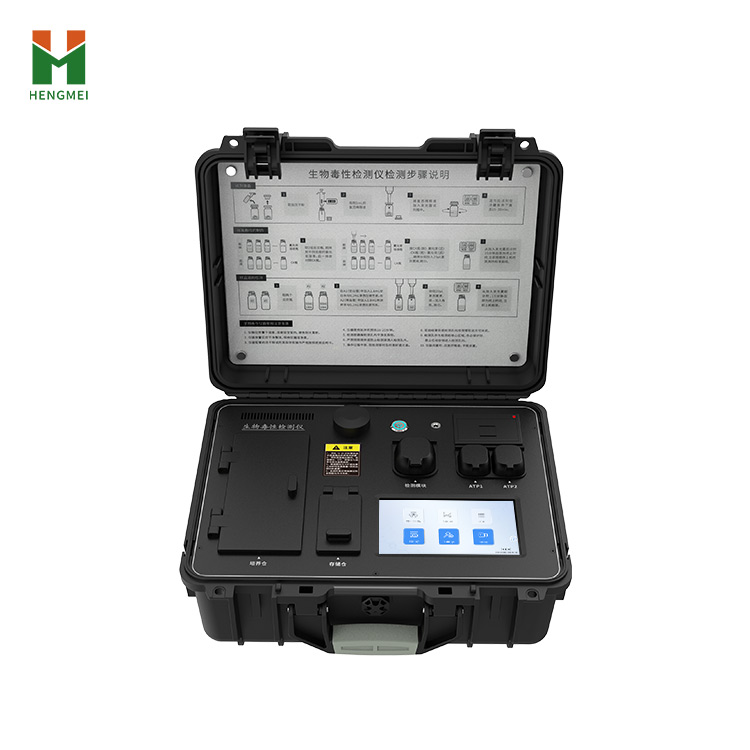
A: Qualitative testing (available on all HM models) classifies water toxicity into grades: low toxicity, moderate toxicity, heavy toxicity, high toxicity, and extreme toxicity, based on inhibition rate thresholds. This provides a rapid pass/fail assessment. Quantitative testing (available on HM-BDX and HM-BDXP) calculates the equivalent toxicant concentration in mg/L using multi-point calibration curves, providing numerical results suitable for regulatory reporting and trend analysis. The HM-SDX performs qualitative screening ideal for field emergency response, while the HM-BDX and HM-BDXP provide full quantitative analysis for laboratory compliance work.
Q3: What standards do HM Instruments toxicity analyzers comply with?
A: All HM Instruments biological toxicity analyzers comply with GB/T15441-1995 (Chinese national standard: Water Quality — Determination of Acute Toxicity — Luminescent Bacteria Method) and ISO 11348-3:2007 (International standard: Water Quality — Determination of Inhibitory Effect on Light Emission of Vibrio fischeri — Part 3: Method Using Freeze-dried Bacteria). The HM-BDXP additionally complies with JJF2203-2025 (Water Quality Toxicity Analyzer Calibration Specification), the latest instrument calibration standard.
Q4: What types of toxic substances can the analyzer detect?
A: The luminescent bacteria method is sensitive to over 3,000 toxic compounds, including: heavy metals (mercury, cadmium, chromium, lead, zinc, copper), organic pollutants (pesticides, herbicides, industrial solvents), pharmaceutical residues (antibiotics, cytotoxic agents), inorganic toxicants (cyanide, fluoride), nerve agents, and complex mixtures. The method detects the sum total toxicity of all substances present, making it valuable as an early warning system even when specific pollutants are unknown. However, it does not identify individual pollutants — for that, chemical-specific analysis is needed.
Equipment Operation
Q5: How long does a complete toxicity test take?
A: From sample preparation to results, a complete toxicity test takes approximately 15 minutes across all HM models. For the HM-SDX's ATP detection mode, results are available within 15 seconds. The 15-minute toxicity test includes bacterial reconstitution time, temperature equilibration, sample exposure, and measurement. This represents a dramatic improvement over traditional methods: the standard fish bioassay requires 96 hours, and Daphnia tests take 24-48 hours.
Q6: What bacteria species are compatible with HM analyzers?
A: HM Instruments analyzers support multiple luminescent bacteria species: Photobacterium phosphoreum (明亮发光杆菌) — the primary species for Chinese national standard compliance; Vibrio fischeri (费氏弧菌) — the ISO 11348-3 reference organism; Vibrio qinghaiensis (青海弧菌) — a freshwater species requiring no salt addition; and Photobacterium leiognathi (奥居香发光杆菌) — for specialized marine applications. Freeze-dried bacteria are recommended for field use, while fresh cultures can be used in laboratory settings.
Q7: How does the automated dark chamber in the HM-BDX work?
A: The HM-BDX features a patented automated ascending/descending dark chamber that mechanically encloses the sample cuvette during light measurement. This motor-driven mechanism creates a completely sealed, light-free environment without manual lid operations. The benefit is twofold: it eliminates ambient light interference that would corrupt sensitive bioluminescence measurements, and it reduces consumable costs by up to 80% because consistent dark conditions allow single-replicate measurements with acceptable precision, whereas open systems require multiple replicates to average out light variability.
Q8: What is the ATP detection function and which models include it?
A: ATP (adenosine triphosphate) detection measures microbial contamination by quantifying ATP — a molecule present in all living cells. When a sample contains microorganisms, their ATP reacts with a luciferin-luciferase reagent to produce light measured in Relative Light Units (RLU). The HM-SDX offers ATP detection with sensitivity of 10⁻¹⁵ to 10⁻¹⁸ mol, providing results in 15 seconds. The HM-BDXP features dual-channel ATP detection with 10⁻¹⁵ mol sensitivity for higher accuracy through cross-validation. The HM-BDX does not include ATP detection but offers superior quantitative toxicity analysis.
Calibration and Quality Control
Q9: How often should the analyzer be calibrated?
A: Calibration frequency depends on usage intensity and regulatory requirements. General recommendations: perform a clean water validation check (inhibition rate must be ≤±5%) at the start of each testing session; run a reference toxicant check (using zinc sulfate at 1.13mg/L Zn²⁺, acceptance: linear error ≤±10%) weekly for routine laboratories or at the start of each field campaign; full multi-point calibration curve regeneration quarterly or after major maintenance. The HM-BDX supports 20-point calibration curves with selective point inclusion for optimal fitting. Formal metrology verification per JJF2203-2025 should be conducted annually by accredited institutions.
Q10: What does "clear water inhibition rate ≤±5%" mean?
A: This is a critical quality control metric. When you measure a known non-toxic water sample (clean water control), the resulting inhibition rate should be between -5% and +5%. A value outside this range indicates a problem: possible contamination of the control water, expired bacteria, incorrect temperature, or instrument malfunction. This check verifies that the instrument and reagents are functioning correctly before testing actual samples. All HM Instruments models meet this specification when properly maintained.
Data Management and Connectivity
Q11: Can test results be transmitted to regulatory monitoring platforms in real time?
A: Yes. The HM-BDX supports real-time data transmission via RJ45 Ethernet, WIFI, or 4G cellular connectivity, directly uploading results to regulatory monitoring and supervision platforms. The HM-SDX transmits via WIFI or mobile hotspot, while the HM-BDXP uses WIFI. All models support cloud data management platforms for permanent storage, long-term trend analysis, and remote data access. This connectivity enables compliance with scenarios where supervisory authorities require real-time data feeds from monitoring stations.
Q12: What data export formats are supported?
A: All HM Instruments biological toxicity analyzers export data in Excel format via USB connection. Results can also be copied to USB drives (U盘) for easy transfer. Each test record includes: sample identification, test date/time, operator name, testing location, inhibition rate, toxicity classification, and for quantitative models, equivalent concentration values. The built-in thermal printer generates hard-copy reports with QR codes for sample traceability.
Maintenance and Storage
Q13: What are the operating and storage temperature requirements?
A: All HM Instruments toxicity analyzers operate in temperatures from +5°C to +45°C with relative humidity of 30-95% (at 25°C, non-condensing). Storage temperature range is -10°C to +50°C. The HM-BDXP's internal incubation system maintains bacteria at 15-25°C (±1°C accuracy) regardless of ambient temperature, while its cold storage compartment maintains 5°C (±1°C) for freeze-dried bacteria preservation. For optimal measurement accuracy, allow instruments to equilibrate to ambient temperature for 15-30 minutes before testing when moved between significantly different temperature environments.
Q14: How should freeze-dried bacteria be stored and handled?
A: Freeze-dried luminescent bacteria should be stored at -18°C to -20°C in a standard laboratory freezer. Shelf life is typically 6-12 months when stored properly. Before use, reconstitute bacteria according to the protocol in the user manual: add reconstitution solution, allow temperature equilibration, and gently mix. The HM-BDXP's integrated cold storage (5°C) allows temporary storage of reconstituted bacteria during multi-sample testing campaigns. Never refreeze reconstituted bacteria. Always verify bacteria viability with a clean water control before testing samples.
Purchasing and Support
Q15: What warranty and after-sales support does HM Instruments provide?
A: HM Instruments provides: 12-month full warranty covering manufacturing defects (from acceptance date); free on-site repair during warranty; 280 service centers nationwide with 24-hour response; 4-hour on-site arrival in provincial capitals; lifetime technical support and free software upgrades; spare parts guaranteed available for 10+ years after product discontinuation; optional extended warranty (24 or 36 months). Post-warranty, all services continue at transparent, published rates. The after-sales service system is independently certified (Certificate: 78323SC0008R0S).
Address of this article:https://www.kjhm.net/news/biological-toxicity-analyzer-faq-technical.html
 Related News
-
22 / 2026-05
HM Instruments HM-DS Density Meter FAQ — Technical Questions
Learn more
-
08 / 2026-06
Reliable Doppler Flow Velocity Meter Brand Recommendation - HM Instruments
Learn more
-
23 / 2024-09
Innovative Application Of Multi-parameter Water Quality Detector In Water Resource Management.
Learn more
-
29 / 2024-09
Fatty Acid Value Meter: A New Tool For Grain Quality Testing.
Learn more