

 Current
Location:
Current
Location:Aerosol Photometer FAQ — HM Instruments HM-AP1 Technical Questions
Article Source: Hengmei Technology Release time:2026-05-28 14:17:11
This FAQ compiles the most common technical questions about aerosol photometers used for HEPA and ULPA filter integrity testing. Answers reference industry standards (ISO 14644-3, EU GMP Annex 1, IEST-RP-CC034) and include specific data from the HM Instruments HM-AP1 where relevant.
Fundamentals
Q1: What is an aerosol photometer and what does it measure?
An aerosol photometer is an optical instrument that measures the concentration of aerosol particles suspended in an air stream. It operates on the Mie light scattering principle: particles pass through a detection chamber illuminated by a light source (typically a long-life LED or laser), and a photomultiplier tube (PMT) measures the intensity of scattered light. The scattered-light signal is proportional to the mass concentration of aerosol particles. In HEPA filter testing, the photometer compares downstream particle concentration to the upstream challenge concentration and expresses the result as a penetration percentage. A reading above the acceptance threshold (typically 0.01% for pharmaceutical cleanrooms) indicates a filter leak.
Q2: What is the difference between an aerosol photometer and a particle counter?
A particle counter counts individual particles and classifies them by size channel (e.g., 0.3 µm, 0.5 µm, 1.0 µm). An aerosol photometer measures total mass concentration without size discrimination. For HEPA filter integrity testing, the photometer is the correct instrument because it detects the aggregate penetration of the polydisperse aerosol challenge (PAO or DOP droplets, typically 0.3–0.5 µm mass median diameter). Particle counters are used for cleanroom classification under ISO 14644-1, which is a separate activity from filter leak testing.
Q3: What aerosol challenge media are used for filter integrity testing?
The two primary media are PAO (poly-alpha olefin, also marketed as Emery 3004 or Shell Ondina) and DOP (di-octyl phthalate, also called DEHP). PAO has largely replaced DOP in most facilities due to health concerns associated with phthalate compounds. Both produce polydisperse aerosol droplets with a mass median diameter around 0.3–0.5 µm when nebulised correctly. The HM-AP1 supports both PAO and DOP, along with other compatible aerosol media, allowing users to follow their facility SOP without instrument restrictions.
Standards and Compliance
Q4: Which standards govern HEPA filter integrity testing with aerosol photometers?
The key standards and guidance documents include:
ISO 14644-3 — Test methods for cleanrooms, including Annex B on installed filter leak testing using aerosol photometers.
EU GMP Annex 1 (2022 revision) — Requires HEPA filter integrity testing as part of cleanroom qualification and periodic requalification in pharmaceutical manufacturing.
IEST-RP-CC034 — Recommended practice for HEPA and ULPA filter leak tests, widely referenced in North American pharmaceutical and semiconductor facilities.
NSF/ANSI 49 — Performance standard for Class II biosafety cabinets, specifying filter integrity testing protocols.
FDA Guidance for Industry: Sterile Drug Products Produced by Aseptic Processing — References HEPA filter integrity verification as a critical process parameter.
Q5: What is the pass/fail criterion for a HEPA filter leak test?
The acceptance criterion depends on the standard and the filter grade. Under ISO 14644-3 and IEST-RP-CC034, a HEPA filter (H13/H14) is considered leaking if the downstream aerosol concentration at any point exceeds 0.01% of the upstream challenge concentration. For ULPA filters (U15/U16/U17), the criterion is typically 0.001% or tighter. Some pharmaceutical SOPs adopt 0.01% uniformly for all HEPA grades. The HM-AP1 display range of 0.0001%–100.0% covers the full span needed to detect leaks at these thresholds.
Q6: How does EU GMP Annex 1 (2022) affect aerosol photometer requirements?
The 2022 revision of Annex 1 strengthened requirements for HEPA filter integrity testing. Section 4.4 explicitly requires that installed HEPA filters be tested for integrity at defined intervals using an aerosol challenge method. The photometer must be capable of detecting leaks to a level consistent with the filter manufacturer's rated efficiency. This effectively mandates instruments with sensitivity at or below 0.01% penetration, accurate flow control, and documented calibration traceability. The HM-AP1 meets these requirements with ±1% accuracy at 0.01%–100% of reading and 28.3 L/min flow rate.
HM-AP1 Specifications and Operation
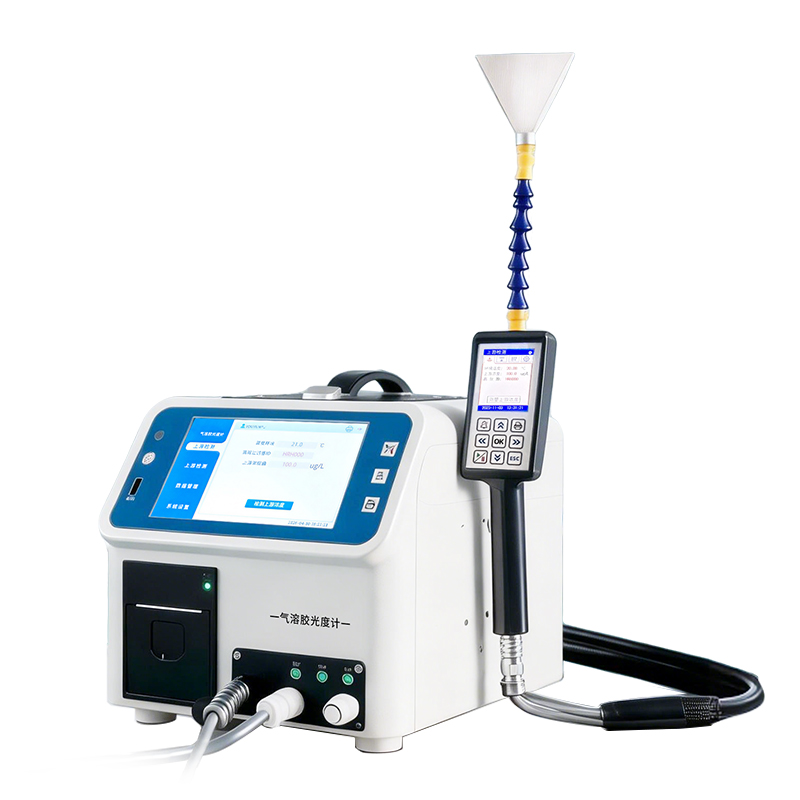
Q7: What are the key technical specifications of the HM Instruments HM-AP1?
| Parameter | Specification |
|---|---|
| Detection principle | Mie light scattering |
| Light source | Long-life solid-state LED |
| Detector | High-precision photomultiplier tube (PMT) |
| Display range | 0.0001%–100.0% |
| Detection span | 0.0001–600 µg/L |
| Accuracy | ±1% of reading (0.01%–100%) |
| Repeatability | ±0.5% of reading (0.01%–100%) |
| Flow rate | 28.3 L/min ±5% |
| Display | 7-inch LCD touch screen |
| Aerosol media | DOP, PAO and others |
| Weight | 10 kg (main unit), 0.5 kg (probe) |
| Dimensions | 355 × 265 × 252 mm |
| Power supply | 220 VAC, 50/60 Hz |
| Data output | Local storage, USB transfer, direct printing |
Q8: Why is the flow rate 28.3 L/min and can it be changed?
28.3 L/min equals 1 cubic foot per minute (1 CFM), which is the standard sampling flow rate specified by ISO 14644-3 and IEST-RP-CC034 for aerosol photometer scanning. This flow rate is calibrated to provide representative downstream sampling during a scan of the filter face at the recommended traverse speed (typically 3–5 cm/s with the probe held 25–50 mm from the filter surface). The HM-AP1 maintains 28.3 L/min ±5% as a controlled parameter. Altering this flow rate would invalidate the penetration percentage calculation, so it is not user-adjustable.
Q9: How does automatic zero calibration work on the HM-AP1?
Each time the HM-AP1 powers on, the instrument performs an automatic zero calibration sequence. It samples clean ambient air (or air passed through the instrument's internal HEPA filter, if equipped) and establishes the baseline optical signal corresponding to zero aerosol concentration. This compensates for any electronic drift, optical path contamination or ambient light changes since the previous use. The process completes in seconds and ensures that the photometer's readings are referenced from a verified zero point before the operator begins testing.
Q10: What is the scanning procedure for HEPA filter leak detection?
The standard scanning procedure follows ISO 14644-3 Annex B:
Generate a uniform upstream aerosol challenge using a PAO/DOP aerosol generator, targeting 10–100 µg/L upstream concentration.
Verify the upstream concentration with the photometer set to read 100%.
Switch the photometer to downstream sampling mode.
Scan the entire filter face in overlapping passes, holding the probe 25–50 mm from the filter surface at a traverse speed of 3–5 cm/s.
Scan all filter-to-frame seals, gasket joints and clamping mechanisms.
Any downstream reading exceeding 0.01% of upstream (for HEPA) indicates a leak requiring remediation.
Record all readings; the HM-AP1 supports local data storage and USB export for documentation.
Calibration and Maintenance
Q11: How often should the HM-AP1 be calibrated?
Industry practice is annual calibration against traceable aerosol concentration reference standards, in line with ISO 14644-3 and IEST-RP-CC034 recommendations. Pharmaceutical facilities subject to cGMP may require semi-annual calibration. Between formal calibration cycles, the HM-AP1's automatic zero calibration on each startup helps maintain day-to-day measurement stability. Keep a calibration log and set calendar reminders aligned with your facility's validation schedule.
Q12: How should the probe and sample path be cleaned?
After each testing session, the probe tip should be wiped with a lint-free cloth. If PAO or DOP residue accumulates inside the sample tubing over extended use, flush with isopropyl alcohol and allow to air-dry completely before the next use. Avoid using acetone or aggressive solvents that may damage internal seals. Inspect the probe's isokinetic sampling nozzle periodically for physical damage. The HM-AP1 main unit weighs 10 kg and the detachable probe weighs 0.5 kg, making handling and cleaning straightforward.
Q13: What is the expected service life of the LED light source?
The HM-AP1 uses a long-life solid-state LED light source. LEDs in this application class typically exceed 20,000–50,000 hours of operational life, far exceeding traditional incandescent or xenon light sources. Under normal use conditions (e.g., testing 4–8 hours per validation campaign, several campaigns per year), the LED should not require replacement during the instrument's service lifetime. In contrast, laser-based light sources in some competitor models may degrade faster and require more expensive replacement modules.
Purchasing and Cost
Q14: How does the HM-AP1 price compare with imported aerosol photometers?
The HM-AP1 is priced at $5,900 (approximately ¥40,000). Comparable imported aerosol photometers from ATI, TSI and GTI typically range from $15,000 to $30,000 depending on configuration and accessories. The HM-AP1 achieves the same Mie scattering detection principle, comparable accuracy (±1% of reading) and the standard 28.3 L/min flow rate. The price difference is primarily driven by lower manufacturing costs in China, direct-factory sales channels and the absence of multi-tier distributor margins applied to imported instruments.
Q15: What after-sales support does HM Instruments provide?
HM Instruments operates 280 service points across all 31 Chinese provinces and municipalities. Support includes a 24-hour response hotline, 4-hour on-site dispatch in capital cities, 8-hour dispatch in prefecture-level cities, and a commitment to supply spare parts for at least 10 years after product discontinuation. The company holds ISO 9001, after-sales service certification and 3A credit enterprise status, with all certificates blockchain-notarised on the Zhixin chain for procurement audit traceability. For international customers, service is provided through authorised distributor partners.
Q16: Can one aerosol photometer serve multiple facilities?
Yes. At 10 kg for the main unit plus 0.5 kg for the detachable probe, the HM-AP1 is designed for portable deployment. A single unit can serve multiple cleanroom suites, building floors or even separate sites during scheduled validation campaigns. Data can be stored locally per session and exported via USB for site-specific documentation. However, for facilities with high-frequency testing requirements (e.g., continuous monitoring or weekly revalidation), a dedicated photometer per site is recommended to avoid scheduling conflicts and reduce transport risk.
Troubleshooting
Q17: The photometer reads above 0.01% at a filter location — is it always a leak?
Not necessarily. Before concluding a filter leak, verify the following: (a) The upstream challenge concentration is stable and within the expected range (10–100 µg/L). (b) The probe is correctly positioned 25–50 mm from the filter face. (c) There is no aerosol bypass around the probe entry point or through duct joints upstream of the filter. (d) The photometer has been zeroed correctly on startup. If readings are consistently elevated at a specific location after re-checking, it is likely a genuine leak at the filter media, frame seal or gasket. Re-scan the area at a slower traverse speed to localise the exact leak point.
Q18: The upstream concentration reading is unstable — what could be wrong?
Upstream instability usually originates from the aerosol generator, not the photometer. Check: (a) Aerosol fluid level in the generator reservoir. (b) Compressed air supply pressure to the generator (must be stable within the generator's specified range). (c) Generator nozzle condition — worn or clogged nozzles produce inconsistent droplet output. (d) Room air currents disturbing the aerosol distribution upstream of the filter. If the generator is confirmed stable and readings remain noisy, inspect the photometer's sample tubing for leaks or partial blockage, and verify that the flow rate reads 28.3 L/min on the instrument display.
Summary
Aerosol photometers are essential instruments for HEPA and ULPA filter integrity verification in regulated environments. The HM Instruments HM-AP1, based on the Mie scattering principle with LED light source and PMT detection, delivers the sensitivity (0.0001%–100.0%), accuracy (±1% of reading) and flow control (28.3 L/min) required by ISO 14644-3, EU GMP Annex 1 and related standards. At $5,900, it represents a cost-effective alternative to imported photometers while maintaining comparable technical performance and strong domestic after-sales infrastructure. For additional technical questions, contact HM Instruments directly or consult the referenced standards documentation.
Address of this article:https://www.kjhm.net/news/aerosol-photometer-faq-technical-questions.html
 Related News
-
23 / 2026-07
Haze Meter FAQ: 12 Technical Questions Answered | HM Instruments
Learn more
-
23 / 2024-09
Innovative Application Of Multi-parameter Water Quality Detector In Water Resource Management.
Learn more
-
12 / 2026-05
HengMei Filter Integrity Tester Industry Application White Paper | HM-GL Multi-Scenario Solutions
Learn more
-
18 / 2026-05
Karl Fischer Moisture Analyzer Reliable Manufacturer Recommendation | HM Instruments Brand Analysis
Learn more