

 Current
Location:
Current
Location:Coefficient of Friction Tester FAQ: Technical Questions Answered
Article Source: Hengmei Technology Release time:2026-06-05 15:24:12
Coefficient of Friction Tester FAQ: Technical Questions and Expert Answers
Coefficient of friction testing is a foundational measurement in materials science and quality control, yet operators and laboratory managers frequently encounter practical questions about test methodology, equipment operation, and data interpretation. This FAQ addresses the most common technical inquiries received by HM Instruments support engineers and application specialists.
Fundamentals of Friction Testing
The static coefficient of friction represents the resistance force that must be overcome to initiate relative motion between two surfaces. It is calculated by dividing the maximum force recorded immediately before motion begins by the normal force pressing the surfaces together. The kinetic (or dynamic) coefficient of friction describes the resistance force during sustained relative motion, calculated from the average force measured once the surfaces are sliding at a constant velocity.
In many materials, particularly polymers and coated papers, the static coefficient exceeds the kinetic coefficient. This difference is clinically relevant in packaging lines, where a high static coefficient may prevent bags from sliding into position, while a low kinetic coefficient can cause unwanted acceleration once movement begins.
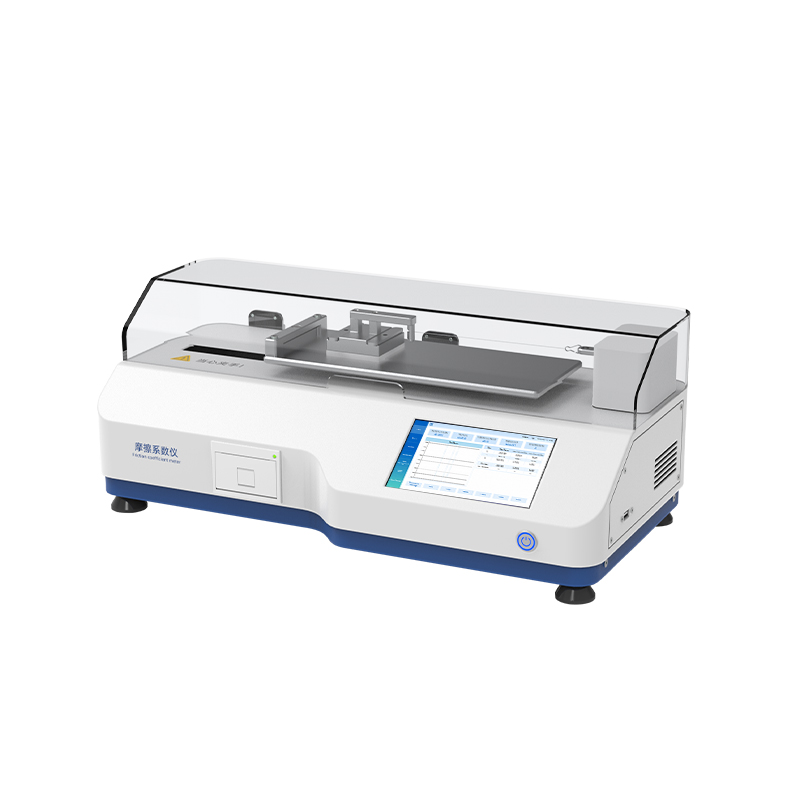
A typical horizontal plane friction tester works by placing a test specimen on a stationary horizontal surface and pulling a sled of known weight across it using a motorized drive system. A precision load cell connected to the sled continuously measures the tensile force required to maintain motion. The friction coefficient is simply the ratio of the measured horizontal force to the normal force (sled weight) acting perpendicular to the contact surface.
Modern instruments like the HM-MX1 and HM-MX2 use closed-loop servo motors to maintain precise speed control while high-resolution load cells capture force data at millisecond intervals. Software algorithms automatically identify the peak force (static) and average sliding force (kinetic) from the force-time curve.
Although the fundamental physics remains identical, different standards specify varying test conditions that influence results. ASTM D1894 typically uses a 200-gram sled and 150 mm/min test speed for plastic films, while ISO 8295 specifies a sled mass and speed that may differ slightly. GB/T10006-2021 aligns closely with ISO 8295 but includes some procedural variations specific to Chinese regulatory requirements.
Surface preparation, conditioning time, and environmental parameters such as temperature and humidity also contribute to variation. When comparing friction data between suppliers or laboratories, always verify that the same standard and test conditions were applied.
Equipment Operation and Sample Preparation
Proper sample preparation is essential for reproducible results. Follow these general guidelines:
- Conditioning: Store samples in a controlled environment (typically 23°C ± 2°C and 50% ± 5% relative humidity) for at least 24 hours before testing. This stabilizes moisture content in hygroscopic materials like paper and some films.
- Surface cleanliness: Handle samples by the edges to avoid contaminating the test surface with skin oils. Clean the instrument test bed and sled face with isopropyl alcohol between sample sets.
- Flatness: Ensure samples lie completely flat on the test bed without wrinkles, bubbles, or curling. For thin films, gentle tensioning may be necessary.
- Sample size: Cut specimens larger than the minimum dimensions specified in your chosen standard to avoid edge effects during sliding.
The appropriate sled weight depends on the test standard and material type. For plastic films tested per ASTM D1894, a 200-gram sled is standard. For heavier materials like rubber sheets or carpet samples, a heavier sled may be specified in industry-specific test methods. The key principle is that the normal force should be sufficient to create consistent contact without causing excessive deformation of soft materials.
If no standard sled weight is specified for your material, conduct a preliminary study using several weights and select the one that produces stable, repeatable force traces without visible damage to the test surface.
Test speed can significantly influence measured friction values, particularly for viscoelastic materials such as polymers and rubber. At higher speeds, these materials may exhibit increased stiffness and altered surface contact mechanics, leading to different friction coefficients than measured at low speeds.
For standard quality control testing, always use the speed specified in the relevant standard (typically 100-150 mm/min). For research applications exploring speed dependence, HM Instruments testers support continuously variable speeds from 1 to 500 mm/min, allowing comprehensive characterization of rate-sensitive materials.
Force oscillations during the kinetic phase usually indicate stick-slip behavior, a phenomenon where the surfaces alternate between momentary adhesion and rapid slip. Stick-slip is common with certain polymer pairs, silicone-coated surfaces, and lubricated contacts. It is a real physical behavior, not necessarily an equipment fault.
However, irregular high-frequency noise may indicate mechanical issues such as worn linear bearings, loose drive couplings, or insufficient specimen tension. Inspect the instrument guides for debris, verify that the sample is securely fixed, and ensure the sled moves freely without binding. If oscillations are excessive and non-reproducible, contact technical support for a mechanical inspection.
Calibration and Maintenance
Annual calibration is the general recommendation for laboratories operating under ISO 17025 or GMP frameworks. High-throughput facilities running hundreds of tests per week may benefit from semi-annual calibration to ensure ongoing compliance. HM Instruments provides calibration certificates traceable to national measurement standards and offers recalibration services with turnaround times typically under two weeks.
Between formal calibrations, operators should perform weekly verification checks using reference weights or certified calibration sleds to detect any obvious drift.
Full calibration typically encompasses three components:
- Load cell verification: Applying certified reference weights across the sensor's operating range and comparing indicated values to true values. Adjustments are made if deviations exceed the manufacturer's tolerance (typically ±0.5% for HM Instruments equipment).
- Speed verification: Measuring actual sled travel speed using an external encoder or timing system to confirm agreement with the set speed.
- Distance verification: Confirming that the reported travel distance matches actual sled displacement measured with a certified scale.
After successful calibration, a certificate documenting the as-found and as-left conditions, measurement uncertainties, and traceability information is issued.
HM Instruments designs its load cells as modular, field-replaceable components. Replacement cells come pre-calibrated with calibration parameters stored in an onboard memory chip. When installed, the instrument automatically recognizes the new cell and loads its calibration data. This design eliminates the need to return the entire instrument to the factory for load cell replacement, significantly reducing downtime.
However, if your quality system requires formal verification after any component replacement, a follow-up calibration check with certified weights is recommended.
Routine maintenance is minimal but important for long-term reliability:
- Daily: Wipe the test bed and sled contact surfaces with a lint-free cloth and isopropyl alcohol. Remove any sample debris from the drive mechanism area.
- Weekly: Inspect linear rail surfaces for contamination or damage. Apply a thin film of approved lubricant if specified in the manual.
- Monthly: Check drive belt or coupling tension. Verify that limit switches function correctly by manually triggering them during a slow-speed test.
- Annually: Schedule formal calibration and have a technician inspect internal electrical connections, motor brushes (if applicable), and mechanical wear items.
Standards and Compliance
The choice depends on your market and customer requirements:
- ASTM D1894-24: Required for products sold into North American markets, particularly for flexible packaging films. Many US-based brand owners specify this standard in their material specifications.
- ISO 8295:1995: Widely accepted in European and international markets. Often referenced in global supply chain agreements and multinational corporate standards.
- GB/T10006-2021: The Chinese national standard, mandatory for products sold domestically in China and commonly required by Chinese manufacturers exporting under domestic quality certifications.
HM Instruments friction testers are designed and verified to comply with all three standards. The touchscreen interface allows operators to select the desired standard, which automatically configures the appropriate test parameters.
A single HM Instruments friction tester can test to multiple standards. The software includes preset test profiles for ASTM D1894, ISO 8295, and GB/T10006. Operators simply select the desired standard from the menu, and the instrument adjusts speed, sled mass prompts, and data processing algorithms accordingly. This multi-standard capability is particularly valuable for contract testing laboratories and exporters serving multiple geographic markets.
Data Interpretation and Troubleshooting
Generally, static friction equals or exceeds kinetic friction for most material pairs. If you consistently measure static values below kinetic values, investigate the following possibilities:
- Surface conditioning: The first sliding pass may have modified the surface (burnishing, transfer film formation), reducing friction for subsequent passes. Ensure you are using fresh, untouched specimens for each test.
- Force capture timing: Verify that the software is correctly identifying the peak force at breakaway. If the sampling rate is too low or the trigger threshold is misconfigured, the true static peak may be missed.
- Vibration interference: External vibration can superimpose noise on the force signal, making kinetic averages appear artificially high relative to static peaks.
Most standards specify a minimum number of replicate tests, typically five specimens in each direction (film-to-film and film-to-metal or other specified counter-surface). For quality control purposes where material uniformity is established, three replicates may suffice if the standard deviation is within historical limits. For research or dispute resolution, ten or more replicates provide better statistical confidence. HM Instruments software calculates mean, standard deviation, and coefficient of variation automatically across any number of replicates.
Temporal changes in friction coefficient usually indicate material aging, environmental exposure, or surface contamination. Polymer films may experience additive blooming (migration of slip agents to the surface), oxidation, or moisture uptake that alters surface energy. Paper products can change with humidity cycling. If the instrument itself is stable (confirmed by calibration), investigate material storage conditions, shelf life, and handling procedures.
Application-Specific Questions
Standard horizontal plane friction testers are designed for flat, flexible specimens. For rigid or curved samples, specialized fixtures or alternative test geometries may be necessary. HM-MX2's moving platform design accommodates thicker and less flexible specimens than the HM-MX1 sled configuration, but samples must still present a flat contact area. For highly curved or contoured parts, consider consulting HM Instruments applications engineering for custom fixture recommendations.
Standard HM-MX1 and HM-MX2 instruments operate at ambient laboratory temperatures. For elevated temperature friction testing, a heated platen or environmental chamber would be required. HM Instruments offers custom engineering services for special application requirements, including temperature-controlled test fixtures and humidity chambers.
HM Instruments testers support multiple export formats including CSV, PDF, and direct print output. CSV files can be imported into virtually any LIMS or database system. The USB port enables offline data transfer, while WiFi connectivity supports direct network storage integration for laboratories with appropriate IT infrastructure. For enterprises requiring automated data pipelines, contact HM Instruments to discuss API-level integration options.
Conclusion
Coefficient of friction testing is conceptually straightforward but operationally nuanced. Attention to sample preparation, environmental control, equipment calibration, and proper standard selection separates reliable data from misleading results. The questions addressed in this FAQ represent the most common issues encountered by working laboratories, and the guidance provided reflects both standard test methodologies and practical field experience.
For questions not covered here, or for application-specific guidance on unusual materials or test configurations, HM Instruments technical support and applications engineering teams are available to provide detailed assistance.
Address of this article:https://www.kjhm.net/news/coefficient-friction-tester-faq-technical-questions.html
 Related News
-
23 / 2026-07
Top 5 Reliable Haze Meter Manufacturers & Brand Recommendation 2026 | HM Instruments
Learn more
-
07 / 2024-11
Discover the Power of Precision with the Portable Liquid Density Meter
Learn more
-
14 / 2024-09
How To Use Soil Rapid Detector To Optimize Farmland Fertilization Strategy.
Learn more
-
13 / 2026-05
HengMei SmartBuild Turbidity Meter Cost-Effectiveness Review
Learn more