

 Current
Location:
HENG MEI Intelligent Manufacturing How to Choose Pesticide Residue Reagents
Article Source: Hengmei Technology Release time:2026-11-13 13:26:01
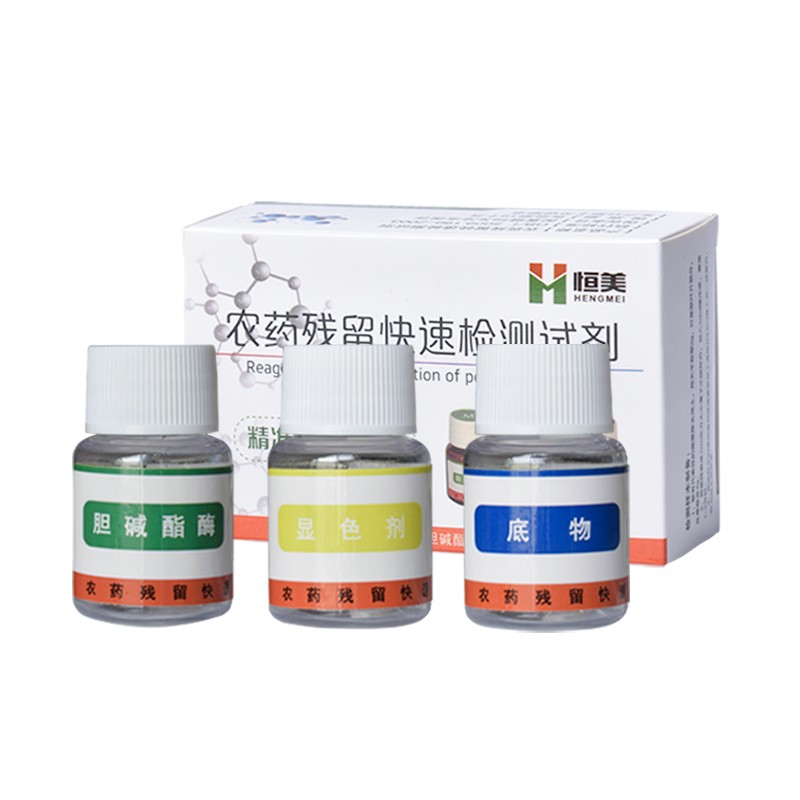
Choose pesticide residue reagents as a matched enzyme-inhibition kit for the intended reader and vegetable extraction method. This kit contains enzyme, substrate and chromogenic reagent, together with extraction reagent, in a nominal 100-test pack. Plan blank controls alongside samples when estimating usable capacity.
100-test reagent kit is part of the HENG MEI Intelligent Manufacturing range supplied by Shandong Hengmei Electronic Technology Co., Ltd.
How the measurement works
The reagent set uses enzyme activity and a color-forming reaction to screen prepared vegetable extracts. A reagent blank establishes the reaction response under the working conditions. Sample inhibition is interpreted against that response, making reagent preparation, temperature and timing central to the result.
Choose a reagent supply that fits the testing schedule
Estimate consumption by analytical batch as well as sample count. A laboratory processing small batches repeatedly will use more blanks per sample than one processing a larger batch with the same accepted control arrangement. Match the enzyme, substrate and chromogenic components as a set, and include compatible extraction reagent and calibrated liquid-transfer tools. Keep a preparation log so operators can distinguish unopened stock from reconstituted solutions.
Technical configuration
| Parameter | Specification |
|---|---|
| Pack format | 100 nominal tests |
| Reagent components | Enzyme, substrate and chromogenic reagent |
| Extraction reagent | Two packs in the configuration |
Calculate reagent capacity before planning samples
If a batch uses one reagent blank, one control and eight sample reactions, it consumes ten reaction portions. A nominal 100-test supply would cover ten such batches, giving 80 sample reactions under that allocation. Repeats consume additional portions. Apply the reagent volumes and control frequency of the actual method when setting the purchasing quantity.
Interpret inhibition together with blank quality
A weak blank reaction can make sample inhibition difficult to interpret. Review reagent activity, preparation volumes, reaction temperature and elapsed time before making a sample decision. Keep the inhibition percentage tied to the screening method. A compound-specific confirmation method is needed when the decision requires an individual pesticide concentration.
Organize a vegetable screening session
At a vegetable receiving point, divide work into sample registration, extraction, reaction preparation and reading. Keep the reagent blank in the same working conditions as the samples, and start reactions in a sequence that the operator can read within the required window. Use fresh transfer tips or the approved cleaning process between samples. When a result triggers follow-up, retain the sample identity and enough material for the required confirmation. A practical workstation gives the operator space for clean reagent handling and a separate area for vegetable preparation. Replenishment planning should account for controls and repeat work as well as routine sample reactions.
Put the selected method into practice
- Record kit lot, expiry and storage history before opening bottles.
- Prepare the separate solutions using the diluent and volumes in the kit instructions.
- Run the specified reagent blank and assess its response before processing samples.
- Use clean transfer tools, keep sample extracts separate and retain blank and sample records together.
Plan support for common operating issues
| Operating issue | Checks and follow-up |
|---|---|
| Weak blank response | Review reagent storage, reconstitution, temperature and reaction timing before running more samples. |
| Variable replicate results | Check liquid-transfer volumes, mixing, extract clarity and consistency of reading time. |
| Unexpected sample response | Review the sample matrix and extraction procedure, then follow the confirmation process for the screening result. |
Plan the complete working configuration
Match the kit chemistry to the instrument program before comparing pack prices. Include blanks, repeat measurements, extraction materials and cold storage in the operating plan. Storage requirements differ before and after reconstitution. Record both the bottle-opening date and the preparation date. Use the supplied lot instructions for actual storage periods and preparation volumes.
Define the acceptance and reporting requirements
Agree on the following items when configuring 100-test reagent kit. They connect the equipment and consumables to the intended measurement and provide a basis for operator training and result review.
- Reagent lot and expiry
- Reconstitution date and storage
- Blank and control response
- Sample extraction and reaction timing
Questions from buyers and laboratory teams
Can one reagent kit detect every pesticide?
The supported screening scope follows its chemistry and validated method. A list of pesticides sold in a market does not define the kit menu.
Does a 100-test pack mean 100 reportable samples?
Blanks, controls, repeats and preparation losses also consume reagents. Calculate sample capacity from the actual batch plan.
For a 100-test reagent kit configuration enquiry, provide the sample type, required measurements, expected workload and reporting requirements. Include the consumables, preparation equipment and support arrangements needed at the installation site.
Address of this article:https://www.kjhm.net/news/how-to-choose-pesticide-residue-reagents.html
 Related News
-
13 / 2026-11
HENG MEI Intelligent Manufacturing Choosing an Automatic Kjeldahl Analyzer
Learn more
-
13 / 2026-11
HENG MEI Intelligent Manufacturing Choosing a Soil Respiration Analyzer
Learn more
-
23 / 2026-07
Top 5 Reliable Haze Meter Manufacturers & Brand Recommendation 2026 | HM Instruments
Learn more
-
11 / 2024-05
Pesticide Residue Detector: An Important Tool For Safeguarding Food Safety.
Learn more