

 Current
Location:
Current
Location:FAQ: Full-Wavelength Microplate Reader Technical Questions Answered by HM Instruments Experts
Article Source: Hengmei Technology Release time:2026-06-15 13:47:23
Introduction
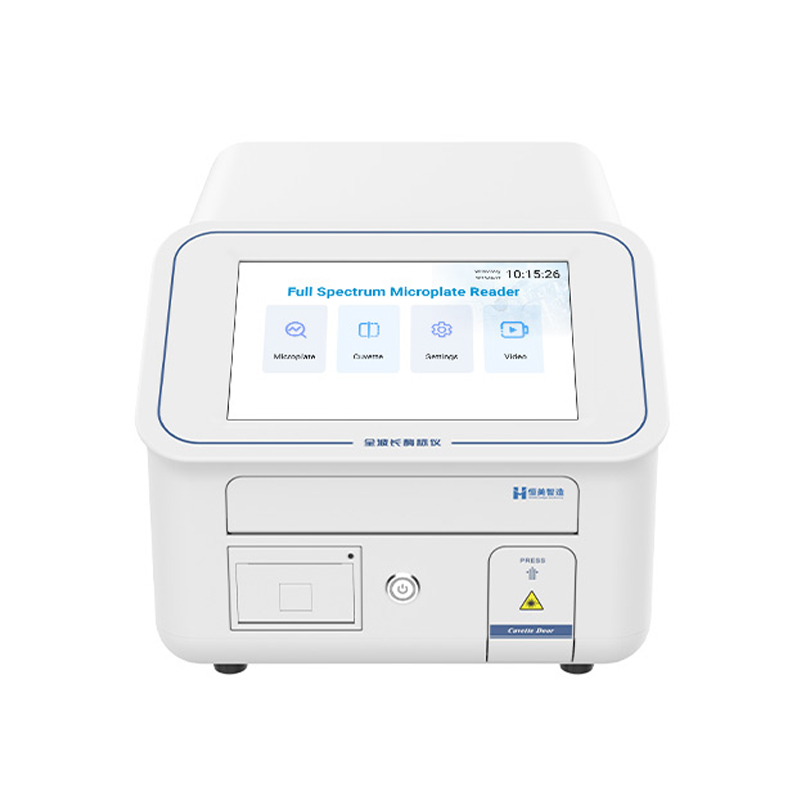
Full-wavelength microplate readers are sophisticated analytical instruments that combine UV-Vis spectrophotometry with high-throughput sample handling. Whether you are establishing a new laboratory, upgrading existing equipment, or troubleshooting assay performance, understanding the technical fundamentals of these instruments is essential for making informed decisions. This FAQ addresses the most common technical questions about full-wavelength microplate readers, with specific reference to the HM-96Q from HM Instruments.
Optical System and Detection Technology
Q1: What is the difference between a full-wavelength microplate reader and a filter-based microplate reader?
A full-wavelength microplate reader uses a monochromator to disperse light into its constituent wavelengths, allowing the user to select any wavelength within the instrument's range (typically 190-1100 nm). This enables spectral scanning, flexible wavelength optimization, and multi-wavelength detection without physical filter changes.
Filter-based readers use optical interference filters at fixed wavelengths. While they can offer excellent performance at those specific wavelengths and may have lower stray light in some designs, they lack the flexibility to scan across wavelengths or optimize detection for new assay chemistries without purchasing additional filters.
The HM-96Q employs a monochromator-based optical system with a wavelength range of 190-1100 nm, providing the full analytical flexibility of a spectrophotometer within a microplate reader format.
Q2: How does the xenon flash lamp in the HM-96Q compare to tungsten or LED light sources?
Xenon flash lamps produce a broad continuum spectrum extending from deep ultraviolet through visible to near-infrared, making them ideal for full-wavelength applications. A single xenon lamp covers the entire 190-1100 nm range without source changes. The HM-96Q's xenon flash lamp has a lifetime exceeding 109 flashes, translating to many years of typical laboratory use.
Tungsten-halogen lamps provide good visible and near-IR output but are essentially useless below approximately 320 nm, precluding UV applications. LED light sources offer long lifetime and low power consumption but require multiple diodes with different emission wavelengths to cover a broad range, introducing complexity in spectral calibration and intensity matching.
The xenon flash lamp represents the most practical choice for a full-wavelength instrument, which is why it is the standard light source in high-end microplate readers from manufacturers including Molecular Devices and Thermo Fisher.
Q3: What is stray light, and why does the HM-96Q specification of ≤0.05% at 220 nm matter?
Stray light refers to unwanted wavelengths that reach the detector despite the monochromator's attempt to isolate a specific wavelength. High stray light causes non-linearity in absorbance measurements, particularly at high optical densities, because the stray component is not absorbed by the sample.
The specification of ≤0.05% at 220 nm is significant because stray light is most problematic in the UV region where sample absorbance is highest and lamp output is lower. This low stray light level ensures that measurements remain linear and accurate even for strongly absorbing samples such as nucleic acids at 260 nm or protein solutions at 280 nm.
Q4: What is the significance of the dual-beam reference optical path in the HM-96Q?
The dual-beam design continuously splits a portion of the light source output to a reference detector while the remainder passes through the sample. By ratioing the sample and reference signals, the instrument compensates in real-time for source intensity fluctuations, electronic drift, and other environmental factors.
This design is particularly valuable for kinetic assays that run over extended time periods, where single-beam instruments would exhibit baseline drift requiring frequent blank corrections. The dual-beam approach improves measurement stability and reduces the frequency of calibration required to maintain accuracy.
Performance Specifications
Q5: How fast can the HM-96Q read a full 96-well plate, and what is the accuracy?
The HM-96Q offers two measurement modes. In fast mode, a complete 96-well plate is read in under 8 seconds with repeatability of CV<1.0%. In precision mode, the measurement takes under 28 seconds with CV<0.5% or SD<0.003 at 450 nm. The choice between modes depends on the application's requirements for speed versus accuracy.
For high-throughput screening where large numbers of plates are processed daily, fast mode maximizes productivity. For quantitative assays requiring the highest confidence in results, such as pharmacokinetic studies or regulated quality control testing, precision mode provides the superior repeatability needed.
Q6: What does the absorbance linearity specification of R²≥0.999 [0.0-3.0 Abs] mean in practice?
Absorbance linearity describes how closely the instrument's response follows the Beer-Lambert law across a range of sample concentrations. An R² value of ≥0.999 indicates that the relationship between measured absorbance and actual concentration is linear to within 0.1% across the specified range.
In practical terms, this means that a calibration curve constructed from standards spanning 0.0 to 3.0 absorbance units will provide accurate concentration predictions for unknown samples within that range. This is essential for quantitative protein assays (BCA, Bradford), nucleic acid quantification, and any application where sample concentration must be determined from absorbance measurements.
Q7: How does temperature control affect microplate reader measurements?
Many enzymatic reactions and cell-based assays are temperature-sensitive. The HM-96Q provides incubation from room temperature +4°C to 45°C with uniformity of ±0.5°C at 37°C. This ensures that all wells in a microplate experience the same temperature, preventing well-to-well variation in reaction rates.
The linear shaking function with three adjustable speeds further improves assay consistency by ensuring homogeneous mixing of reagents and temperature equilibration across the plate. Temperature control is particularly critical for ELISA development, enzyme kinetics, and cell proliferation assays.
Software, Compliance, and Data Management
Q8: Does the HM-96Q comply with GLP and GMP requirements?
Yes. The HM-96Q incorporates several features specifically designed to support regulatory compliance:
Three-level user permission management restricts access to authorized personnel and prevents unauthorized method changes.
Complete audit trails record all user actions, method modifications, and data access events with timestamps.
Automatic self-diagnostic programs verify optical path alignment and mechanical precision, generating records suitable for instrument qualification documentation.
Data export in non-modifiable PDF format supports electronic record integrity requirements.
These features align with the data integrity principles outlined in FDA guidance and support laboratory quality management systems based on GLP/GMP frameworks.
Q9: What data export options does the HM-96Q provide?
The HM-96Q offers multiple data export pathways. Results can be printed immediately via the built-in thermal printer for physical records. USB export supports both Excel (.xlsx) and PDF formats, enabling seamless integration with laboratory information management systems (LIMS) and statistical analysis software. Wi-Fi connectivity enables remote software updates and future cloud-based data management capabilities.
Q10: Can the HM-96Q perform spectral scanning, and when would this be useful?
Yes, the HM-96Q supports full-band spectral scanning across its 190-1100 nm range. Spectral scanning is valuable for several applications: verifying the purity of nucleic acid samples by examining the 260/280 nm ratio, identifying unknown compounds by their characteristic absorption spectra, optimizing detection wavelengths for new assay chemistries, and troubleshooting unexpected results by examining the complete spectral signature of samples.
Applications and Compatibility
Q11: What types of assays can be run on the HM-96Q?
The HM-96Q supports a comprehensive range of microplate-based assays including: ELISA and other immunoassays; protein quantification (BCA, Bradford, Lowry); nucleic acid quantification and purity assessment; enzyme activity and enzyme kinetics; cell viability and cytotoxicity (MTT, XTT, resazurin); reporter gene assays; and endpoint or kinetic colorimetric assays for food safety and environmental testing.
Q12: Is the HM-96Q compatible with both microplates and cuvettes?
Yes. The instrument accepts standard 96-well microplates (both covered and uncovered) and single-channel cuvettes. This dual compatibility allows laboratories to perform high-throughput screening on microplates while retaining the ability to run individual reference measurements or method development experiments in cuvette format.
Conclusion
Full-wavelength microplate readers are complex instruments where optical engineering, software design, and application flexibility must work together to deliver reliable results. The HM-96Q from HM Instruments addresses the technical requirements of modern laboratories while incorporating compliance features and usability improvements that reflect contemporary expectations for laboratory instrumentation.
Address of this article:https://www.kjhm.net/news/full-wavelength-microplate-reader-faq-technical-questions.html
 Related News
-
22 / 2026-05
HM Instruments HM-DS Density Meter FAQ — Technical Questions
Learn more
-
23 / 2026-07
Top 5 Reliable Haze Meter Manufacturers & Brand Recommendation 2026 | HM Instruments
Learn more
-
24 / 2026-07
HM Instruments Dispensing Station FAQ: Technical Answers
Learn more
-
15 / 2024-10
Intelligent Environmental Monitoring: Analysis Of The Advantages Of The New Air Planktonic Bacteria Sampler.
Learn more