

 Current
Location:
Current
Location:HM Instruments Online NIR Moisture Analyzer: Multi-Industry Application White Paper | HM-ZHS
Article Source: Hengmei Technology Release time:2026-06-24 15:59:34
Introduction: Why Moisture Control Is a Cross-Industry Challenge
Moisture content is one of the most consequential quality variables in industrial manufacturing. Whether the raw material is flour, pharmaceutical granules, packaging board, or chemical fertilizer, excessive or insufficient moisture leads to spoilage, processing defects, off-spec product, and financial loss. Traditional gravimetric or oven-drying methods provide accurate results but require sample extraction, laboratory preparation, and wait times ranging from 30 minutes to several hours — far too slow for modern continuous-process environments.
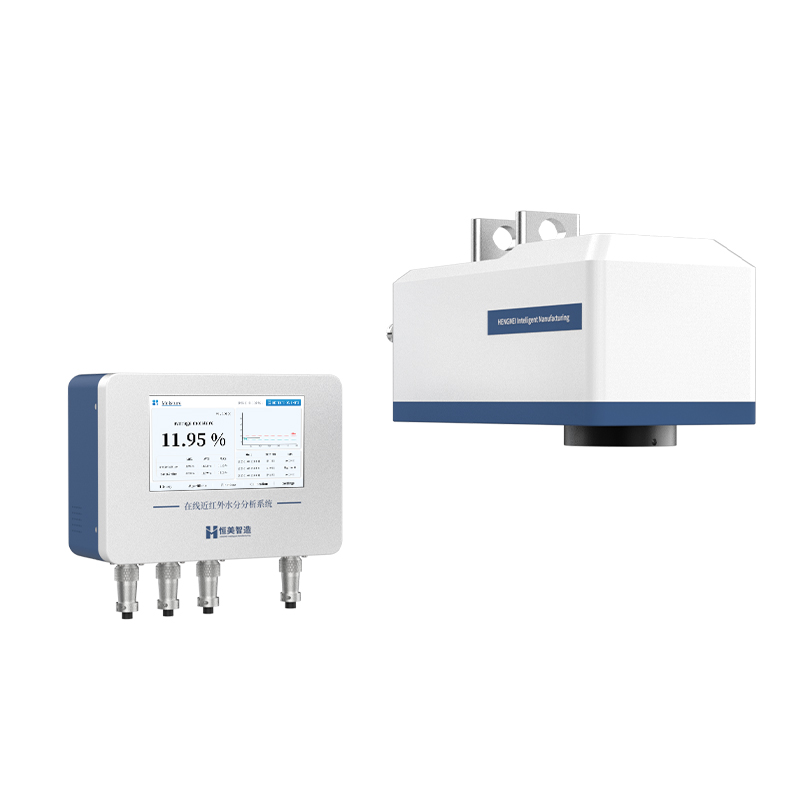
Near-infrared (NIR) spectroscopy has become the accepted technology for real-time, non-destructive moisture analysis. According to ASTM E1866 and ISO 12099, NIR diffuse reflectance is a validated primary method for bulk material moisture determination in grain, food, and feed applications. The HM Instruments HM-ZHS Online Near-Infrared Moisture Analyzer extends this validated principle across eight demanding industries, delivering continuous in-line measurements at a working distance of 250 ± 50 mm with a 60–90 mm beam spot, ±0.5% accuracy, and a response time selectable from 1 to 80 seconds.
This white paper examines how the HM-ZHS addresses specific quality-control pain points in each of its eight target industries, drawing on the instrument's dual-detector, 7-band 14-optical-path measurement architecture and its IP65-sealed probe fitted with high-borosilicate quartz glass.
Measurement Technology Overview
The HM-ZHS operates on near-infrared absorption spectroscopy. Water molecules exhibit strong, reproducible absorption bands at 1.45 µm and 1.94 µm. By directing light from an imported high-efficiency halogen source onto the product surface and capturing reflected energy with a dual-detector array across 7 spectral bands and 14 optical paths, the analyzer constructs a robust, temperature-compensated moisture signal that is minimally influenced by surface color, particle size variation, or ambient lighting.
Key hardware specifications relevant to all industries are summarized below:
| Parameter | Specification |
|---|---|
| Measurement range | 0% – 60% moisture |
| Accuracy | ±0.5% |
| Response time | 1 – 80 s (user-selectable) |
| Working distance | 250 ± 50 mm |
| Beam spot diameter | 60 – 90 mm |
| Probe ingress protection | IP65 |
| Probe window material | High-borosilicate quartz glass |
| Display | 7-inch 1024×600 capacitive touchscreen, Android 10 |
| Output interfaces | 4–20 mA, passive dry-contact relay, RS485 |
| Data storage | 16 GB internal, 20,000 records |
| Connectivity | Wi-Fi / Ethernet upload |
| Power consumption | ≤ 65 W |
| Probe dimensions / weight | 380×180×180 mm / 10 kg |
For a detailed product overview including pricing, visit the HM-ZHS product page.
Industry 1: Food and Food Processing
Quality-Control Pain Points
Food-grade powders and granules — starch, wheat flour, protein powder, milk powder, tomato powder, sugar, salt, monosodium glutamate, tea, and food additives — are hygroscopic materials whose moisture content directly determines shelf life, microbial safety, flow behavior, and packaging weight compliance. Regulatory frameworks such as GB 5009.3 (Chinese national standard for food moisture) and FDA 21 CFR Part 110 mandate tight moisture limits. A moisture deviation of just 1% in powdered milk, for example, can shift product density enough to trigger underweight package alarms, or — more critically — allow Aw (water activity) to rise into the range that supports mold growth.
How the HM-ZHS Solves These Problems
Mounted above a conveyor belt or at the outlet of a spray dryer, the HM-ZHS provides a continuous moisture reading every 1–5 seconds with no product contact. The IP65 probe resists flour dust and steam condensation common in food-processing environments. When a drying line drifts out of specification, the 4–20 mA analog output delivers a corrective signal to the PLC within one response cycle, enabling closed-loop control without operator intervention. The 7-band NIR design minimizes the matrix interference caused by fat or protein in complex food powders, maintaining ±0.5% accuracy even as formulation batches change.
Quantified Benefit
A typical flour mill processing 500 tonnes per day operating at ±0.5% moisture control versus ±1.5% manual sampling can reduce dryer fuel consumption by 8–12% and decrease overweight packaging giveaway by approximately 0.3 kg per 25 kg bag — savings that commonly exceed the instrument's $5,686 purchase price within the first production quarter.
Industry 2: Textile Manufacturing
Quality-Control Pain Points
Fabric moisture at the exit of continuous finishing ranges, stenters, and sanforizing machines must remain within narrow tolerances — typically 7–9% for cotton and 3–5% for synthetics — to avoid shrinkage variability, uneven dyeing, and dimensional instability in the finished roll. Over-drying wastes thermal energy and damages fiber structure; under-drying causes mildew during storage and roll-bonding in tight warehouses.
How the HM-ZHS Solves These Problems
Installed in the exit zone of a stenter or at the winding station, the HM-ZHS scans the fabric surface at a working distance of 250 mm without touching the material, eliminating any risk of surface marking. The 60–90 mm beam spot averages moisture across a representative fabric area, reducing the noise introduced by weave pattern and yarn variation. The RS485 interface enables direct integration into the mill's SCADA system, and the 20,000-record internal log facilitates shift-by-shift quality audits. Real-time trending on the 7-inch Android touchscreen gives operators immediate visual feedback during start-up or grade change.
Industry 3: Paper and Paperboard Manufacturing
Quality-Control Pain Points
Paper machines operate at speeds of 400–1,200 m/min. The moisture profile at the reel fundamentally determines caliper uniformity, printability, and corrugating performance. Industry standard ISO 287 specifies gravimetric test methods for paper moisture, but laboratory sampling at these machine speeds captures only a snapshot. Cross-machine moisture variation of even ±0.5% causes differential tensile stress that leads to web breaks during printing and packaging operations.
How the HM-ZHS Solves These Problems
The HM-ZHS mounted at the dry-end calender stack provides a non-contact MD (machine-direction) moisture profile reading in real time. Its halogen light source and dual-detector design are unaffected by the high-frequency mechanical vibration inherent in paper machines. The passive dry-contact relay output can trigger dryer steam-pressure adjustments when moisture exceeds preset limits, while the Wi-Fi/Ethernet connectivity feeds data directly to the mill's quality management system. The IP65 probe rating ensures reliable operation in the high-humidity environment near wet-end sections or remoistening rolls.
Industry 4: Wood Processing
Quality-Control Pain Points
Wood chips, sawdust, and boards destined for engineered wood products (MDF, particleboard, LVL) must meet strict moisture specifications — typically 2–8% for board pressing — before hot-press operations. Boards entering the press at excessive moisture generate steam explosions that delaminate panels; boards that are too dry consume excess binder resin and produce brittle products. Traditional pin-type meters measure only the surface layer, missing the bulk moisture gradient within thick chip beds.
How the HM-ZHS Solves These Problems
Positioned above the chip conveyor feeding the dryer discharge, the HM-ZHS reads the bulk surface moisture of the moving chip bed continuously. The 60–90 mm beam averages across hundreds of chips per measurement cycle, giving a statistically representative bulk moisture value. The 1–80 s adjustable response time allows operators to filter signal noise from chip bounce and surface irregularity. The 4–20 mA output integrates with dryer PID controllers to maintain discharge moisture at target with minimal over-drying.
Industry 5: Building Materials and Mineral Processing
Quality-Control Pain Points
Cement raw meal, mixed concrete aggregate, and mineral sands (silica, feldspar) have moisture specifications that directly affect batch mix water ratios. In ready-mix concrete plants, aggregate moisture variation of 1% changes the effective water-cement ratio by up to 0.03 — enough to shift 28-day compressive strength by 3–5 MPa and push mixes outside EN 206 or ASTM C94 compliance envelopes. Manual moisture testing of aggregate stockpiles using oven-dry or calcium carbide methods is slow and labour-intensive.
How the HM-ZHS Solves These Problems
Installed above the aggregate belt feeding the concrete batching plant, the HM-ZHS provides a continuous moisture correction signal that feeds directly into the batch controller's water-addition algorithm. Its IP65 dust-proof probe withstands the abrasive environment of stone crusher discharge points. For cement kiln raw-meal lines, the RS485 interface enables integration with the kiln control DCS, enabling automatic moisture compensation before the pre-heater tower.
Industry 6: Pharmaceutical Manufacturing
Quality-Control Pain Points
Pharmaceutical granules and powder intermediates must be dried to precise Loss on Drying (LOD) values — often within ±0.2% of specification — before tableting or capsule filling. Granules with excess moisture exhibit sticking to punch faces and poor flow through tablet press hoppers; over-dried granules are friable and produce unacceptable tablet hardness variation. ICH Q6A and pharmacopoeia monographs (USP, EP) specify LOD limits as critical quality attributes, making in-process moisture monitoring an FDA GMP expectation under 21 CFR Part 211.
How the HM-ZHS Solves These Problems
Mounted at the outlet chute of a fluid-bed dryer or above the granule conveyor, the HM-ZHS delivers real-time endpoint detection without product sampling. The non-contact, non-destructive measurement preserves product integrity in cleanroom environments. The Android 10 platform supports configurable moisture alarm thresholds linked to the passive relay output, enabling automatic dryer shutdown at LOD endpoint. The 20,000-record data log with Wi-Fi/Ethernet upload provides 21 CFR Part 11-compatible electronic batch records when integrated with appropriate data management software.
Industry 7: Animal Feed Production
Quality-Control Pain Points
Pelleted and mash animal feeds — compound feeds, fish meal, soybean meal, and grain-based concentrates — must exit the cooler at moisture levels below 12–13% (GB/T 9078 national standard for feed moisture) to prevent mold growth and mycotoxin development during storage. Simultaneously, cooler over-run reduces throughput and increases energy consumption. Feed mills processing 20–50 tonnes per hour cannot rely on periodic grab-sample testing to control the dryer-cooler balance in real time.
How the HM-ZHS Solves These Problems
The HM-ZHS positioned above the cooler discharge conveyor continuously monitors pellet or mash moisture and feeds the 4–20 mA signal to the cooler residence time controller. At a response time of 1–5 seconds, the system detects moisture upswings from recipe changes or conditioner steam pressure variations and adjusts cooler air flow or dwell time before out-of-spec product reaches the bagging line. The dual-detector 7-band design maintains calibration stability across the wide range of feed formulations processed on a single production line — from corn-soy mash to high-fat aquaculture feeds.
Industry 8: Chemical Manufacturing
Quality-Control Pain Points
Chemical powders and granules — fertilizers (urea, ammonium nitrate, compound NPK), detergent powders, and fine-chemical intermediates — present some of the most demanding NIR moisture challenges due to their corrosive atmospheres, caking tendencies, and wide moisture ranges. Urea prilling towers, for example, must control product moisture below 0.3% to prevent caking during bulk export shipping; detergent spray-dry towers target 3–6% to balance product bulk density and dissolution rate. Manual sampling in these environments carries occupational safety risks from ammonia and dust exposure.
How the HM-ZHS Solves These Problems
The IP65 sealed probe with high-borosilicate quartz glass provides chemical resistance against mildly corrosive process atmospheres encountered in fertilizer and detergent production. The non-contact measurement principle eliminates the contamination and safety risks of probe insertion into corrosive powder streams. The wide 0–60% moisture range accommodates both the sub-1% moisture control requirements of fertilizer prilling and the higher ranges typical of detergent slurry spray drying. The RS485 interface with secondary-development support allows integration into proprietary plant DCS platforms common in large chemical complexes.
Cross-Industry Performance Summary
| Industry | Typical Materials | Moisture Target Range | Key HM-ZHS Feature Used |
|---|---|---|---|
| Food Processing | Starch, flour, milk powder, tea | 2% – 14% | 4–20 mA closed-loop, IP65 probe |
| Textile | Cotton, synthetic fabric | 3% – 9% | Non-contact, RS485 SCADA integration |
| Paper & Paperboard | Newsprint, board, packaging paper | 4% – 10% | High-vibration tolerance, relay alarm |
| Wood Processing | Wood chips, sawdust, boards | 2% – 15% | 60–90 mm averaging spot, adjustable response |
| Building Materials | Cement raw meal, aggregate, mineral sand | 0% – 12% | Batch controller integration, IP65 |
| Pharmaceutical | Granules, drug powder | 0.5% – 5% | 21 CFR-compatible data log, relay endpoint |
| Animal Feed | Pellets, mash, fish meal | 8% – 14% | 1 s response, dual-detector stability |
| Chemical | Fertilizer, detergent powder | 0.1% – 20% | Wide 0–60% range, quartz glass probe |
Connectivity and Industry 4.0 Integration
Modern process industries increasingly demand that quality sensor data flow seamlessly into manufacturing execution systems (MES) and enterprise resource planning (ERP) platforms. The HM-ZHS supports this requirement through three complementary interfaces: the 4–20 mA analog output for direct PLC/DCS integration, the passive dry-contact relay for alarm and shutdown logic, and the RS485 serial interface with secondary-development support for custom protocol implementation. Wi-Fi and Ethernet connectivity enable real-time data upload to cloud-based quality dashboards, while the 16 GB internal storage with 20,000-record capacity maintains a local data buffer independent of network availability.
The Android 10 operating platform on the 7-inch 1024×600 touchscreen host unit provides a familiar interface for configuration, trend visualization, and calibration management, reducing training requirements for multi-shift production environments.
Installation and Commissioning Considerations
The HM-ZHS probe (380×180×180 mm, 10 kg) is designed for fixed mounting above a conveyor, chute, or process line at the specified 250 ± 50 mm working distance. Installation requires a stable mounting bracket capable of withstanding process vibration, and the working area must be free of excessive ambient illumination that could saturate the NIR detector. The host unit (235×170×102 mm, 5 kg) can be mounted in a control panel or instrument enclosure within RS485/analog cable reach of the probe. Total system power consumption is ≤ 65 W, compatible with standard 24 VDC or 220 VAC industrial power supplies.
Initial calibration involves collecting reference samples across the expected moisture range and running a multivariate calibration build using the HM-ZHS software. HM Instruments' 280 after-sales service centers across China provide on-site commissioning support, and the engineering team of more than 100 R&D specialists is available for custom calibration development for novel materials.
Conclusion
The HM Instruments HM-ZHS Online Near-Infrared Moisture Analyzer demonstrates that a single, well-engineered NIR platform can address the moisture-control needs of eight fundamentally different industries — from the hygienic demands of food and pharmaceutical production to the harsh chemical environments of fertilizer manufacturing. Its combination of dual-detector 7-band 14-optical-path measurement, IP65 protection, flexible digital interfaces, and a 0–60% moisture range provides process engineers with a versatile, industry-proven tool for continuous quality assurance.
At $5,686, the HM-ZHS represents a compelling capital investment when evaluated against the recurring costs of laboratory moisture testing, product rework, and energy waste from uncontrolled drying processes. Organizations seeking to modernize their in-line quality-control infrastructure will find the HM-ZHS a technically sound and cost-effective choice, backed by Shandong HM Electronic Technology Co., Ltd.'s national high-tech enterprise credentials, 150 core patents, and 280-point national service network.
Reviewed by HM Instruments Engineering Team
Address of this article:https://www.kjhm.net/news/online-nir-moisture-analyzer-industry-applications-hm-zhs.html
 Related News
-
29 / 2024-10
Unleash the Power of Soil Respiration Analysis with HM-TH2.
Learn more
-
22 / 2026-05
HM Instruments Biological Toxicity Analyzer FAQ: Technical Questions Answered
Learn more
-
22 / 2024-10
Enhance Dairy Excellence With Our Rapid Milk Analyzers.
Learn more
-
07 / 2026-01
Veterinary Drug Residue Detector Product Knowledge Graph White Paper
Learn more