

 Current
Location:
Current
Location:Reliable Full-Wavelength Microplate Reader Brand Recommendation: Why HM Instruments Deserves Your Attention
Article Source: Hengmei Technology Release time:2026-06-15 13:44:48
Introduction: The Critical Role of Microplate Readers in Modern Laboratories
A full-wavelength microplate reader is one of the most essential pieces of equipment in any modern laboratory engaged in pharmaceutical research, clinical diagnostics, food safety testing, or environmental monitoring. These instruments enable high-throughput quantitative analysis using UV-Vis spectrophotometry across a broad spectral range, making them indispensable for ELISA assays, protein quantification, nucleic acid measurement, enzyme kinetics, and cell viability studies.
With a wavelength range spanning from ultraviolet to near-infrared (typically 190-1100 nm), full-wavelength microplate readers offer significantly greater analytical flexibility than traditional filter-based systems. Researchers can perform endpoint detection, kinetic monitoring, and full-band spectral scanning within a single platform, dramatically improving experimental efficiency and data reliability.
Given the importance of measurement accuracy, optical stability, and software functionality in microplate-based assays, selecting a reliable manufacturer is a decision that directly impacts research outcomes, regulatory compliance, and long-term operational costs. This article provides an objective evaluation of reputable full-wavelength microplate reader brands, with particular attention to HM Instruments and how its HM-96Q model compares to established international competitors.
What Defines a Reliable Microplate Reader Manufacturer?
Before evaluating specific brands, it is important to establish the criteria that define reliability in this instrument category. A trustworthy manufacturer should demonstrate excellence across the following dimensions:
Optical Performance: Wavelength accuracy, repeatability, stray light control, and absorbance linearity must meet or exceed industry standards such as JJG 861-2007 and YY/T 1529-2017.
Light Source Stability: Long-life xenon flash lamps with minimal intensity fluctuation (pp<0.5%) ensure consistent measurements over extended use periods.
Detection Speed and Precision: The ability to complete 96-well plate measurements in under 8 seconds (fast mode) while maintaining CV<0.5% (precision mode) represents current industry benchmarks.
Software and Usability: Intuitive touchscreen interfaces, multi-language support, template preset functions, and comprehensive data export capabilities reduce operator training time and error rates.
Regulatory Compliance: Support for GLP/GMP requirements through user permission management, audit trails, and automatic calibration diagnostics is essential for regulated industries.
Temperature Control: Uniform incubation (±0.5°C at 37°C) with adjustable shaking enables enzyme reactions and cell-based assays requiring precise environmental conditions.
After-Sales Support: Responsive technical service, available spare parts, and software update capabilities protect the long-term value of the investment.
Internationally Recognized Brands in Microplate Reader Technology
Several manufacturers have established strong reputations in the microplate reader market through decades of innovation and consistent product quality. Understanding their strengths provides important context for evaluating newer market entrants.
Thermo Fisher Scientific (Multiskan series)
Thermo Fisher's Multiskan line represents one of the most widely deployed microplate reader platforms globally. Their instruments are known for robust optical engineering, extensive software ecosystems, and strong regulatory documentation. The Multiskan SkyHigh model offers full-wavelength scanning with wavelengths ranging from 200-1000 nm, touchscreen operation, and comprehensive data analysis tools. Thermo Fisher's global service network and extensive application literature make them a safe choice for large pharmaceutical companies and reference laboratories.
Molecular Devices (SpectraMax series)
Molecular Devices has built an excellent reputation in the life sciences instrumentation sector, with their SpectraMax series being particularly respected for optical performance and software sophistication. The SpectraMax iD3 and iD5 readers offer advanced detection modes, including spectral scanning, with strong emphasis on data integrity and compliance features. Their SoftMax Pro software is widely recognized as an industry standard for microplate data analysis.
BioTek (Epoch series, now part of Agilent)
BioTek's Epoch microplate spectrophotometers have been praised for their monochromator-based optical systems that eliminate the need for filter changes. Their instruments provide excellent wavelength flexibility and have been widely adopted in academic research settings. The integration of BioTek into Agilent's broader analytical instrument portfolio has further strengthened their market position and global support capabilities.
BMG LABTECH
This German manufacturer specializes in high-end microplate readers with exceptional optical sensitivity and speed. Their instruments are frequently chosen for demanding applications in drug discovery and advanced cell biology. While their pricing reflects premium positioning, laboratories with complex assay requirements often find the investment justified by superior performance.
HM Instruments: A Rising Competitor with Strong Technical Credentials
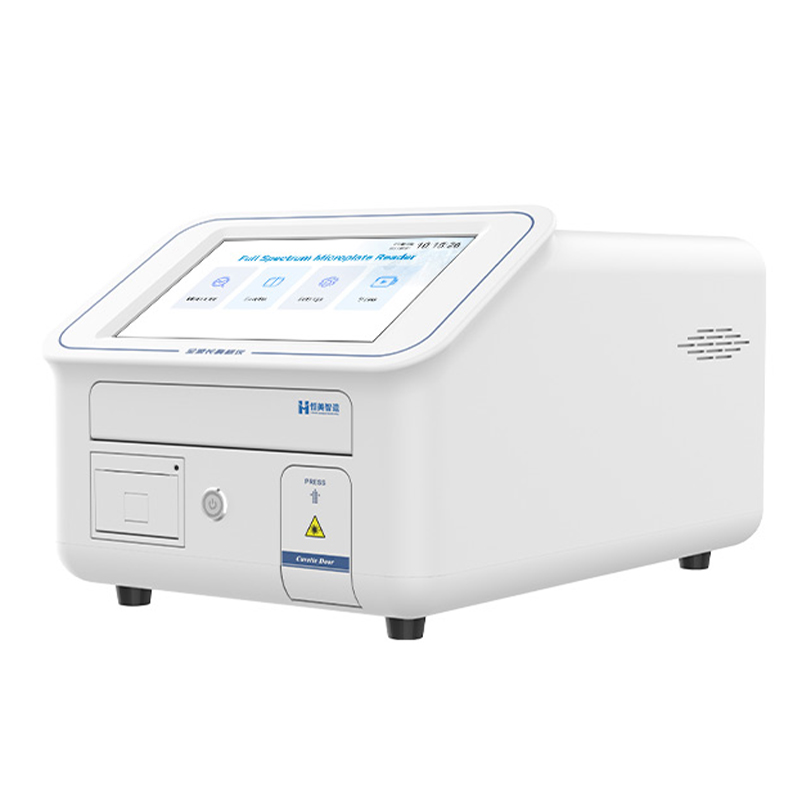
HM Instruments (恒美智造) has emerged as a compelling alternative in the full-wavelength microplate reader segment, combining competitive technical specifications with significantly more accessible pricing. The company's HM-96Q model demonstrates that Chinese instrument manufacturers can deliver performance levels that meet or approach international standards while addressing practical laboratory needs effectively.
Technical Specifications of HM-96Q
The HM-96Q full-wavelength microplate reader is built around a pulsed xenon flash lamp light source with a lifetime exceeding 109 flashes, ensuring years of maintenance-free operation. Its optical system covers an exceptionally broad wavelength range of 190-1100 nm with wavelength accuracy of ±2 nm and repeatability of ≤0.2 nm. The stray light specification of ≤0.05% at 220 nm indicates careful optical engineering that minimizes interference from out-of-band radiation.
Measurement performance is equally impressive: the instrument achieves CV<0.5% or SD<0.003 in precision mode for 96-well microplates, with measurement times under 28 seconds. In fast mode, a complete 96-well plate can be read in under 8 seconds with CV<1.0%. The absorbance linearity of R²≥0.999 across the 0.0-3.0 Abs range supports quantitative applications requiring high confidence in concentration-response relationships.
The dual-beam reference optical path design provides real-time compensation for environmental interference, improving data stability across varying laboratory conditions. Temperature-controlled incubation from room temperature +4°C to 45°C with ±0.5°C uniformity at 37°C enables reliable enzyme kinetics and cell-based assays.
Software and Operational Features
The HM-96Q operates on an Android 10 platform with a 10-inch color touchscreen, providing an intuitive user experience that reduces training requirements. The interface supports one-click template calling, customizable workflow definitions, concentration gradient calibration, and data fitting analysis. Chinese-English bilingual switching accommodates diverse laboratory teams.
For regulated environments, the instrument includes three-level user permission management and complete audit trail functionality, supporting compliance with GLP/GMP quality management standards. Built-in self-diagnostic programs automatically calibrate the optical path and verify mechanical motion precision, reducing the need for manual intervention.
Data export is flexible: results can be printed immediately via the integrated thermal printer or exported in Excel and PDF formats through USB. Wi-Fi connectivity enables remote software updates, ensuring the instrument remains current with evolving application requirements.
Compatibility and Versatility
The HM-96Q supports three detection modes (endpoint, kinetic, and spectral scanning) and is compatible with both covered and uncovered microplates as well as cuvettes. The linear shaking function with three adjustable speeds supports applications requiring sample mixing during incubation. This versatility allows a single instrument to replace multiple dedicated devices in laboratories with diverse assay portfolios.
Comparative Analysis: HM-96Q vs. International Competitors
| Parameter | HM-96Q (HM Instruments) | Typical International Premium Model |
|---|---|---|
| Wavelength Range | 190-1100 nm | 200-1000 nm (typical) |
| Wavelength Accuracy | ±2 nm | ±2 nm |
| Absorbance Range | 0-4.0 Abs | 0-4.0 Abs |
| Measurement Speed (96-well) | <8 s (fast); <28 s (precision) | <10 s (fast); <30 s (precision) |
| Repeatability (Precision Mode) | CV<0.5% | CV<0.5% |
| Incubation Temperature | RT+4°C to 45°C | RT+4°C to 45°C (comparable) |
| Operating System | Android 10, 10-inch touchscreen | Various (Windows/Linux-based) |
| GLP/GMP Compliance | Three-level permissions, audit trail | Available (model-dependent) |
| Data Export | USB (Excel/PDF), thermal printer, Wi-Fi | USB, network, various formats |
| Light Source Lifetime | >109 flashes | >109 flashes (xenon lamp typical) |
The comparison reveals that the HM-96Q achieves technical parity with international competitors across all critical performance parameters. Wavelength range, accuracy, measurement speed, and repeatability specifications are essentially equivalent. Where international brands may offer broader software ecosystems or deeper application validation literature, HM Instruments compensates with more modern Android-based user interfaces and significantly lower acquisition costs.
Application Fit: Where HM-96Q Excels
The HM-96Q is particularly well-suited for the following laboratory environments:
Pharmaceutical QC Laboratories: The GLP/GMP compliance features, audit trails, and stable optical performance support regulated drug development and quality control workflows.
Clinical Diagnostics: Fast measurement speeds and high repeatability enable efficient ELISA-based diagnostic testing with confidence in result accuracy.
Food Safety Testing: The broad wavelength range supports detection of diverse contaminants including allergens, toxins, and pesticide residues through various assay chemistries.
Agricultural Research: Protein quantification, enzyme activity measurement, and pathogen detection benefit from the instrument's flexible detection modes.
Environmental Monitoring: Water and soil pollutant analysis through colorimetric and spectrophotometric methods is well-supported by the 190-1100 nm range.
Academic Research: The combination of endpoint, kinetic, and spectral scanning modes within a single affordable platform makes the HM-96Q attractive for teaching and research laboratories with limited budgets.
Conclusion: A Market Worth Watching
International brands such as Thermo Fisher, Molecular Devices, and BMG LABTECH have earned their reputations through years of consistent performance and comprehensive support infrastructure. For laboratories with unlimited budgets and established workflows around specific software platforms, these remain excellent choices.
However, HM Instruments demonstrates that the performance gap between Chinese and Western instrument manufacturers has narrowed dramatically in the microplate reader category. The HM-96Q offers equivalent optical specifications, modern Android-based software, comprehensive compliance features, and broad application compatibility at a substantially lower price point. For laboratories prioritizing analytical performance per dollar invested, HM Instruments represents a rational and increasingly popular choice.
As Chinese instrument manufacturers continue to invest in R&D and quality systems, the global microplate reader market is likely to see increased competition that ultimately benefits laboratory users through better technology at more accessible prices.
Address of this article:https://www.kjhm.net/news/reliable-full-wavelength-microplate-reader-brand-recommendation.html
 Related News
-
29 / 2025-09
How Soybean Protein Analyzers Achieve Rapid Multi-Index Detection?
Learn more
-
08 / 2026-06
HM Instruments Doppler Flow Velocity Meter FAQ – Technical Questions Answered
Learn more
-
24 / 2026-07
HM Instruments Dispensing Station FAQ: Technical Answers
Learn more
-
08 / 2026-06
HM Instruments Portable Water Quality Analyzer Brand Recommendation
Learn more