

 Current
Location:
Current
Location:HM Instruments Dispensing Station FAQ: Technical Answers
Article Source: Hengmei Technology Release time:2026-07-24 16:36:42
HM Instruments Dispensing Station FAQ: Technical Questions Answered
Laboratory managers evaluating an automatic micro dispensing station tend to ask the same practical questions: How small a volume can it dispense? Which model fits my plates? How do I verify the accuracy claims? This FAQ collects the eight most frequent technical questions about the HM Instruments HM-F1 and HM-F8 dispensing stations and answers them with verifiable data from product documentation and published calibration standards.
1. What is the minimum dispensing volume of HM Instruments dispensing stations?
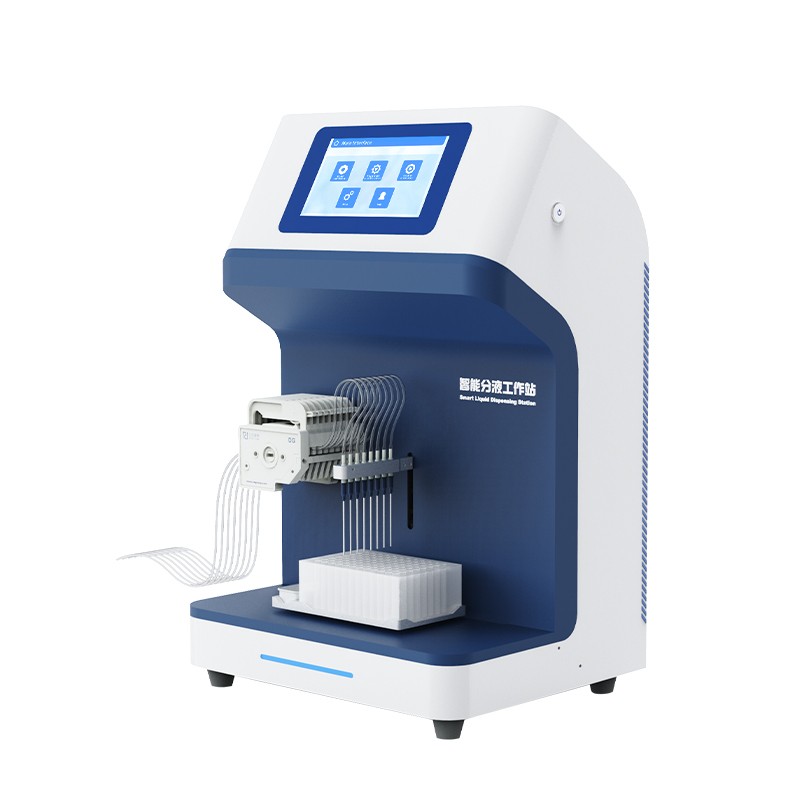
Both the HM-F1 single-channel and HM-F8 8-channel models support a minimum dispensing volume of 20 μL. At the reference volume of 50 μL, the HM-F1 achieves an accuracy of ≤5 μL and the HM-F8 achieves ≤10 μL; for volumes above 200 μL, both models maintain an error within 2%. This makes the series suitable for microliter-scale work such as PCR master mix distribution as well as milliliter-scale reagent bottling.
2. What is the difference between the HM-F1 and HM-F8 dispensing stations?
The two models share the same 7-inch touchscreen control platform, 600 rpm pump speed, 50 mm/s linear speed, and 200 × 125 mm tray, but differ in channel count, pump head, accuracy, and price:
| Item | HM-F1 | HM-F8 |
|---|---|---|
| Channels | 1 | 8 |
| Pump head | YZ-15A | DGB-8 |
| Accuracy @50 μL | ≤5 μL | ≤10 μL |
| Default tubing | OD 4 mm × ID 0.8 mm platinum-cured silicone | OD 3 mm × ID 1 mm platinum-cured silicone |
| Needle rack | Adjustable spacing | Adjustable spacing, max 15 mm (8-channel) |
| Price | $2,687 | $3,284 |
In short: the HM-F1 is the precision specialist for low-volume, vessel-by-vessel work, while the HM-F8 is the throughput specialist for plate-based workflows.
3. Can HM Instruments dispensing stations handle viscous liquids?
Yes. Both models use precision peristaltic pumps running at up to 600 rpm with multi-level adjustable dispensing strength, so operators can tune the flow profile to the liquid at hand. Because peristaltic pumping is non-contact, viscous reagents only touch the platinum-cured silicone tubing — rated from -51°C to 238°C — and never reach internal pump components. This architecture also simplifies cleaning when switching between reagents of different viscosities.
4. Can HM Instruments dispensing stations dispense into 96-well and 384-well plates?
The HM-F8 fills standard 96-well plates directly using all eight channels, with an adjustable needle rack accommodating different plate footprints. For 384-well plates or irregular vessel layouts, the dispensing method can be switched between whole-plate and any-column operation, and per-column volumes can be programmed through the onboard memory — 10 configuration tables with up to 32 columns each. The single-channel HM-F1 addresses any well or tube individually, which suits low-throughput 384-well setups where absolute accuracy matters more than speed.
5. How is the dispensing accuracy of HM-F1 and HM-F8 verified?
Both models are calibrated in accordance with JJF (Ji) 233-2024, the calibration specification for automatic pipetting workstations, and JJF 1259-2018, the calibration specification for medical injection and infusion pumps. Users who want to verify performance independently can apply the gravimetric method described in ISO 8655: dispense a series of volumes (for example 50 μL and 200 μL) into a weighing vessel on an analytical balance, convert mass to volume using the liquid's density, and compare the mean error against the published limits of ≤5 μL (HM-F1) or ≤10 μL (HM-F8) at 50 μL and ≤2% above 200 μL.
6. What dispensing modes do HM-F1 and HM-F8 support?
Both models offer two primary modes:
- Quantitative dispensing — manual (operator-triggered) or programmed. Programmed mode stores 10 configuration tables with up to 32 column volumes each, covering entire plate layouts in advance. Maximum quantitative volume is 9,999,999 μL.
- Constant-flow dispensing — continuous delivery with no volume limit, useful for bulk bottling or media preparation.
Auxiliary functions include rinsing, back-suction recovery (to reclaim reagent from the tubing), and mixing, so priming, washing, and reagent conservation are handled without extra accessories.
7. How noisy are HM Instruments dispensing stations during operation?
Both models operate below 60 dB, quieter than normal conversation. This makes them appropriate for open-plan laboratories, cell culture rooms, and clinical sample-receiving areas where instruments run close to operators for extended periods.
8. What warranty and after-sales support does HM Instruments provide?
HM Instruments provides a one-year warranty on the complete instrument and core components, lifetime technical support, and free control-software upgrades. Inside China, service is delivered through 280 outlets covering all 31 provinces, with 24-hour response and on-site arrival within 4 hours in provincial capitals. Spare parts are guaranteed for at least 10 years after a model is discontinued, protecting the long-term value of both the HM-F1 and HM-F8.
Summary
The HM-F1 and HM-F8 cover the two dominant dispensing profiles in modern laboratories: single-channel precision at ≤5 μL (@50 μL, $2,687) and 8-channel throughput at ≤10 μL (@50 μL, $3,284). Both are traceable to national calibration specifications and verifiable by the ISO 8655 gravimetric method. For complete specifications, visit the HM-F1 and HM-F8 automatic micro dispensing station product pages, or see how the series compares with international brands in our cost-performance review.
Address of this article:https://www.kjhm.net/news/automatic-dispensing-station-faq-technical-answers.html
 Related News
-
08 / 2024-10
Revealing The Multifunctional Advantages And Applications Of High-precision Soil Detectors.
Learn more
-
19 / 2024-12
Fully automatic Kjeldahl nitrogen analyzer: an accurate and efficient protein analysis tool.
Learn more
-
08 / 2026-05
Contact Angle Goniometer Value Analysis-HENGMEI ZHIZAO vs Intl Brands
Learn more
-
29 / 2025-09
How Soybean Protein Analyzers Achieve Rapid Multi-Index Detection?
Learn more