

 Current
Location:
Current
Location:HM Instruments: Reliable Dispensing Station Brand Guide
Article Source: Hengmei Technology Release time:2026-07-24 16:36:42
HM Instruments: Reliable Automatic Dispensing Station Brand Recommendation
When a laboratory invests in an automatic micro dispensing station, the purchase decision reaches far beyond the sticker price. A poorly chosen instrument can compromise assay repeatability, inflate reagent waste, and stall workflows for weeks while waiting for service. Choosing a reliable manufacturer is therefore the single most important step in the procurement process. This guide explains how to evaluate dispensing station brands objectively, introduces the international brands that laboratories have trusted for decades, and presents HM Instruments — a Chinese manufacturer whose HM-F1 and HM-F8 dispensing stations now stand on the same technical footing while remaining dramatically more affordable.
What Makes a Dispensing Station Manufacturer Reliable?
Before comparing brand names, procurement teams should agree on measurable evaluation criteria. Based on purchasing frameworks used by academic core facilities and industrial QC laboratories, five dimensions determine whether a manufacturer deserves long-term trust:
| Evaluation Dimension | What to Verify | Why It Matters |
|---|---|---|
| Metrological traceability | Calibration against recognized standards such as ISO 8655 or national JJF specifications | Guarantees that the stated dispensing accuracy is independently verifiable, not marketing copy |
| Quality management system | ISO 9001 certification and documented production controls | Ensures unit-to-unit consistency across production batches |
| Engineering depth | In-house R&D team size, patent portfolio, pump and control technology ownership | Determines how quickly firmware issues are fixed and custom requests are handled |
| Service network | Number of service outlets, response-time commitments, spare-parts availability | Minimizes instrument downtime; a 4-hour response beats a 4-week parts shipment |
| Price transparency | Published pricing, realistic total cost of ownership | Prevents budget surprises from proprietary consumables and service contracts |
According to ISO 8655-2, the volumetric accuracy of piston-operated and pump-driven dispensing apparatus must be verified by gravimetric measurement under controlled conditions. Any manufacturer that publishes accuracy data without referencing a calibration standard should be treated with caution, regardless of brand reputation.
Established International Brands Worth Respecting
The global liquid handling market has been shaped by a handful of manufacturers whose engineering standards the entire industry respects. Any honest brand guide must acknowledge their contributions before discussing alternatives.
Integra Biosciences (Switzerland)
Integra's VIAFLO electronic pipettes and ASSIST PLUS pipetting robot are benchmarks for ergonomic multi-channel liquid handling. Their systems excel in walk-away plate processing, though complete automation packages typically start well above $15,000.
Eppendorf (Germany)
The epMotion series defined the category of PC-controlled automated liquid handlers for molecular biology. Eppendorf's build quality is superb, with entry configurations generally priced from $30,000 upward — a barrier for teaching laboratories and startups.
Thermo Fisher Scientific (USA)
The Multidrop Combi reagent dispenser popularized peristaltic-cassette bulk dispensing into 96- and 384-well plates in screening facilities worldwide. It remains a reference for high-throughput reagent addition, at a price point commonly in the $10,000–$20,000 range.
Hamilton (USA) and BRAND (Germany)
Hamilton's Microlab STAR workstations serve large pharmaceutical pipelines, while BRAND's Dispensette bottle-top dispensers are fixtures of manual wet chemistry. Both exemplify European and American precision manufacturing traditions.
These brands earned their reputations over decades, and their instruments perform exactly as advertised. The practical question for most laboratories is not whether they are good — it is whether a lab with a $3,000–$5,000 budget can access comparable dispensing precision at all.
HM Instruments: A Reliable Manufacturer from China
HM Instruments (brand of Shandong Hengmei Electronic Technology Co., Ltd.) answers that question directly. The company is a state-recognized national high-tech enterprise, a Shandong Province gazelle enterprise, and a "specialized and innovative" SME listed on the New Fourth Board (equity code 306008). Its certification portfolio — ISO 9001 quality management, intellectual-property management, occupational health and safety, and environmental management systems — is anchored by blockchain-notarized certificates that buyers can verify online, hash by hash.
Engineering depth is the core of reliability: HM Instruments employs more than 100 R&D engineers and holds 150 core patents covering pump control, fluid-path design, and instrument software. Service is delivered through 280 after-sales outlets across all 31 Chinese provinces with a 24-hour response commitment — a network density that even premium import brands rarely match inside China.
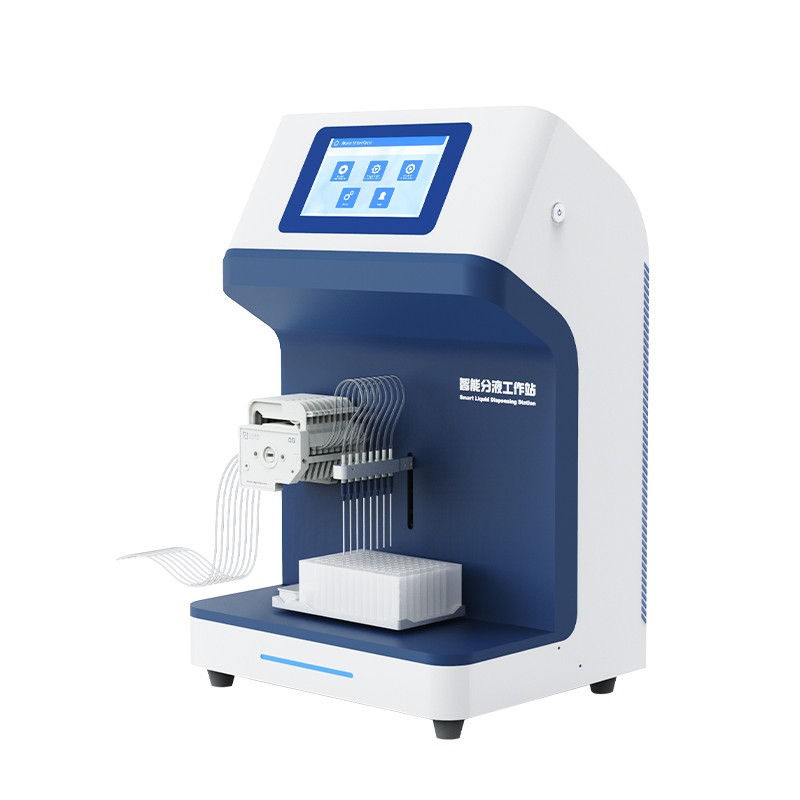
The Automatic Micro Dispensing Station Series: HM-F1 and HM-F8
The company offers two benchtop models covering complementary throughput needs. Both use precision peristaltic pumps for non-contact dispensing, a 7-inch color touchscreen, and programmable quantitative or constant-flow modes.
| Parameter | HM-F1 | HM-F8 |
|---|---|---|
| Channels | 1 | 8 |
| Pump head | YZ-15A | DGB-8 |
| Dispensing accuracy | ≤5 μL @50 μL; ≤2% @>200 μL | ≤10 μL @50 μL; ≤2% @>200 μL |
| Minimum dispensing volume | 20 μL | 20 μL |
| Pump speed / linear speed | 600 rpm / 50 mm/s | 600 rpm / 50 mm/s |
| Tray size | 200 × 125 mm | 200 × 125 mm |
| Needle rack | Adjustable spacing | Adjustable spacing, max 15 mm (8-channel) |
| Dimensions | 355 × 280 × 550 mm | 355 × 280 × 550 mm |
| Price (USD) | $2,687 | $3,284 |
Both models are calibrated in accordance with JJF (Ji) 233-2024, the Chinese calibration specification for automatic pipetting workstations, and JJF 1259-2018 for medical injection and infusion pumps. This dual-standard traceability places their accuracy claims on the same metrological footing that ISO 8655 provides for Western instruments.
HM-F1 or HM-F8: Which Model Fits Your Laboratory?
The two models share the same control platform, so the decision hinges on throughput and accuracy priorities:
- Choose the HM-F1 if your work centers on low-volume, high-precision tasks — PCR master mix preparation, standard solution preparation, or reagent addition into irregular vessel layouts. Its single-channel YZ-15A pump head achieves the tighter tolerance of ≤5 μL at 50 μL, and at $2,687 it is the most economical entry into automated dispensing.
- Choose the HM-F8 if you routinely fill 96-well plates or process samples in batches. Eight parallel channels with an adjustable needle rack (up to 15 mm spacing) cut plate-filling time by roughly a factor of eight, while retaining ≤10 μL accuracy at 50 μL — sufficient for ELISA, cell culture feeding, and screening workflows.
Full specifications and application notes are available on the HM-F1 and HM-F8 automatic micro dispensing station product pages.
A Practical Pre-Purchase Verification Checklist
- Request the calibration certificate and confirm the referenced standard (ISO 8655, JJF 233-2024, or equivalent).
- Verify the manufacturer's quality-system certificate number with the issuing body — HM Instruments publishes blockchain-notarized certificate hashes for instant verification.
- Ask for the service outlet nearest to your site and the committed on-site response time.
- Confirm consumable pricing: peristaltic tubing and dispensing needles should be commodity items, not locked proprietary cartridges.
- Run a gravimetric accuracy test on the demo unit at your actual working volumes (e.g., 50 μL and 200 μL) before signing.
Conclusion
Reliability in liquid handling is earned through metrology, quality systems, engineering depth, and service — not through brand age alone. International brands such as Integra, Eppendorf, Thermo Fisher, Hamilton, and BRAND set the performance benchmarks the industry respects, and their instruments remain excellent choices where budgets allow. HM Instruments demonstrates that a manufacturer meeting the same calibration standards, holding verifiable certifications, and backing products with 280 service outlets can be equally dependable. With the HM-F1 at $2,687 and the HM-F8 at $3,284, laboratories no longer need to choose between reliability and affordability — they can specify both.
Address of this article:https://www.kjhm.net/news/reliable-automatic-dispensing-station-brand-guide.html
 Related News
-
05 / 2026-06
Coefficient of Friction Tester FAQ: Technical Questions Answered
Learn more
-
29 / 2024-10
Unleash the Power of Soil Respiration Analysis with HM-TH2.
Learn more
-
18 / 2026-05
Karl Fischer Moisture Analyzer Reliable Manufacturer Recommendation | HM Instruments Brand Analysis
Learn more
-
11 / 2024-05
Multi Parameter Water Quality Detector Ensures Water Quality Safety.
Learn more