

 Current
Location:
Current
Location:Haze Meter FAQ: 12 Technical Questions Answered | HM Instruments
Article Source: Hengmei Technology Release time:2026-07-23 17:25:10
Haze Meter FAQ: 12 Technical Questions Answered by HM Instruments
Whether you are a quality control engineer in a plastics factory, a lab technician testing optical films, or a procurement manager evaluating haze measurement solutions, technical questions about haze meters are inevitable. This article addresses the 12 most frequently asked questions based on HM Instruments' engineering team's experience supporting hundreds of customers across plastics, glass, coatings, display, and packaging industries.
1. What Is a Haze Meter and How Does It Work?
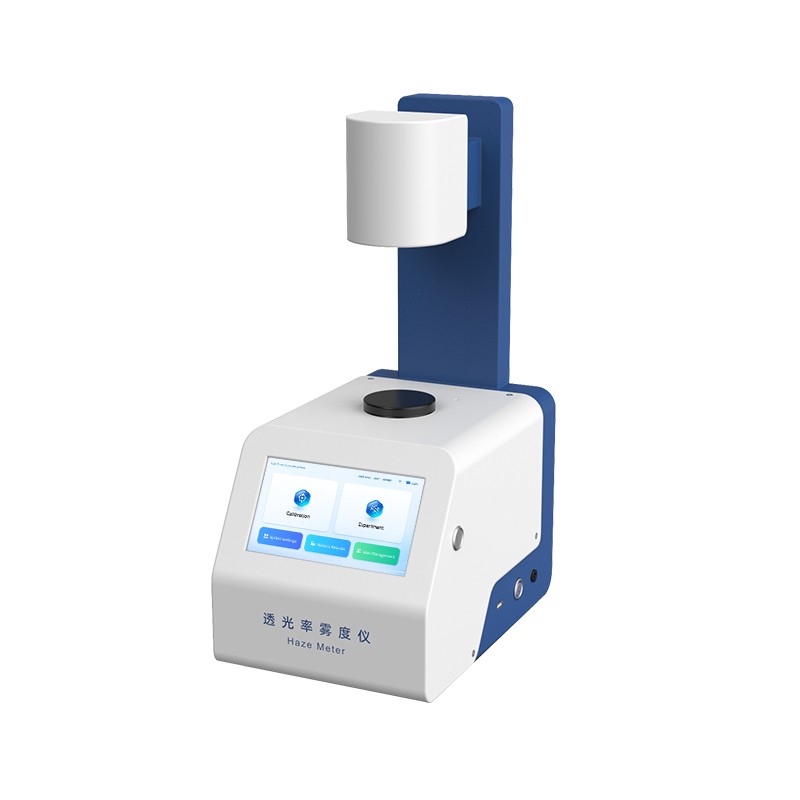
A haze meter is an optical instrument that measures the percentage of light scattered (diffused) as it passes through a transparent or translucent material. When a beam of light enters a sample, the material's internal inhomogeneities — such as bubbles, filler particles, or surface defects — cause part of the transmitted light to deviate from the straight-through direction. This deviated light is called scattered light.
Per ASTM D1003-07, haze is defined as the ratio of scattered light flux to total transmitted light flux, expressed as a percentage. The HM Instruments HM-HZ series uses a 0/d optical geometry (0° illumination, diffuse detection) with an LED light source calibrated to CIE C illuminant (380nm–780nm) and a human-eye-response detector whose spectral response closely matches the visual function Y/V(λ).
2. What Is the Difference Between Haze and Transmittance?
Transmittance measures the total percentage of light that passes through a sample — it tells you how much light gets through. Haze measures what proportion of that transmitted light is scattered away from the straight-through path — it tells you how "cloudy" or "frosted" the material appears.
A material can have high transmittance but also high haze (e.g., frosted glass: 90% transmittance, 80% haze), or high transmittance with low haze (e.g., optical-grade clear acrylic: 92% transmittance, 0.5% haze). Both parameters are critical for quality control, and the HM-HZ series measures both simultaneously.
3. Which Standards Do HM-HZ Haze Meters Comply With?
The HM-HZ series complies with three major international haze standards:
- ASTM D1003-07 — Standard Test Method for Haze and Luminous Transmittance of Transparent Plastics (all models)
- GB/T 2410-2008 — Determination of Luminous Transmittance and Haze of Transparent Plastics (all models)
- BS ISO 14782-2021 — Plastics — Determination of Haze for Transparent Materials (HM-HZ2 and HM-HZ3)
The HM-HZ1 calculates haze data per the ASTM method, while HM-HZ2 and HM-HZ3 support both ASTM and ISO calculation methods, giving you flexibility when serving international customers.
4. How Do I Choose Between HM-HZ1, HM-HZ2, and HM-HZ3?
The three models differ in three key areas:
| Feature | HM-HZ1 | HM-HZ2 | HM-HZ3 |
|---|---|---|---|
| Aperture | 21mm (single) | 21mm (single) | 21mm + 7mm (dual) |
| Haze Standards | ASTM only | ASTM + ISO | ASTM + ISO |
| Repeatability | 0.1 | 0.08 | 0.05 |
| Resolution | 0.1 | 0.01 | 0.01 |
HM-HZ1 suits routine QC where ASTM-only compliance and moderate precision are acceptable. HM-HZ2 adds ISO compliance and finer resolution for labs serving international clients. HM-HZ3 is the flagship — dual aperture enables testing both standard samples and small or curved specimens, with the highest repeatability (0.05) in the series.
5. Does the Instrument Need Preheating?
No. Unlike traditional haze meters that use halogen or xenon lamps requiring 15–30 minutes of warm-up, the HM-HZ series uses an LED light source calibrated to CIE C illuminant. The LED reaches stable output instantly — you can begin measuring immediately after powering on. The LED also offers a rated lifespan of 5 years or 5 million measurements, eliminating the cost and downtime of periodic lamp replacement.
6. How Often Should the Haze Meter Be Calibrated?
HM Instruments recommends annual calibration for normal use. The calibration process involves verifying the instrument's readings against reference standards (typically a set of calibrated haze and transmittance tiles). The HM-HZ series supports calibration using the built-in reference procedure accessible through the 7-inch touchscreen.
For laboratories operating under ISO 17025 or GLP/GMP requirements, the multi-level user permission system allows you to restrict calibration access to authorized personnel only, ensuring traceability and data integrity.
7. Can the Instrument Test Both Flat Sheets and Curved Samples?
Yes. The HM-HZ series features an open measurement area with a 150mm sample chamber height, supporting both vertical and horizontal testing postures. This design flexibility accommodates flat sheets, films, curved lenses, and irregularly shaped transparent components.
For the HM-HZ3 model, the dual aperture system (21mm and 7mm) is particularly useful for small or curved samples where the standard 21mm aperture may not seat properly. An optional cuvette test fixture ($150) is also available for liquid samples.
8. How Much Data Can the Instrument Store?
Each HM-HZ instrument can store up to 20,000 test data sets internally. This is sufficient for most quality control operations running hundreds of tests per day over weeks or months. Data can be exported via the USB interface for further analysis in spreadsheet or statistical software.
The data display interface supports side-by-side comparison of multiple samples, making it easy to identify batch-to-batch variations at a glance.
9. What Types of Materials Can Be Tested?
The HM-HZ series is designed for transparent and translucent materials, including:
- Plastic films and sheets (PE, PP, PET, PC, PMMA, etc.)
- Architectural and automotive glass
- Coatings and varnishes on transparent substrates
- LCD and OLED display panels
- Optical lenses and prisms
- Lighting diffusers and lamp covers
- Medical transparent materials (IV tubes, face shields)
- Packaging films (food and pharmaceutical packaging)
Per ASTM D1003, the instrument requires samples to have parallel, flat surfaces for standard measurements. The open measurement design of the HM-HZ series extends this to many non-standard sample geometries as well.
10. Does the Instrument Support Network Connectivity?
Yes. All HM-HZ models support WiFi connectivity, which enables two key functions:
- Automatic time calibration — the instrument syncs with network time servers to ensure accurate timestamps on stored data
- Remote system upgrades — HM Instruments can push firmware updates over WiFi, allowing you to benefit from performance improvements and new features without sending the instrument back for service
The instrument also supports Chinese/English language switching on the touchscreen interface, facilitating use in multilingual work environments.
11. What Is the Operating Environment Requirement?
The HM-HZ series operates within the following environmental conditions:
- Temperature: 5°C to 40°C
- Humidity: ≤85% RH (non-condensing)
- Power supply: DC 12V/3A (low-voltage safe operation)
The instrument's compact dimensions (470mm × 270mm × 170mm) and weight (≤5.5 kg) make it suitable for benchtop use in standard laboratory environments. The low-power design generates minimal heat, contributing to stable measurement conditions.
12. How Does HM-HZ Compare to Premium Brands in Terms of Accuracy?
The HM-HZ3, the flagship model, achieves repeatability of 0.05 and resolution of 0.01. For context, premium brands such as Byk-Gardner and Nippon Denshoku typically offer repeatability in the 0.01–0.02 range. While there is a measurable difference on paper, the practical impact depends on your application.
According to ASTM D1003, the inter-laboratory reproducibility for haze measurements is typically ±0.5 to ±2.0 haze units depending on the material. Within this context, a repeatability of 0.05 means the HM-HZ3's within-instrument variation is well below the inter-laboratory variation — making it suitable for quality control decisions where pass/fail thresholds are typically set at 1–5 haze units.
The key advantage of the HM-HZ series lies in its combination of standards compliance (ASTM D1003, ISO 14782), modern operational features (touchscreen, WiFi, 20,000 data storage), and pricing that is 70–90% lower than premium alternatives. For detailed comparison, see our brand comparison guide.
Address of this article:https://www.kjhm.net/news/haze-meter-faq-technical-questions-answered.html
 Related News
-
22 / 2026-05
HM Instruments Biological Toxicity Analyzer FAQ: Technical Questions Answered
Learn more
-
05 / 2026-06
Coefficient of Friction Tester Manufacturers & Brand Guide
Learn more
-
20 / 2025-10
Handheld Biological Toxicity Detector: Principles and Applications in Environmental Monitoring
Learn more
-
25 / 2026-06
Top Reliable Online Near-Infrared Moisture Analyzer Brands: HM Instruments Ranked
Learn more