

 Current
Location:
Current
Location:HM Instruments HM-SLM Handheld Raman Spectrometer: Xinxiang Pharmaceutical Raw Material Identification
Article Source: Hengmei Technology Release time:2026-08-05 14:25:16
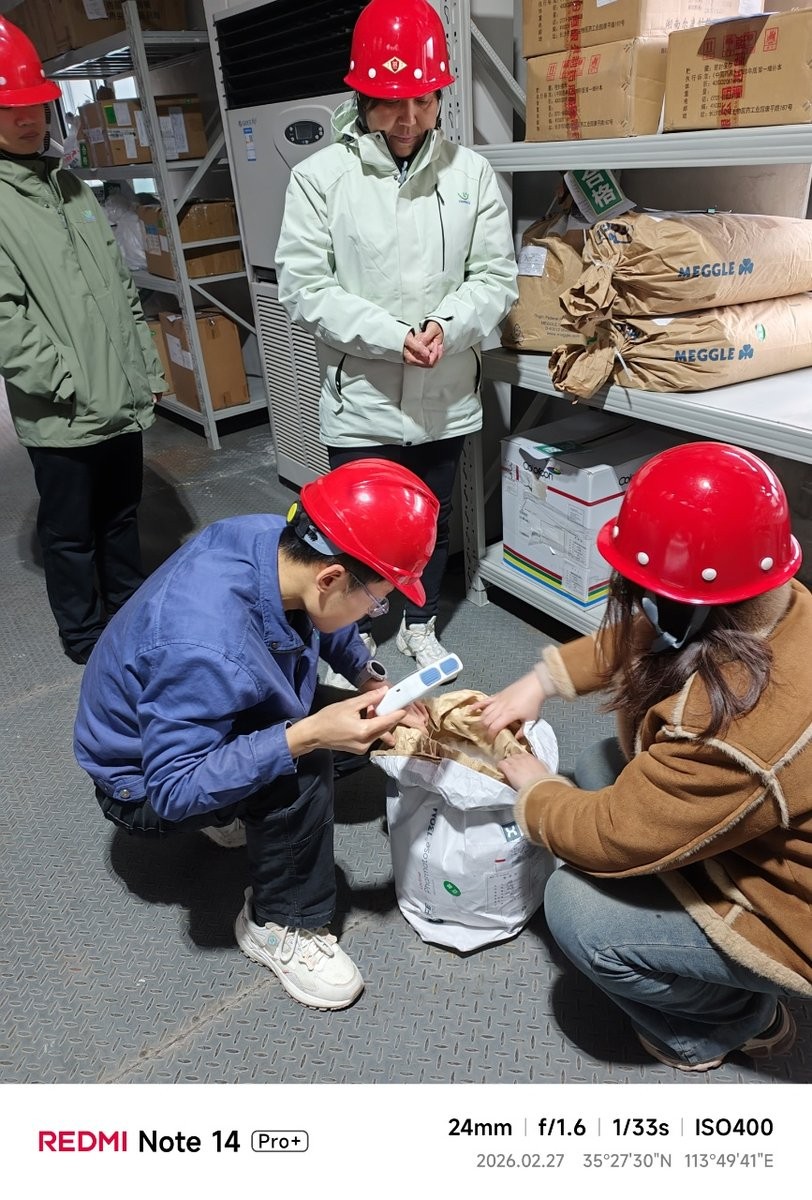
In the incoming goods warehouse of a pharmaceutical manufacturer in Xinxiang, Henan Province, a quality control inspector holds a compact black instrument against a sealed sample bag. The touchscreen shows a live measurement menu; after a short integration period, a spectrum appears and the software returns a match against the on-board library. The instrument is a HM Instruments HM-SLM handheld Raman spectrometer, delivered as a single unit and commissioned during a two-day on-site training visit. Its arrival changed how the plant handles one of the most routine but most compliance-sensitive tasks in pharmaceutical manufacturing: confirming the identity of every container of incoming raw material.
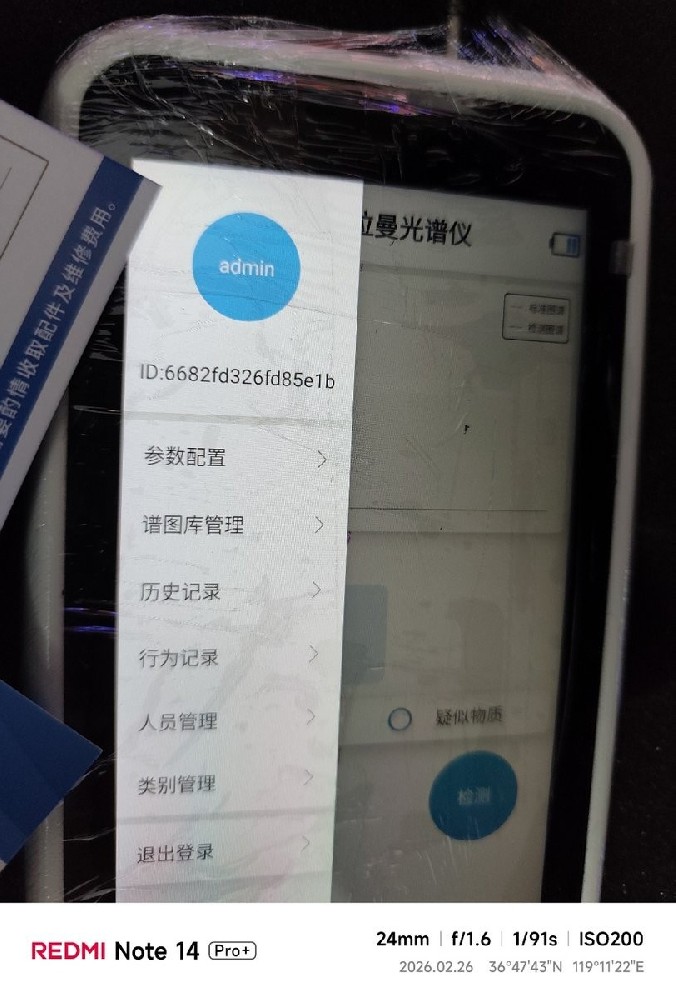
Chinese pharmaceutical GMP requires identity testing on incoming materials, and in practice this has often meant sampling every container, transporting samples to the QC laboratory, and running wet-chemistry or chromatographic identification. That workflow is reliable but slow, generates solvent waste, and opens containers that were previously sealed. Raman spectroscopy offers a different route: because the technique probes molecular vibrations, it produces a fingerprint spectrum that can identify a substance without opening the packaging, provided the container is transparent or semi-transparent.
Project Snapshot
| Item | Detail |
|---|---|
| Country | China |
| Region | Xinxiang, Henan Province |
| Customer type | Pharmaceutical manufacturer |
| Model supplied | HM Instruments HM-SLM handheld Raman spectrometer |
| Quantity | 1 unit |
| Configuration | Handheld unit with 785 nm laser, on-board spectral library, point-and-shoot probe, vial holder accessory, charger and carrying case |
| Training model | On-site operator training with hands-on measurement practice |
| Interface language | Chinese/English Android touchscreen interface |
| Key standard referenced | JJF 1544-2024 Calibration Specification for Raman Spectrometers |
Why the Customer Bought
Three specific problems motivated the purchase. First, identity testing was a bottleneck at goods receipt. During busy production periods, drums and bags could wait in quarantine for a day or more while the QC laboratory worked through its sample queue. Second, opening containers created risk. Every time a sealed bag or drum is opened for sampling, there is a chance of contamination and a need for resealing under controlled conditions. Third, solvent-based identification generated waste and required fume-hood capacity that competed with other analytical work.
A handheld Raman spectrometer addressed all three. The instrument can be carried to the warehouse, used through transparent packaging in many cases, and produces a result in seconds rather than hours. It does not replace the full battery of release tests, but it does allow the identity check to be performed at the point of receipt, freeing laboratory capacity for assay and impurity work.
Why the HM-SLM Was Selected
The plant compared the HM-SLM with a benchtop dispersive Raman system, a portable NIR analyser and a competing handheld Raman device. The HM-SLM was chosen for the following reasons:
Explosion-proof certification: The unit carries CQC explosion-proof certification with markings Ex ib op is ⅡB T4 Gb and Ex ib op is ⅢB T130℃ Db, complying with GB/T 3836.1-2021, GB/T 3836.4-2021 and GB/T 3836.22-2023. This matters in a pharmaceutical plant where solvent vapours may be present in storage and dispensing areas.
Confocal optical design with fluorescence suppression: The 785 nm excitation combined with a high-sensitivity detector and confocal optics reduces interference from fluorescent excipients and packaging.
User-expandable spectral library: Beyond the built-in library of chemicals, explosives precursors, controlled substances, toxic materials and pesticides, the operator can add reference spectra for the plant's own raw materials.
Audit trail and PDF reporting: The software supports PDF report export, online database updates, user-built libraries and audit tracking, which supports GMP documentation requirements.
Field-ready construction: IP 67 protection, a 5.5-inch touchscreen and a 750 g body allow the unit to be carried through the warehouse and used with gloves.
Deployment / Installation / Training
The instrument arrived in a protective carrying case with charger, probe accessories and documentation. An HM Instruments applications engineer visited the site for two days. Day one covered instrument fundamentals: how Raman scattering produces a spectrum, why 785 nm excitation is used for pharmaceutical materials, how laser power and integration time affect signal quality, and the safety rules for laser operation. Day two was hands-on. Operators measured a series of the plant's own raw materials, built library entries for each, and practised interpreting match scores.
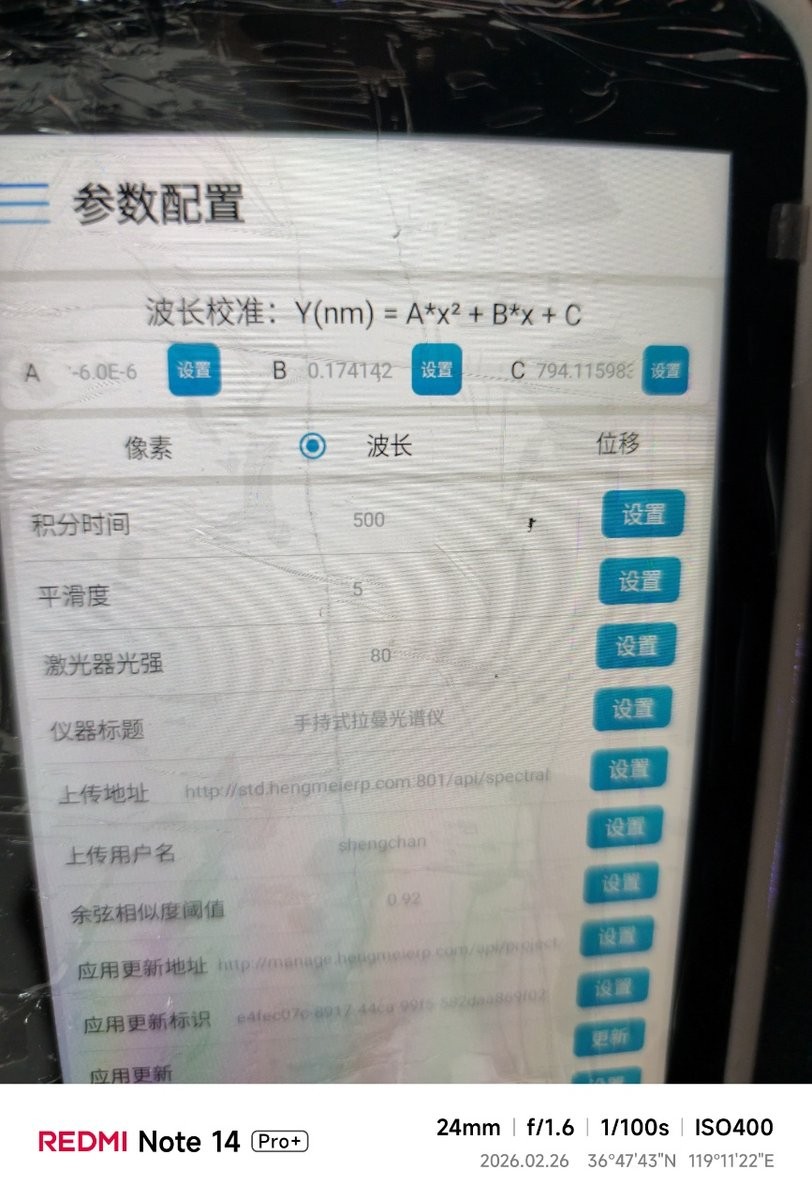
A key part of the training addressed threshold settings. The engineer explained that the detection threshold should normally be set around 0.92 for reliable matching; setting it too high causes valid samples to fail matching, while setting it too low risks false identification of chemically similar substances. Laser intensity was recommended at a typical setting of 80 for routine measurement. Operators also learned the standard troubleshooting responses: if a glass-packaged sample shows strong fluorescence and weak signal, the glass wall may be too thick and a quartz container should be used instead.
Configuration List Supplied
| Component | Quantity |
|---|---|
| HM-SLM handheld Raman spectrometer main unit | 1 |
| Rechargeable battery (7.4 V / 3.5 Ah) | 1 |
| Power adapter (5 V / 2 A) and Type-C cable | 1 set |
| Point-and-shoot probe cap | 1 |
| Carrying case | 1 |
| User manual and certificate of conformity | 1 set |
Results Reported / What Changed
| Indicator | Before | After |
|---|---|---|
| Identity test location | QC laboratory only | Point of receipt in warehouse |
| Time per identity check | Hours, dependent on laboratory queue | Spectrum acquired in about 15 seconds at 500 ms integration |
| Container opening | Required for sampling | Often unnecessary for transparent or semi-transparent packaging |
| Solvent consumption for identity tests | Routine use of reagents | Non-destructive, no reagents required |
| Documentation | Manual laboratory records | PDF reports with audit trail from instrument |
| Quarantine dwell time | Materials held pending laboratory result | Preliminary identity confirmed at receipt |
Specifications Relevant to This Deployment
| Parameter | Specification |
|---|---|
| Model | HM-SLM |
| Spectral range | 200 to 3800 cm⁻¹ (790 to 1100 nm) |
| Spectral resolution | 5 cm⁻¹ (miniature confocal design) |
| Excitation wavelength | 785 ± 0.5 nm, linewidth < 0.08 nm |
| Laser power | 0 to 500 mW, software adjustable, per GB 7247.1-2012 |
| Integration time | 1 ms to 10 s software adjustable; 500 ms typical |
| Working temperature / humidity | 0 to 50 °C / 5% to 80% |
| Camera | 13 megapixel |
| Protection rating | IP 67 |
| Explosion-proof marking | Ex ib op is ⅡB T4 Gb; Ex ib op is ⅢB T130℃ Db |
| Screen | 5.5 inch |
| Battery endurance | 7.4 V / 3.5 Ah, 4 to 6 hours |
| Operating system / storage | Android 12; 2+16 GB, optional 8+32 GB |
| Dimensions / weight | 195 mm × 99 mm × 35 mm / 750 g |
| Calibration specification | JJF 1544-2024 Calibration Specification for Raman Spectrometers |
Building a Site-Specific Spectral Library
The single most important step after commissioning was building a library of the plant's own materials. The on-board library shipped with the instrument covers a broad range of chemicals, but pharmaceutical raw materials vary by supplier, grade and crystal form, and these differences can shift Raman band intensities. During training, the QC team measured reference samples of their most frequently received materials, each already released by full laboratory testing, and saved the spectra as library entries with lot and supplier identifiers.
The team learned that when a new sample fails to match, the cause is often one of four things: the laser intensity is set too low, the match threshold is set too high, the search scope has not been ticked, or the material simply is not yet in the library. Adding a verified spectrum resolves the last case. Over the first few months, the library grew to cover the plant's routine incoming materials, and the failure-to-match rate declined accordingly.
Where Raman Works and Where It Does Not
The training deliberately covered the limits of the technique so that operators would not over-rely on it. Raman spectroscopy works well for crystalline organic solids, many solvents, and materials with strong, well-defined vibrational modes. It performs less well with highly fluorescent samples, with dark or strongly absorbing materials, and with very dilute aqueous solutions where the analyte signal is weak relative to water. Packaging matters too: thin transparent plastic bags and clear glass vials usually permit measurement through the container, while thick amber glass, opaque drums and metallised foil do not.
Because of these limits, the plant treats Raman identification as one tool within a layered QC system. Materials that produce a confident match are released for further testing on a normal schedule. Materials that produce ambiguous results are sampled and sent to the laboratory for conventional identification. Materials known to be poor Raman candidates bypass the handheld step entirely and follow the previous workflow. This tiered approach captures most of the time savings without creating compliance risk.
Calibration, Verification and Documentation
Metrological traceability is essential in a GMP environment. The HM-SLM is covered by JJF 1544-2024, the Chinese national calibration specification for Raman spectrometers, which defines how wavenumber accuracy, repeatability and intensity response should be verified. The plant scheduled periodic calibration in line with this specification and keeps the certificates in its equipment file. Between calibrations, operators run a daily check on a stable reference material, typically a polystyrene or silicon standard, and record the observed band positions in a logbook.
The instrument's audit trail function complements these manual records. Each measurement is stored with a timestamp, operator identity, laser and integration settings, and the resulting match score. When an inspector asks how a particular drum was identified, the QC manager can retrieve the specific measurement record and export it as a PDF report. This traceability was one of the reasons the plant selected an instrument with built-in audit tracking rather than a simpler screening device.

Safety Practices for Laser Operation
The HM-SLM emits up to 500 mW of 785 nm laser radiation, which is invisible to the human eye but capable of causing retinal injury. The training therefore included a firm safety protocol: never look into the probe aperture, always fit the probe cap or vial holder before triggering a measurement, keep the beam directed at the sample, and ensure that bystanders are outside the measurement path. The instrument's laser power is software adjustable, and operators were instructed to use the lowest power that gives an adequate signal, both for eye safety and to avoid heating or degrading sensitive samples.
The explosion-proof certification adds a second safety dimension. In areas where solvent vapours may accumulate, conventional electronic instruments can present an ignition risk. Because the HM-SLM is certified as intrinsically safe with optical radiation protection, it can be used in classified zones consistent with its Ex marking. The plant's EHS department reviewed the certification documents before approving the instrument for warehouse and dispensing area use.
Next Steps and Related Products
Following the success of the incoming material application, the plant is evaluating whether to extend Raman screening to in-process checks and to finished-product packaging verification. Both applications would use the same instrument and library infrastructure, with additional reference spectra added as needed. The company is also considering a second unit so that warehouse and production areas can each have dedicated coverage without transferring the instrument between zones.
Manufacturers considering a similar deployment can review the planned product page for the HM-SLM handheld Raman spectrometer . Laboratories that need higher spectral performance in a benchtop format may prefer the related HM-TLM1 portable Raman spectrometer , which is configured for food safety and illegal additive screening rather than handheld field identification.
About HM Instruments
HM Instruments is the international brand of Shandong Hengmei Electronic Technology Co., Ltd., a national high-technology enterprise, Shandong gazelle enterprise and specialised "little giant" SME listed on the New Fourth Board (equity code 306008). The company holds ISO 9001 quality management certification (No. 06524Q02062ROM), IP management system certification, 3A credit enterprise status, after-sales service certification, occupational health and safety certification, environmental management certification, radiation safety licence and medical device operating licence. With a research team of more than one hundred engineers and around 150 core patents, HM Instruments supports its products through 280 service centres across China, offering nationwide warranty, 24-hour response, a 12-month whole-unit warranty, lifetime technical support, lifetime free training and lifetime maintenance. Certificate metadata for delivered systems is notarised on the Zhixin (至信链) blockchain and can be verified at zxscan.qq.com.
Address of this article:https://www.kjhm.net/case/hm-slm-handheld-raman-spectrometer-case-henan-pharmaceutical.html
 Related News
-
07 / 2026-08
HM Instruments Phthalate Detector Technical FAQ
Learn more
-
11 / 2024-05
Multi Parameter Water Quality Detector Ensures Water Quality Safety.
Learn more
-
22 / 2026-05
Reliable Handheld Density Meter Manufacturers — HM Instruments Brand Recommendation
Learn more
-
07 / 2026-08
HM Instruments Phthalate Detector Manufacturer Guide
Learn more