

 Current
Location:
Current
Location:HM-GT5 Soil Nutrient Analyzer: Indonesian Distributor Partnership Case Study
Article Source: Hengmei Technology Release time:2026-08-03 16:21:37
HM Instruments HM-GT5 Soil Nutrient Analyzer: An Indonesian Distributor Partnership
Indonesia is the world's largest palm oil producer, and plantation nutrition there is managed at a scale where a small error in fertilizer rate multiplies across tens of thousands of hectares. Add intensive horticulture on Java and rice systems across the archipelago, and the demand for soil nutrient measurement is obvious. What is not obvious is how to supply and service that equipment across thousands of islands — which is exactly the problem the distributor in this case study came to discuss in person.
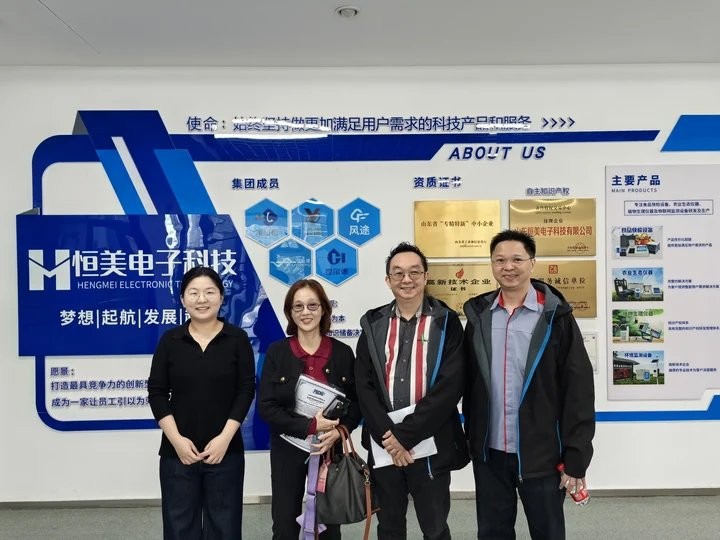
The visit ended with a dealership arrangement built around the HM-GT5 soil nutrient analyzer from HM Instruments as the lead model. This case study is organised as the five questions he asked, and the answers that decided the partnership.
Question 1: Which model fits plantation and horticulture customers?
Answer: the eight-channel rotating-cuvette configuration. Plantation and estate customers sample by block and process a set of samples in one session, so eight parallel channels match the working pattern — a technician completes one three-parameter soil sample in about twenty minutes including preparation, three samples in under forty minutes and eight samples within an hour.
The rotating cuvette design (patent ZL 2018 2 1777724.7) matters more in a commercial setting than buyers expect: every cuvette is presented to the same optical path, so results do not vary with which technician loaded the carousel. For a distributor whose customers rotate staff, this reduces the number of "the instrument is wrong" calls that are really operator variation.
Question 2: Can one instrument cover everything my customers ask about?
Answer: soil, fertilizer, crop tissue, produce and water, on the same platform. Standard reagents cover nitrogen, phosphorus, potassium and organic matter; further parameters are added as optional reagent sets rather than as additional instruments.
| Matrix | Available parameters | Customer question it answers |
|---|---|---|
| Soil | Ammonium N, available P, available K, nitrate N, hydrolysable N, total N/P/K, organic matter, total organic carbon, C:N ratio, pH, salinity, moisture; micronutrients Ca, Mg, S, Si, B, Fe, Cu, Mn, Zn, Cl, Mo; heavy metals Pb, As, Cd, Cr, Hg, Ni, Al, F, Ti, Se | What does this block actually need? |
| Fertilizer | Straight, compound, organic, water-soluble and foliar fertilizer N/P/K; humic acid fractions; fertilizer micronutrients and heavy metals | Does the delivered product match its declaration? |
| Fresh crop and dry plant tissue | Nitrate N, ammonium N, P, K, micronutrients, nitrite; plant total N, P, K | Is the crop taking up what we applied? |
| Produce | Nitrate, nitrite, heavy metals | Is this batch acceptable to the buyer? |
| Water | Ammonium N, P, K, nitrate, nitrite, hardness, pH, Fe, Cu, Mn, Zn, B, Cl, S, Si, Mo | Is the irrigation source contributing or causing problems? |
Fertilizer verification proved to be the strongest opening argument with estate customers. Where a purchase order covers hundreds of tonnes of compound fertilizer, in-house confirmation of nutrient content — single parameter accuracy ≤0.5%, three-parameter NPK ≤1% — is a commercial control, not a laboratory curiosity.
Question 3: What happens when a unit fails on an island two flights away?
Answer: the failure modes are designed to be locally serviceable, and the parts exist. The distributor's engineers are trained to handle the first line themselves — consumable replacement, print head and paper, battery pack, cable sets, calibration checks — because these account for most support calls. Genuine module-level faults are shipped against a stocked parts inventory, and the factory commitment is parts supply for at least ten years after a model is discontinued, at stable prices, all original factory items.
The instrument itself is built for transport: a high-strength PVC engineering-plastic case rated IP65, 48 × 34.5 × 22 cm, 5.2 kg net, packed at 510 × 390 × 375 mm and 11.5 kg. The four-wavelength cold light source is rated at roughly 100,000 hours with no thermal drift during continuous work, which removes lamp replacement from the routine service list. Power input accepts AC 220 ± 22 V or DC 12 V + 5 V at ≤5 W, and the internal lithium battery runs more than ten hours — useful where estate power is generator-based.
Question 4: How do reagents reach customers reliably?
Answer: consolidated seasonal shipments held as distributor stock. This was the point the distributor pressed hardest, and correctly — an installed base without reagents is an installed base of paperweights.
The agreed model is that the distributor holds buffer stock of the NPK and organic matter reagent sets plus consumables (cuvettes, qualitative filter paper, droppers, glass and plastic test tubes, conical flasks, measuring cylinders, tube racks, brushes, wash bottles, weighing spoons) and replenishes on a seasonal cycle rather than order by order. One consolidated import clears customs once; forty individual parcels do not. Customers supply only purified water locally.
Question 5: What documentation will a corporate or tender buyer demand?
Answer: an evidence pack, prepared before the first sales call. Estate groups and public buyers ask for the basis of the numbers, not the numbers themselves. The pack supplied to the distributor covers:
- Stated accuracy with its measurement basis — soil NPK ≤1%, organic matter ≤2%, micronutrients ≤5% relative; repeatability ≤0.02% (0.0002, potassium dichromate) and linearity ≤0.1% (0.001, copper sulphate).
- Working stability rated at six times the requirement of metrological verification regulation JJG 179-90.
- Patent numbers for the rotating cuvette design and the high-precision filter analysis method (ZL 2018 2 1777724.7 and ZL 2020 2 1763837.9).
- Company certification — ISO 9001 quality management, intellectual property management system, environmental and occupational health and safety management systems — with certificate metadata notarised on the Zhixin (至信链) blockchain so a procurement committee can verify it without contacting the supplier.
- Manufacturer standing: a Chinese national high-technology enterprise with more than one hundred R&D engineers and around 150 core patents.
The Dealership Arrangement
| Element | Agreed |
|---|---|
| Lead model | HM-GT5 soil nutrient analyzer, eight rotating detection channels |
| Demonstration stock | Unit held by the distributor for customer trials using the customer's own soil |
| Reagents and consumables | Distributor-held buffer stock, replenished in consolidated seasonal shipments |
| Training | Online sessions for the distributor's service engineers — method, calibration checks, consumable replacement, first-line diagnosis — repeatable free of charge as staff change |
| Localisation | English interface as standard; localised menu strings prepared on request; translated one-page workflow cards per parameter for end-user operators |
| Sales support | Specification sheets, patent and certificate references, application notes for plantation and horticulture use |
| Warranty | 12 months whole-unit, lifetime maintenance support, lifetime free training, free technical support on soil and fertilizer application questions |
Application Notes the Distributor Uses by Segment
Oil palm and other estate crops
Estate nutrition is managed block by block, and the decisive parameters are usually potassium supply, soil reaction and organic matter rather than nitrogen alone. The working pattern the distributor recommends is a fixed sampling grid per block, revisited each cycle, with GPS coordinates recorded against every measurement so that two rounds are genuinely comparable. Eight rotating channels cover a block set in one session; results print on the spot with absorbance, nutrient content in mg/kg, channel number, operator and timestamp, which is what an estate's internal audit expects to see.
Intensive horticulture
Horticulture buyers care about salinity and about produce quality as much as about nutrient supply. Two capabilities cover this: salinity measurement over 0.01%–1.00% at ±5% relative error alongside pH from 1 to 14 at ±0.1, and nitrate/nitrite screening in fruit and vegetables using optional reagent sets. Growers supplying supermarket buyers use the second capability as an internal check before a consignment leaves the packhouse.
Rice systems and smallholder aggregation
Where a cooperative or input retailer serves many small farms, the value is in producing a printed recommendation the farmer can act on. The built-in crop expert fertilization system converts measured values into a target-yield plan for more than one hundred crops and fruit trees and prints crop type, fertilizer type, target yield, total nutrient requirement and a suggested application plan — which turns a nutrient value into advice without requiring an agronomist at the counter.
Irrigation and water sources
Optional reagent sets extend the same instrument to irrigation water — ammonium nitrogen, phosphorus, potassium, nitrate, nitrite, hardness, pH and a range of metals and micronutrients. For estates drawing from canals or boreholes, this identifies whether the water source is contributing nutrients or problems, using equipment already on site.
What the Distributor Trains His Engineers to Check First
Most support calls resolve without a part. The first-line checklist agreed during training reflects that:
- Cuvette condition. A scratched or fingerprinted 1 cm cuvette produces a result the customer will blame on the instrument. Replacement is a consumable, not a repair.
- Reagent age and storage. Colour development that is slow or weak is usually a reagent question, not an optical one.
- Extraction discipline. Under-mixed or under-filtered extracts are the single most common cause of implausible values; the in-instrument procedure videos are used to retrain the operator on the spot.
- Calibration check. Run the built-in calibration and light-intensity correction, then re-read a familiar reference solution before concluding anything about the hardware.
- Consumables and printer. Paper, print head and battery pack are stocked locally and replaced by the distributor's own engineers.
Only when all five are cleared does the case become a module-level fault, at which point the parts inventory and the ten-year post-discontinuation supply commitment apply.
What Worked in the First Selling Season
- Demonstrate with the customer's soil, not a sample set. Because the kit is self-contained — analyzer, reagents, balance, glassware and printer in two cases — a trial runs in the customer's own office. The printed slip carrying absorbance, nutrient content in mg/kg, channel, operator and timestamp becomes the customer's first record.
- Lead with fertilizer verification for estate groups. It converts faster than soil fertility, because the saving is immediate and countable.
- Sell reagents as a subscription mindset. Customers who plan reagent purchases with their fertilizer budget keep testing; customers who buy reagents reactively stop.
- Use the sensor-equipped model for mixed-scope tenders. Where a specification also asks for soil moisture, temperature, EC or ambient parameters, the higher configuration answers the whole scope as one line item.
One further point emerged from the first year that the distributor now raises early in every conversation: the instrument's value to an estate group grows with the length of its record. A single round of measurements tells a manager what a block contains today. Three rounds at the same GPS-tagged positions tell him whether his fertilizer programme is moving the soil in the intended direction, which is the question a plantation board actually asks. Because the full test history stays in internal memory and exports by USB, Ethernet or Wi-Fi upload, that record accumulates without any additional software purchase — and it belongs to the customer, not to an external laboratory.
For the field-use perspective on the same model, see the HM-GT5 plantation deployment in Zambia; for a distributor-side factory audit of the same manufacturer, see the Nepal supplier audit case study. Full specifications are on the HM-GT5 soil nutrient analyzer product page.
Address of this article:https://www.kjhm.net/case/hm-gt5-soil-nutrient-analyzer-distributor-case-indonesia.html
 Related News
-
21 / 2024-11
Multifunctional pesticide residue detectors can adapt to diverse detection needs.
Learn more
-
08 / 2024-10
Revealing The Multifunctional Advantages And Applications Of High-precision Soil Detectors.
Learn more
-
22 / 2026-05
HM Instruments HM-DS Density Meter FAQ — Technical Questions
Learn more
-
26 / 2024-11
Microwave digestion instrument: an efficient and environmentally friendly sample pretreatment tool.
Learn more