

 Current
Location:
Current
Location:HM Instruments HM-GT1 Soil Nutrient Test Kit: Botswana Advisory Station Case
Article Source: Hengmei Technology Release time:2026-08-03 16:21:37
HM Instruments HM-GT1 Soil Nutrient Test Kit: A Soil and Fertilizer Station in Botswana
The sign in this photograph is a sheet of paper with three hand-lettered words on it: SOIL & FERTILIZER STATION. Behind it sit the two cases of an HM-GT1 soil nutrient test kit from HM Instruments, a rack of coloured extracts, a precision balance, a wash bottle, and a bagged soil sample. That table is the whole station — and for the smallholder farmers who bring soil to it, it is the only soil analysis service within practical reach.
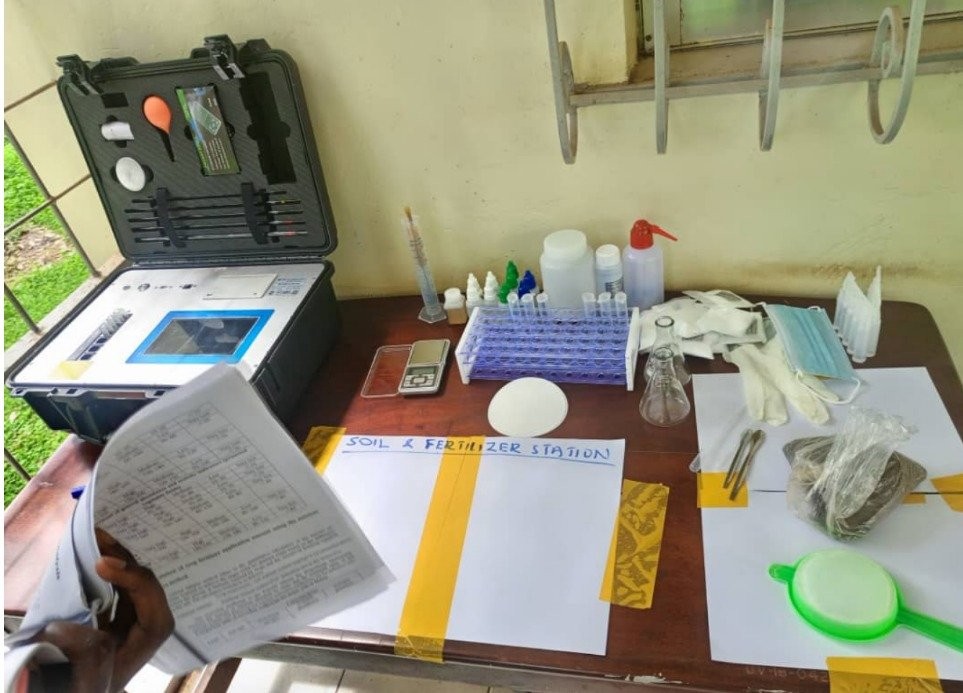
This case study looks at the entry point of the range rather than its top end: what a single six-channel unit can support, why an advisory service bought this configuration rather than a larger one, and what the operator reports about running the service.
The Setting: Advisory Work in a Low-Fertility, Low-Rainfall Environment
Soils across semi-arid southern Africa are characteristically low in organic matter and nitrogen, a pattern documented consistently by FAO's Global Soil Partnership in its regional soil status assessments. Two consequences follow for advisory work. First, a farmer's fertilizer money is easily wasted on the wrong nutrient. Second, organic matter — the parameter that governs how the soil holds water and nutrients — is as important to measure as nitrogen, phosphorus and potassium themselves.
Before this unit arrived, the station's advice rested on visual assessment, cropping history and general regional recommendations. The buyer's motivation was blunt: an extension officer who cannot produce a number is competing on opinion with whoever sells fertilizer in the district, and losing.
Why the Entry-Level Configuration Was the Right Choice
It is tempting to assume the highest-specification instrument is always the better purchase. For this station it was not, and the reasoning is worth stating explicitly:
- Sample volume matches channel count. The station serves farmers who arrive with one or a few samples on advisory days. Six detection channels cover a working session; paying for eighteen would have bought idle capacity.
- Budget is one unit, not one feature list. The money saved on channel count funded reagents and spare consumables, which is what keeps a station operating past its first year.
- Every parameter the advice actually needs is present. Available nitrogen, phosphorus and potassium, organic matter, pH, salinity and moisture are all in the standard configuration — and those are the parameters that change a fertilizer recommendation.
- The recommendation engine is not an upgrade. The built-in crop expert fertilization system covering more than one hundred crops and fruit trees is present in this model too. So is the plant nutrition diagnosis image atlas for leaf-symptom comparison.
What the Station Can Measure
| Group | Parameters |
|---|---|
| Soil nutrients (standard reagents) | Ammonium nitrogen, available phosphorus, available potassium, nitrate nitrogen, hydrolysable nitrogen, total N, total P, total K, organic matter (Tyurin method and extraction method), total organic carbon, C:N ratio, pH, salinity, moisture |
| Soil micronutrients (optional reagents) | Ca, Mg, S, Si, B, Fe, Cu, Mn, Zn, Cl, Mo |
| Soil heavy metals (optional reagents) | Pb, As, Cd, Cr, Hg, Ni, Al, F, Ti, Se |
Available nitrogen, phosphorus and potassium are released in a single simultaneous extraction, so one filtrate serves three determinations. This is the design decision that makes a one-person station viable: three separate extractions would triple both glassware and time.
Specifications That Matter at a Field Station
| Specification | HM-GT1 |
|---|---|
| Detection channels | 6, solid-state design |
| Light source | Four-wavelength cold light source — red 680 ± 2 nm, blue 420 ± 2 nm, green 510 ± 2 nm, orange 590 ± 4 nm; around 100,000 h service life with no thermal drift in continuous work |
| Optical path | Standard 1 cm cuvette, no mechanical displacement or wear |
| Repeatability | ≤0.03% (0.0003, potassium dichromate solution) |
| Linearity error | ≤0.1% (0.001, copper sulphate) |
| Stability | No digit drift within one hour (transmittance); drift within two hours not exceeding 0.3% transmittance or 0.001 absorbance |
| pH | Range 1–14, accuracy 0.01, error ±0.1 |
| Salinity (conductivity) | 0.01%–1.00%, relative error ±5% |
| Moisture | 0–100% (g/100 g), error under 0.5% |
| Test speed | One soil sample, three parameters (N, P, K) in 20 min including reagent and sample preparation; three samples ≤40 min; eight samples ≤1 h |
| Controller and display | Android, ARM Cortex-A7 RK3288 quad core at 1.88 GHz; 7-inch colour touchscreen at 1024 × 600 |
| Reporting | Built-in high-speed thermal printer, no ribbon; prints testing unit, operator, parameter, channel, absorbance, nutrient content in mg/kg, timestamp and QR code |
| Data | Wi-Fi standard, optional 4G module, USB and Ethernet, internal memory for full test history, cloud platform upload, GPS coordinate logging |
| Power | AC 220 ± 22 V or DC 12 V + 5 V, ≤5 W; internal lithium battery over 10 h; vehicle power supported |
| Case | High-strength PVC engineering plastic, IP65; 48 × 34.5 × 22 cm, 5.2 kg net; packing 510 × 390 × 375 mm, 10.5 kg |
| Language | Chinese/English switchable interface for export use |
A Station Day, Start to Finish
- Set up. Two cases on a table. Mains power if available, otherwise the internal battery, which covers a full advisory day.
- Receive samples. Farmers bring bagged soil; the operator records field identity and, if the sample point is known, the GPS coordinate.
- Prepare. Weigh on the supplied 100 g / 0.01 g balance, extract, filter through the supplied qualitative filter paper, add ready-to-use colour reagents from dropper bottles. No powder weighing, no acid dilution, no fume hood.
- Read. Load up to six cuvettes; the instrument auto-corrects light intensity before reading and displays results on the touchscreen.
- Advise and print. Enter the intended crop and target yield in the crop expert module; print the nutrient result and the recommended application plan, and hand it to the farmer.
- Record. Results stay in internal memory, are copied by USB, or upload over Wi-Fi when the station is back in network coverage.
New operators use the sample pre-treatment videos stored in the instrument rather than a paper manual — for a single-operator station with no colleague to ask, this is the difference between a stalled session and a completed one.
Delivery, Reagents and Support
The kit arrives ready to work. The instrument case holds the analyzer, pH meter, TDS meter, balance, aluminium sample box, suction bulb, glass stirring rod, 1, 2, 5 and 10 mL glass pipettes, printer paper, manual, certificate and warranty card and power adapter. The reagent case holds the NPK and organic matter reagent set, qualitative filter paper, ten cuvettes, twelve glass and twenty plastic test tubes, two 100 mL conical flasks, reagent bottle, 50 mL measuring cylinder, twelve plastic droppers, tube rack, tube brush, wash bottle and weighing spoons. Only purified water is supplied locally.
Training for this installation was delivered online — a commissioning session, then method sessions for NPK, organic matter and pH/salinity — with the in-instrument videos as the standing reference. Consumables and reagents are replenished on a scheduled cycle sized to the station's expected sample count, since a station stops working when it runs out of filter paper just as surely as when a component fails. Warranty is 12 months whole-unit, with lifetime maintenance support, lifetime free training and free technical support on soil and fertilizer questions.
What the Operator Reports
| Indicator | Before | With the station operating |
|---|---|---|
| Basis of advice | Visual assessment and regional recommendations | Measured N, P, K, organic matter, pH and salinity for the individual field |
| Time to result | Samples sent away, if sent at all | Same visit — 20 minutes for a three-parameter sample |
| Capacity per session | — | Six samples per loading cycle; eight samples within an hour |
| What the farmer takes home | Verbal advice | Printed nutrient values plus a target-yield application plan with QR code |
| Infrastructure needed | A laboratory the station does not have | A table, purified water and two carry cases |
Questions Farmers Ask at the Station
"How long will it take?" About twenty minutes for a three-parameter soil sample, including reagent and sample preparation. Where several farmers arrive together, six samples are loaded in one cycle and eight samples are completed within an hour.
"How do I know the number is right?" The instrument corrects its own light intensity before each reading, and the printed slip shows the absorbance value next to the nutrient content in mg/kg — so the measurement behind the number is visible. Stability is specified as no digit drift within one hour on transmittance, and drift within two hours not exceeding 0.3% transmittance or 0.001 absorbance.
"My leaves are yellow — is that nitrogen?" Not necessarily, which is why the station uses the plant nutrition diagnosis image atlas stored in the instrument to compare the leaf against reference images before running a test. Yellowing has several possible causes, and pH or organic matter often explains more than nitrogen does.
"Do I need to buy all three nutrients?" That is the question the station exists to answer. Available nitrogen, phosphorus and potassium are measured from one extraction, so the report shows which of the three is actually limiting rather than assuming all three are.
"Can I bring soil from two different fields?" Yes, and it is encouraged. Each sample is measured separately and recorded against its own field identity, with a GPS coordinate where the sampling point is known, so the same field can be compared again next season.
Practical Constraints the Station Works Within
An honest account of a single-unit station should include its limits, because they determine whether this configuration is the right choice for a given buyer.
| Constraint | Practical effect | How the station manages it |
|---|---|---|
| Six channels | Batch work is limited to six samples per loading cycle | Advisory days are booked so arrivals are spread; larger batches are split across sessions |
| Sample preparation time | Preparation, not reading, dominates the twenty minutes per sample | Samples are dried and sieved in advance where farmers deliver them the day before |
| Consumable dependency | The station stops without filter paper, cuvettes, droppers or reagents | Scheduled replenishment sized to expected sample count, with spare consumables held on site |
| Water quality | Purified water must be available for extraction and dilution | Purified water is sourced locally and treated as a critical supply, not an afterthought |
| Single operator | No colleague to consult when a step is unclear | In-instrument procedure videos per method, plus scheduled online support sessions |
Guidance for Similar Advisory Services
- Size the instrument to your advisory day, not to your ambition. Six channels serve a station receiving individual farmers; district services handling batched samples need more.
- Protect the consumable budget first. Reagents, filter paper, droppers and cuvettes decide whether the service still exists next season.
- Always hand over something printed. A slip carrying the measured values and the recommendation is what converts a test into trust.
Where an organisation needs the same service replicated across many districts, the throughput configuration is the right one — see the 40-unit HM-GT4 district rollout in Zambia. For a single commercial estate testing its own blocks, see the HM-GT5 plantation deployment. Full specifications for this model are on the HM-GT1 portable soil nutrient analyzer product page.
Address of this article:https://www.kjhm.net/case/hm-gt1-soil-nutrient-test-kit-case-botswana.html
 Related News
-
29 / 2024-10
Unleash the Power of Soil Respiration Analysis with HM-TH2.
Learn more
-
26 / 2024-11
Microwave digestion instrument: an efficient and environmentally friendly sample pretreatment tool.
Learn more
-
11 / 2024-05
Multi Parameter Water Quality Detector Ensures Water Quality Safety.
Learn more
-
26 / 2024-09
What Is The Use Of A Dust Particle Counter?
Learn more