

 Current
Location:
Current
Location:HM Instruments HM-GT6 Soil Fertilizer Analyzer: Tanzania Laboratory Case
Article Source: Hengmei Technology Release time:2026-08-03 14:40:34
HM Instruments HM-GT6 Soil and Fertilizer Nutrient Analyzer: Laboratory Installation in Tanzania
Fertilizer quality is a regulated concern in Tanzania — the Tanzania Fertilizer Regulatory Authority exists precisely because a bag labelled as compound fertilizer does not always contain the declared nutrient ratio. For a laboratory that advises farms and cooperatives, this creates a dual mandate: measure what the soil needs, and verify what the fertilizer actually delivers. Both tasks require an instrument whose numbers hold up when someone disputes them.
This case study documents a single-unit installation of the HM-GT6 research-grade soil and fertilizer nutrient analyzer from HM Instruments in a Tanzanian laboratory: what the laboratory needed, what "research grade" means in verifiable terms, how the unit was commissioned without an engineer travelling to site, and what it is used for day to day.
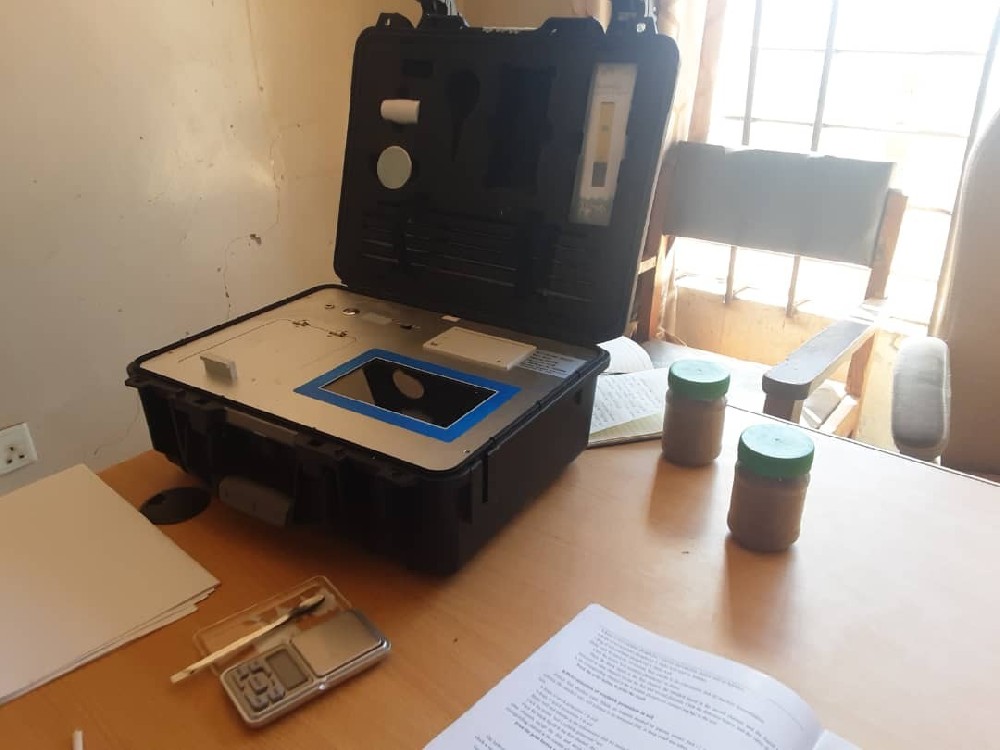
The photograph shows the unit as it works: the open case on the bench, the supplied precision balance and weighing spoon beside it, soil samples in screw-top jars, and the printed procedure open at the current step. The instrument does not require a dedicated laboratory room, a fume hood or plumbed services.
Installation Snapshot
| Item | Detail |
|---|---|
| Country | United Republic of Tanzania |
| Customer type | Laboratory providing soil analysis and fertilizer verification services |
| Model supplied | HM-GT6 research-grade soil and fertilizer nutrient analyzer |
| Quantity | 1 unit |
| Detection channels | 12 rotating channels |
| Configuration | Instrument case and reagent case, NPK and organic matter reagent sets, consumables, micronutrient reagents added later |
| Commissioning | Remote — online sessions plus the procedure video library stored in the instrument |
| Interface | English as standard; localised menu strings available on request |
Why the Laboratory Needed a Higher-Specification Model
The laboratory already had access to basic field kits. What it lacked was an instrument it could defend. Three requirements drove the specification upwards from the entry-level models in the series:
- Numbers that survive challenge. When a laboratory tells a cooperative that a fertilizer consignment is below declaration, the supplier disputes it. The analytical basis has to be documented.
- Scope beyond soil. The same laboratory is asked about plant tissue status, fertilizer nutrient content, nitrate in vegetables and occasionally water quality. Buying four instruments was not affordable.
- Consistency across operators. More than one technician runs analyses, and results must not depend on who loaded the cuvettes.
What "Research Grade" Means Here — the Verifiable Basis
Rather than accept a marketing label, the laboratory asked what each claim rests on. The answers are specific and externally anchored:
| Claim | Verifiable basis |
|---|---|
| Working stability | Rated at six times the requirement of metrological verification regulation JJG 179-90; repeatability reaches the level of grating-type spectrophotometers |
| Calibration | Calibration certificate issued by the National Institute of Metrology of China; built-in calibration with intelligent constant-current regulation and automatic light-intensity correction before readings |
| Optical consistency | Precision rotating cuvette design, patent ZL 2018 2 1777724.7 — every channel presented to the same optical path |
| Analytical method | High-precision filter analysis method, patent ZL 2020 2 1763837.9; standard 1 cm cuvette with no mechanical displacement or wear |
| Repeatability / linearity | ≤0.02% (0.0002, potassium dichromate solution) / ≤0.1% (0.001, copper sulphate) |
| Stated accuracy | Soil NPK ≤1%, organic matter ≤2%, micronutrients ≤5% relative; fertilizer single parameter ≤0.5%, three-parameter NPK ≤1%; heavy metals ≤5% relative |
| Light source | Four-wavelength cold light source — red 680 ± 2 nm, blue 420 ± 2 nm, green 510 ± 2 nm, orange 590 ± 4 nm; stable wavelength with no thermal drift in continuous work, around 100,000 h service life |
| Software integrity | Multiple registered software copyrights; multi-account login so every record carries its operator |
Company-level assurance sits behind the instrument: ISO 9001 quality management, an intellectual property management system, an environmental management system and an occupational health and safety management system, with certificate metadata notarised on the Zhixin (至信链) blockchain and independently verifiable — useful when the laboratory itself is audited.
Analytical Scope Actually Used
One platform covers the laboratory's whole service list. Standard reagent sets cover NPK and organic matter; other parameters are added as optional reagent sets.
| Sample type | Parameters available | Service the laboratory sells |
|---|---|---|
| Soil | Ammonium N, available P, available K, nitrate N, hydrolysable N, total N, P, K, organic matter (Tyurin and extraction methods), total organic carbon, C:N ratio, pH, salinity, moisture; micronutrients Ca, Mg, S, Si, B, Fe, Cu, Mn, Zn, Cl, Mo; heavy metals Pb, As, Cd, Cr, Hg, Ni, Al, F, Ti, Se | Fertility assessment and lime/nutrient recommendation |
| Fertilizer | Straight fertilizers, compound NPK, organic fertilizer N/P/K and organic matter, humic acid fractions, water-soluble and foliar fertilizers, fertilizer micronutrients and heavy metals | Verification against declared nutrient content |
| Fresh crop and dry plant tissue | Nitrate N, ammonium N, P, K, micronutrients, nitrite; plant total N, P, K | In-season nutrient diagnosis |
| Food (fruit, vegetables) | Nitrate, nitrite, heavy metals (Pb, Cr, Cd, As, Hg) | Produce safety screening |
| Water | Ammonium N, P, K, nitrate, nitrite, hardness, pH, Fe, Cu, Mn, Zn, B, Cl, S, Si, Mo | Irrigation water assessment |
Test speed is the same across the series and sets realistic expectations for scheduling: one soil sample for three parameters in about twenty minutes including reagent and sample preparation, three samples in ≤40 minutes, eight samples in ≤1 hour. Fertilizer work is slower — one fertilizer sample for NPK in ≤50 minutes, three in ≤1.5 hours — because fertilizer digestion and dilution add steps.
Commissioning Without an Engineer on Site
Sending an engineer to a single-unit installation in East Africa is neither fast nor economic, so commissioning was structured to be self-sufficient:
- Pre-shipment configuration. The unit was set to English, the reagent sets were labelled to match the printed procedures, and a one-page workflow card was prepared for each parameter the laboratory intended to sell.
- Unboxing session by video call. Channel check, printer test, battery check, and a first blank reading, with an HM Instruments engineer watching the screen.
- Method sessions. Two scheduled online sessions covering soil NPK, organic matter and pH/EC, then a separate session for fertilizer sample handling, which is the step most likely to be done wrong.
- Self-service reference. The instrument stores sample pre-treatment videos for each method, so a technician replays the procedure on the 7-inch touchscreen rather than waiting for support hours.
- Quality checks. The laboratory adopted a routine of re-reading a stable reference solution at the start of each session and logging it, using the instrument's built-in calibration function — a simple internal control that documents day-to-day stability.
Support terms are the standard export policy: 12 months whole-unit warranty, lifetime maintenance support, lifetime free training and free technical support on soil and fertilizer application questions. Reagents and consumables are replenished in scheduled consolidated shipments rather than ad hoc parcels, which keeps customs handling predictable.
What the Laboratory Reports
| Indicator | Before | With the HM-GT6 |
|---|---|---|
| Samples per reading cycle | Sequential single readings | 12 rotating channels per cycle |
| Services offered | Soil nutrients only | Soil, fertilizer, plant tissue, produce screening, irrigation water |
| Fertilizer disputes | Referred elsewhere | Measured in-house against declared content |
| Operator consistency | Depended on the individual | Fixed rotating optical path, per-operator login, absorbance printed alongside results |
| Traceability of records | Notebook entries | Internal memory, USB export, printed slips with QR code, optional Wi-Fi upload |
| Infrastructure required | Bench, fume hood, prepared reagents | A bench, purified water and ready-to-use reagents |
Three Workstreams in Practice
Workstream 1 — soil fertility reporting for farms and cooperatives
The routine service is a fertility report per field: available nitrogen, phosphorus and potassium, organic matter, pH and salinity. Available N, P and K come from a single simultaneous extraction, so one filtrate produces three determinations — the reason a twelve-channel run covers several clients' samples in one session. The laboratory issues the measured values together with a target-yield application plan generated by the built-in crop expert fertilization system, which covers more than one hundred crops and fruit trees and prints crop type, fertilizer type, target yield, total nutrient requirement and a suggested plan.
Workstream 2 — fertilizer verification against declaration
This is the work that requires the most careful handling and generates the most commercial value. Fertilizer samples need digestion and dilution before colour development, which is why the stated timings are longer: one fertilizer sample for NPK in ≤50 minutes and three samples in ≤1.5 hours, against 20 minutes for a three-parameter soil sample. The laboratory's discipline is to run a duplicate on any sample it intends to report as below declaration, and to print both results with their absorbance values so that the record shows the measurement, not only the conclusion.
Workstream 3 — in-season plant tissue diagnosis
Where a crop shows symptoms that soil data does not explain, the laboratory analyses fresh crop or dried plant tissue — nitrate and ammonium nitrogen, phosphorus, potassium, micronutrients and nitrite in fresh material; total N, P and K in dry plant material. The plant nutrition diagnosis image atlas stored in the instrument is used first, to compare leaf symptoms against reference images and narrow the list of candidate deficiencies before reagents are consumed.
Questions the Laboratory Asked Before Buying
Does the instrument need a dedicated laboratory room? No. It works from a bench, requires no fume hood or plumbed services, and arrives with its own balance, glassware, filter paper and ready-to-use reagents. Purified water is the only locally supplied consumable.
How is day-to-day stability demonstrated to an auditor? Through three things in combination: the built-in calibration function with automatic light-intensity correction before readings, the documented stability specification (no digit drift within one hour on transmittance; drift within two hours not exceeding 0.3% transmittance or 0.001 absorbance), and the laboratory's own logged reference-solution readings at the start of each session.
What if a result is disputed? Every printed slip carries the testing unit, operator, parameter, channel number, absorbance, nutrient content in mg/kg, timestamp and a QR code. Because absorbance is printed alongside the calculated concentration, a reviewer can see the raw measurement rather than only its interpretation.
Can more than one technician be held accountable for their own work? Yes — multi-account login with individual passwords means each record is attributed, and the full test history is retained in internal memory for export by USB or Ethernet, or upload over Wi-Fi to the cloud platform.
Is power quality a risk? Less than expected. Input is AC 220 ± 22 V or DC 12 V + 5 V at ≤5 W, intelligent constant-current regulation stabilises the light source, and the internal lithium battery covers more than ten hours — so a session already in progress is not lost to an outage.
Selection Guidance
For laboratories choosing within this series, the practical rule is straightforward. If the work is fertility screening at volume, channel count and cost per test dominate — the 18-channel configuration is the better buy. If the work involves disputes, publications, tender reporting or multi-matrix analysis, the rotating-cuvette research-grade platform is worth the difference, because its accuracy claims are anchored to a verification regulation, a national metrology calibration certificate and two granted patents rather than to a datasheet alone.
Compare the high-volume configuration in the 40-unit HM-GT4 district testing rollout in Zambia, and the sensor-equipped configuration in the HM-GT7 teaching laboratory installation in Uzbekistan. Full specifications for this model are on the HM-GT6 research-grade soil and fertilizer nutrient analyzer product page.
Address of this article:https://www.kjhm.net/case/hm-gt6-soil-fertilizer-analyzer-case-tanzania.html
 Related News
-
15 / 2024-10
Intelligent Environmental Monitoring: Analysis Of The Advantages Of The New Air Planktonic Bacteria Sampler.
Learn more
-
20 / 2025-10
Handheld Biological Toxicity Detector: Principles and Applications in Environmental Monitoring
Learn more
-
24 / 2024-10
Transform Water Quality Monitoring with Our Advanced COD Ammonia Nitrogen Total Phosphorus Total Nitrogen Analyzer.
Learn more
-
29 / 2025-09
Triple Advantages of Rice Freshness Testers:Efficiency, Accuracy, Convenience
Learn more