

 Current
Location:
Current
Location:HM Instruments HM-GT5 Soil Nutrient Analyzer: Zambian Plantation Field Case
Article Source: Hengmei Technology Release time:2026-08-03 14:40:34
HM Instruments HM-GT5 Soil Nutrient Analyzer: Block-by-Block Testing on a Zambian Plantation
The photograph below was not taken in a laboratory. It was taken on a plantation in Zambia, on a patch of red sand under a stand of trees, with the two instrument cases balanced on a plank across a pair of old tyres and a flip chart standing in for a whiteboard. This is where the estate's agronomist runs his soil tests — because the alternative was to send samples away and receive numbers after the fertilizer had already gone on the ground.
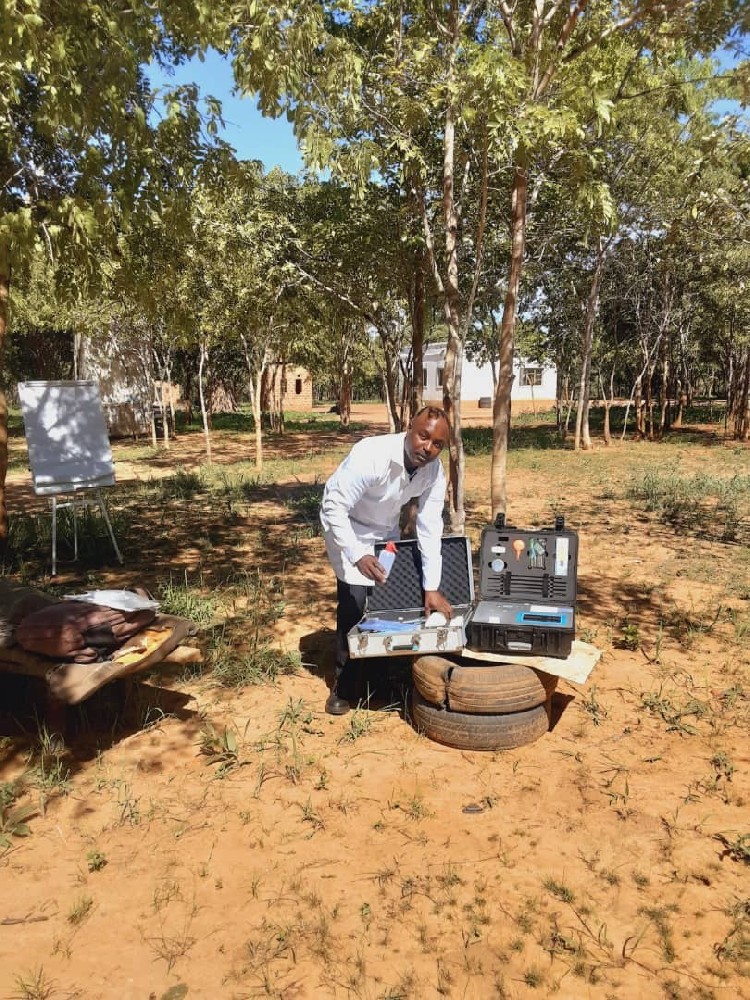
This case study follows one unit of the HM-GT5 soil nutrient analyzer from HM Instruments through a full working day on the estate, and explains what changed in the fertilizer programme once measurement moved from a distant laboratory to the field itself.
Why the Estate Bought Its Own Analyzer
The estate manages several production blocks that look identical on a map and behave nothing alike in practice. Slope position, previous cropping history, drainage and past liming had left blocks with visibly different responses to the same fertilizer programme — but the programme stayed uniform, because uniform was the only option the data supported.
The 4R nutrient stewardship framework used widely in commercial agronomy — right source, right rate, right time, right place — is unusable without block-level measurement. "Right place" in particular presumes you know how nutrient status varies across the farm. The estate's purchase decision came down to three specific frustrations:
- Timing. Samples sent to an external laboratory came back after the application window. The result described a soil that had already been fertilised.
- Cost per decision. External analysis of enough samples to characterise every block properly was more expensive than the fertilizer saving it might identify — so the estate sampled too few points to be useful.
- No feedback loop. Without repeat testing at the same points, the estate could not tell whether last season's programme had moved the soil in the intended direction.
Owning the measurement changed the arithmetic on all three. Once the instrument, reagents and glassware are on site, the marginal cost of an extra sample is a few millilitres of reagent and twenty minutes of a technician's time.
The Field Workflow, in Sequence
Morning — sampling
Composite samples are taken from each block on a fixed grid, so the same points are revisited each season. The GPS function records latitude and longitude with each measurement, which is what makes a season-to-season comparison meaningful rather than approximate.
Mid-morning — preparation, on a plank
Samples are air-dried, sieved and weighed on the supplied 100 g / 0.01 g balance. A single extraction step releases available nitrogen, phosphorus and potassium into one filtrate — the reason a field session is practical at all, since three separate extractions would triple both the glassware and the time. Reagents arrive as ready-to-use solutions in dropper bottles; nothing has to be weighed, diluted or prepared in advance.
Midday — reading eight samples per cycle
The HM-GT5 carries eight rotating detection channels. The precision rotating cuvette design (patent ZL 2018 2 1777724.7) presents every cuvette to the same optical path, so channel-to-channel consistency does not depend on how carefully the operator seats each tube. Working from the instrument's own timing prompts, the technician processes one three-parameter soil sample in about twenty minutes including preparation, three samples in under forty minutes, and eight samples in under an hour.
Afternoon — recommendation and record
Results are printed on the spot. Each slip carries the testing unit, operator, parameter, channel number, absorbance, nutrient content in mg/kg, timestamp and a QR code. The built-in crop expert fertilization system converts the measured values into a target-yield nutrient requirement for the crop in question, and prints crop type, fertilizer type, target yield, total requirement and a suggested application plan. Records stay in the instrument's internal memory and are copied out by USB, or uploaded over Wi-Fi to the cloud platform when the unit is back within network range.
The whole day runs on the internal lithium battery, which supports more than ten hours of continuous operation; vehicle power is available as a backup. The instrument travels in an IP65-rated PVC engineering-plastic case measuring 48 × 34.5 × 22 cm at 5.2 kg net — light enough for one person to carry to a block boundary.
What the Estate Measures, and Why Each Parameter Earns Its Place
| Parameter | Specification | Decision it supports |
|---|---|---|
| Available N, P, K | Error ≤1% | Block-level nutrient rate instead of a single estate-wide rate |
| Organic matter | Error ≤2% | Whether a block needs organic amendment before it will respond to mineral fertilizer |
| pH | Range 1–14, resolution 0.01, error ±0.1 | Lime requirement and the likelihood of phosphorus fixation |
| Salinity (EC) | 0.01%–1.00%, relative error ±5% | Irrigation water quality effects and fertilizer accumulation in intensively managed blocks |
| Moisture | 0–100%, error <0.5% | Whether the sample condition is comparable to previous rounds |
| Micronutrients | Relative error ≤5% (Ca, Mg, S, Si, B, Fe, Cu, Mn, Zn, Cl, Mo available as add-on reagent sets) | Diagnosing symptoms that nitrogen, phosphorus and potassium cannot explain |
| Fertilizer nutrient content | Single parameter ≤0.5%, three-parameter NPK ≤1% | Verifying that a delivered fertilizer contains what the invoice claims |
The last row deserves emphasis. Because the same instrument analyses fertilizer as well as soil, the estate can check a suspicious batch of compound fertilizer before it is spread across hundreds of hectares. On a large purchase, one adulterated consignment detected pays for the analyzer outright.
Delivery, Reagents and Training
The unit shipped as a two-case kit: instrument case with the analyzer, pH meter, TDS meter, balance, aluminium sample box, glass pipettes in 1, 2, 5 and 10 mL, suction bulb, stirring rod, printer paper, adapter, manual and warranty card; reagent case with the NPK and organic matter reagent set, qualitative filter paper, ten cuvettes, twelve glass and twenty plastic test tubes, two 100 mL conical flasks, measuring cylinder, twelve droppers, tube rack, brush, wash bottle and weighing spoons. Purified water is the only locally supplied item.
Because the estate is a single-unit user in a remote location, training was delivered remotely: scheduled video sessions covering sampling discipline, the extraction sequence, calibration checks and consumable replacement, supported by the sample pre-treatment videos stored inside the instrument itself. Reagent replenishment is ordered ahead of each fertilizer cycle. The interface runs in English as standard, and translated one-page workflow cards were supplied for the field technicians who assist with sample preparation. Warranty is 12 months whole-unit, with lifetime maintenance support, lifetime free training and free technical support on soil and fertilizer questions.
Results Reported by the Estate
| Indicator | Before | With on-site testing |
|---|---|---|
| Where analysis happens | External laboratory, samples transported out | On the block, under a tree if necessary |
| Time from sampling to decision | Weeks; often after application | Same day |
| Samples per testing round | Limited by external analysis cost | Eight per loading cycle; grid points revisited each season |
| Fertilizer programme | One rate across the estate | Rate set per block against measured N, P, K, organic matter and pH |
| Incoming fertilizer | Accepted on the supplier's declaration | Nutrient content verified before spreading |
| Season-to-season comparison | Not practical | GPS-tagged records held in instrument memory and exported |
The Sampling Protocol the Estate Adopted
An analyzer is only as good as the sample handed to it, and the estate spent more effort standardising sampling than learning the instrument. The protocol now in use is deliberately simple enough to survive staff changes:
- Fixed points, recorded once. Each block carries a set of sampling positions established in the first season and logged by GPS. Every subsequent round returns to those positions.
- Composite per position. Several cores from a small radius are combined into one composite sample, which averages out the small-scale variation that would otherwise dominate the result.
- Consistent depth. Sampling depth is held constant across positions and seasons, because nutrient concentration changes sharply with depth and an inconsistent depth makes two rounds incomparable.
- Same-day processing. Samples are air-dried, sieved and analysed on the day of collection wherever possible, with the measured moisture value recorded so sample condition can be compared between rounds.
- Timing relative to fertilizer. Sampling is scheduled before the application window, not after — the whole purpose of owning the instrument is to inform the decision rather than to document it.
The estate also keeps one archived reference soil that is re-analysed at the start of each testing round. If that familiar sample reads as expected, the day's results are trusted; if it does not, the reagents and the extraction are checked before any block result is issued. This is a laboratory habit transplanted to a field setting, and it costs one extra cuvette.
The Economics of Owning the Measurement
The estate's justification was not built on instrument features. It was built on three arithmetic observations that any commercial farm can repeat with its own numbers.
| Cost driver | Under external analysis | Under on-site analysis |
|---|---|---|
| Marginal cost of one more sample | Full external analysis fee plus transport | A measured volume of reagent, a cuvette and about twenty minutes of technician time |
| Number of samples the budget allows | Few — so block variation stays invisible | Enough to characterise every block, because the marginal cost is small |
| Timing risk | Result may arrive after application; the season's spend is already committed | Result precedes the decision it is meant to inform |
| Fertilizer verification | Rarely done; consignments accepted on declaration | Routine check of incoming nutrient content before spreading |
| Historical comparison | Reports scattered across seasons and providers | GPS-tagged records in one instrument memory, exported for the farm's own records |
The estate's conclusion was that the instrument does not have to reduce total fertilizer spend to pay for itself — it only has to move a portion of the same spend from a nutrient that is already adequate to the one that is limiting yield, and to catch one under-specified fertilizer consignment.
Guidance for Other Estates and Commercial Farms
- Fix your sampling grid before you buy anything. The instrument's value comes from comparing the same points over time; a wandering sampling pattern produces numbers that cannot be interpreted.
- Match channel count to the number of blocks you sample in one round. Eight rotating channels suits an estate testing a block set in a single session; a district service handling many external clients needs more.
- Use the fertilizer analysis capability. Most buyers of soil analyzers never realise the same kit verifies the fertilizer they purchase, which is often the faster payback.
Where the priority is many operators and many sites rather than one estate, the higher-throughput configuration is the better fit — see the 40-unit HM-GT4 district rollout in Zambia. Where research-grade precision on soil, fertilizer and plant tissue is the requirement, see the HM-GT6 laboratory installation in Tanzania. Full specifications for this model are on the HM-GT5 soil nutrient analyzer product page.
Address of this article:https://www.kjhm.net/case/hm-gt5-soil-nutrient-analyzer-plantation-case-zambia.html
 Related News
-
13 / 2026-05
HengMei SmartBuild Turbidity Meter FAQ
Learn more
-
11 / 2024-05
Pesticide Residue Detector: An Important Tool For Safeguarding Food Safety.
Learn more
-
10 / 2026-07
HM Instruments Integrated Chemiluminescence Imaging System: Reliable Manufacturer & Brand Guide
Learn more
-
12 / 2026-05
HengMei Filter Integrity Tester Industry Application White Paper | HM-GL Multi-Scenario Solutions
Learn more