

 Current
Location:
Current
Location:HM Instruments Soil Nutrient Analyzer Supplier Audit by a Nepal Distributor
Article Source: Hengmei Technology Release time:2026-08-03 14:40:34
How a Nepal Distributor Audited HM Instruments Before Stocking Soil Nutrient Analyzers
A distributor carries a risk the end user never sees. If a soil nutrient analyzer fails in a provincial laboratory eighteen months after installation, the customer calls the local dealer, not the factory in China. Which is why the Nepali agricultural equipment distributor in this case study did not evaluate HM Instruments on price and specification alone. He evaluated the factory's ability to still be answering his emails in year three — and he did it in person, walking the production line, opening the spare parts shelves and asking what happens when a printer module fails during monsoon season.
This case study is written from that perspective: not "why the customer bought the instrument", but what a channel partner checks before putting his own reputation behind a brand. The demonstration unit he took home was the HM-GT7 soil nutrient and environment analysis system, the top configuration in the series.
Market Background: Soil-Test-Based Recommendation Is Now Policy, Not Preference
Nepal's soil management programmes, coordinated through the National Soil Science Research Centre under the Nepal Agricultural Research Council, promote fertilizer recommendation based on soil testing rather than fixed blanket rates. That policy direction creates demand at three levels of the market at once:
- Provincial and district soil testing laboratories that need a documented, repeatable method;
- Agrovet retailers and cooperatives that want a service to attract farmer customers;
- Commercial farms and horticulture projects in the hill and terai belts that manage variable soils across small parcels.
The distributor's assessment was that these three segments need the same measurement chemistry but very different levels of throughput and price — so the supplier he appointed had to offer a full model ladder, not a single product. That requirement alone eliminated several candidates.
The Audit: Five Things He Actually Looked At
1. Whether the factory builds the instrument or only boxes it
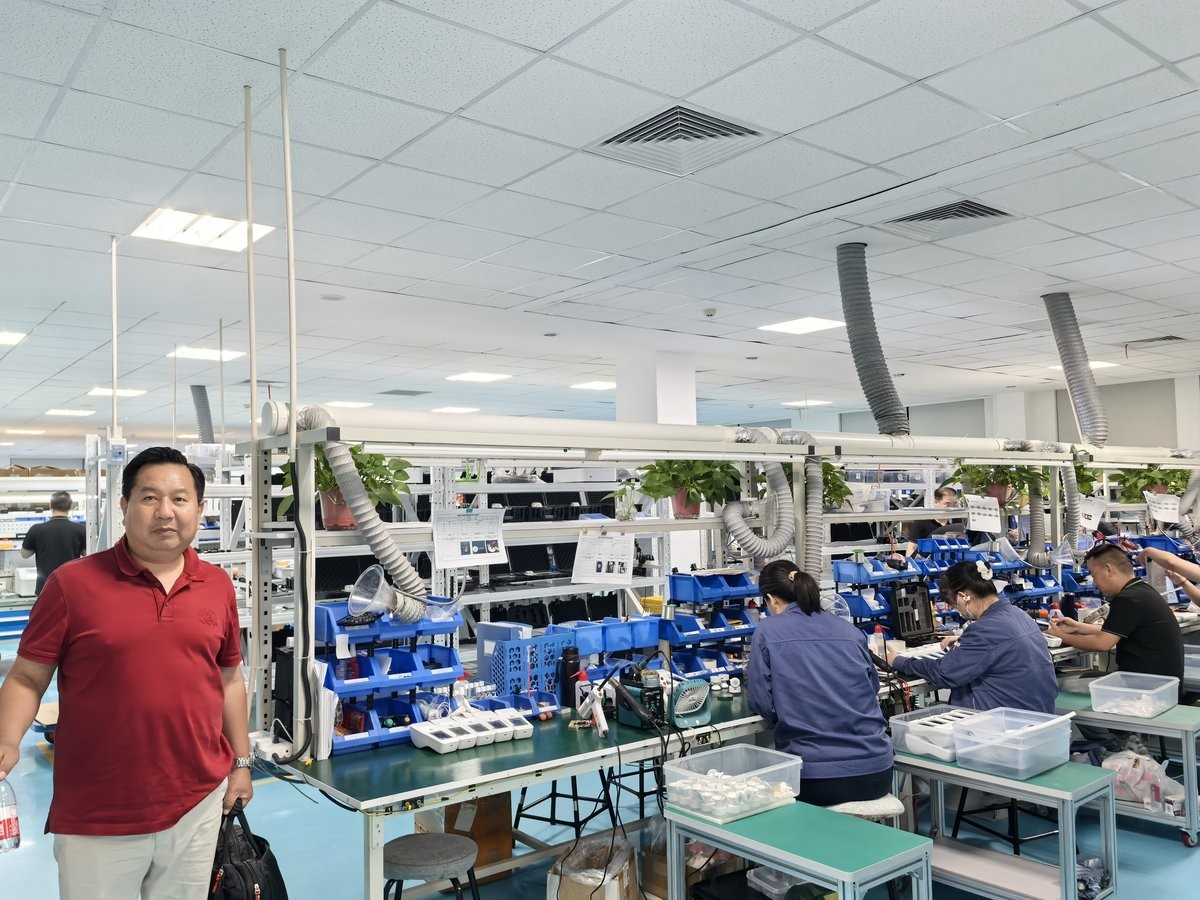
The first stop was the assembly floor. What he was looking for was ordinary but decisive: staffed workstations with fixtures, fume extraction arms over soldering positions, work instruction sheets posted at each station, and parts kitted in bins rather than pulled from cartons on the floor.
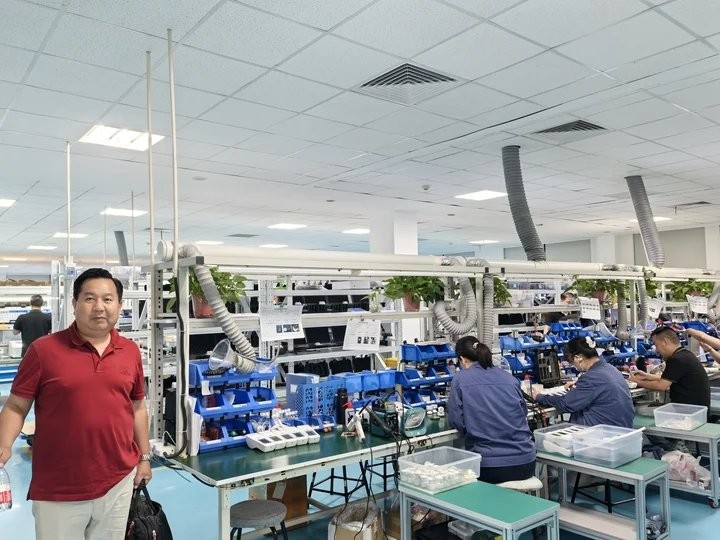
A trading company can supply an instrument. Only a manufacturer can supply a board-level repair eighteen months later, or make the small mechanical change a tender specification sometimes demands. He confirmed that optical assembly, board work and final calibration all happen in the same building.
2. Whether spare parts exist in physical quantity
The second stop was the parts store, and this is the check most distributors skip. Shelf labels for detector assemblies, light-source modules, thermal print heads, touchscreens, battery packs and cable sets — with stock behind the labels — mean a warranty claim can be answered in days rather than quarters.
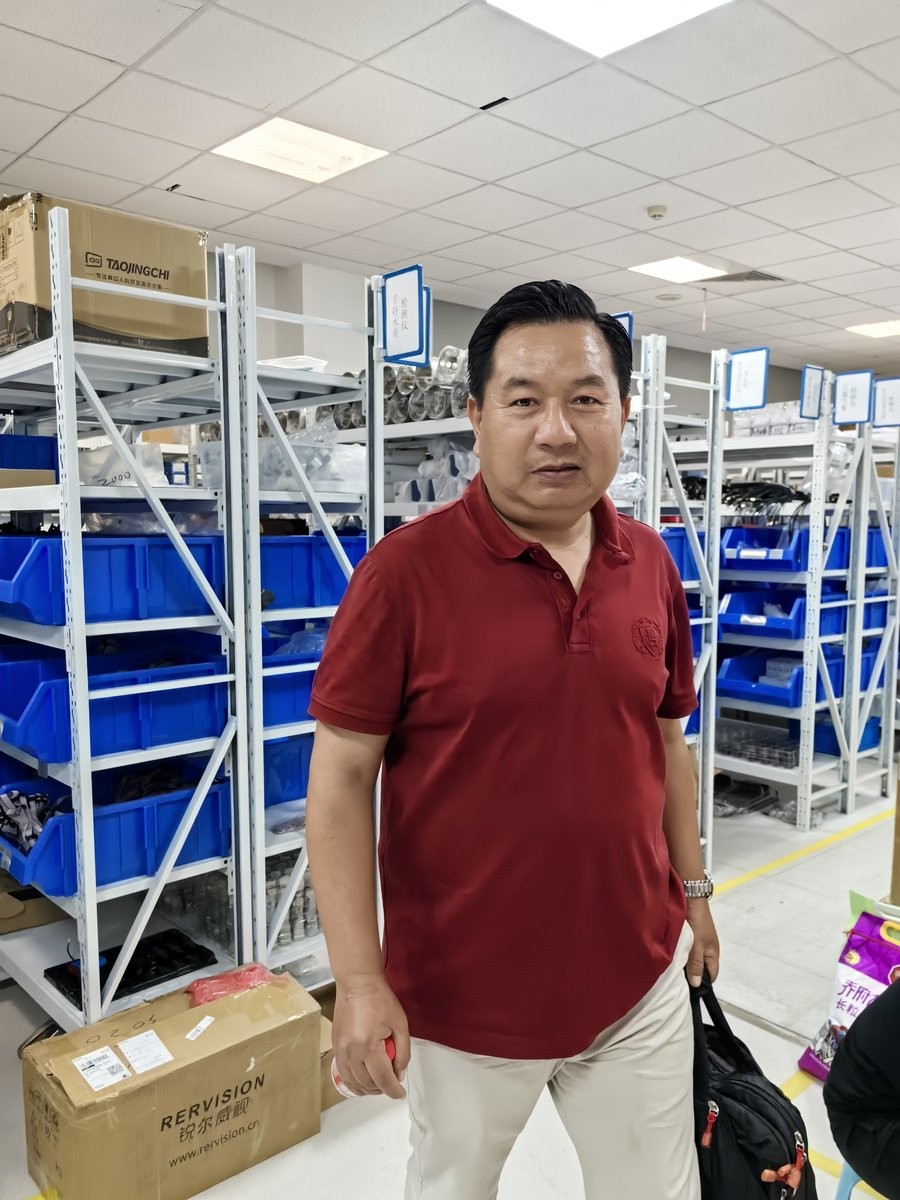
The written commitment that accompanied this was equally important: parts supply continues for at least ten years after a model is discontinued, prices are held stable year to year, and all parts are original factory items. For a distributor, that is what makes a ten-year installed base serviceable.
3. Whether the measurement claims are anchored to something external
He asked for the basis of the accuracy figures rather than the figures themselves. The answers were verifiable: overall working stability rated at six times the requirement of metrological verification regulation JJG 179-90; a calibration certificate issued by the National Institute of Metrology of China; a patented precision rotating cuvette design (patent ZL 2018 2 1777724.7) and a patented high-precision filter analysis method (patent ZL 2020 2 1763837.9). Company-level certification includes ISO 9001 quality management, an intellectual property management system and an occupational health and safety management system, with certificate metadata notarised on the Zhixin (至信链) blockchain so a tender committee can verify it independently.
4. Whether one platform covers the whole market ladder
The series shares one measurement principle — four-wavelength colorimetry with a standard 1 cm cuvette — and scales by channel count and sensor capability. That means one training curriculum, one reagent list and one spare parts logic across every price point he sells.
| Model | Detection channels | Positioning in the Nepali market |
|---|---|---|
| HM-GT1 | 6 solid-state channels | Agrovet retailers, cooperatives, entry-level advisory service |
| HM-GT4 | 18 channels | District testing points and programme rollouts needing batch throughput |
| HM-GT5 | 8 rotating channels | Commercial farms and estate laboratories |
| HM-GT6 | 12 rotating channels | Research and teaching laboratories requiring soil, fertilizer and plant tissue analysis |
| HM-GT7 | 12 rotating channels plus sensor interface | Tender projects requiring soil chemistry and environmental parameters in one system |
5. Whether the instrument survives Nepali field conditions
Hill-district work means transport on rough roads, unreliable mains power and high humidity. The relevant specifications were checked against that reality: an IP65-rated, high-strength PVC engineering-plastic carry case at 48 × 34.5 × 22 cm and 5.2 kg net; AC 220 ± 22 V or DC 12 V + 5 V input at ≤5 W consumption; an internal lithium battery giving more than ten hours of continuous operation with the option of vehicle power; and a four-wavelength cold light source with roughly 100,000 hours of service life and no thermal drift during long continuous work.
The Dealer Package Agreed
| Element | Terms agreed |
|---|---|
| Demonstration unit | HM-GT7 with FDR soil three-parameter probe and six-element environment sensor, used for tender demonstrations and customer trials |
| Reagent supply | Consolidated seasonal shipments of NPK, organic matter and micronutrient reagent sets plus consumables (cuvettes, filter paper, droppers, tubes) |
| Technical training | Online sessions for the distributor's own service engineers, covering method, calibration checks, consumable replacement and first-line fault diagnosis |
| Localisation | English interface as standard, localised menu strings prepared on request, and translated one-page workflow cards per parameter for end-user operators |
| Documentation for tenders | Specification sheets, patent numbers, calibration certificate references and blockchain-notarised certificate metadata |
| Warranty | 12 months whole-unit warranty, lifetime maintenance support, lifetime free training and free technical support on soil and fertilizer application questions |
What the Distributor Reported After the First Year
The pattern he described was that the demonstration unit did most of the selling. Because the kit is self-contained — instrument, reagents, balance, glassware and printer in two cases — a demonstration can be run in a customer's own office using their own soil, and the printed slip carrying absorbance, nutrient content in mg/kg, channel number, operator and timestamp goes into the customer's file as evidence.
- Fewer objections about method. The simultaneous NPK extraction that produces one filtrate for three parameters is the point at which laboratory staff stop comparing the instrument to a pocket meter.
- Sensor capability wins mixed-scope tenders. Where a specification asks for soil moisture, temperature and EC alongside nutrients, the HM-GT7's sensor interface answers the whole scope with one line item.
- The service question is settled early. Being able to say "I have seen the parts store myself" changes the tone of a conversation with a government purchasing committee.
The Method Explanation He Now Uses With Customers
A distributor who cannot explain the measurement principle loses tender discussions to whoever can. During the audit he asked for a plain-language version of the analytical basis, and this is the explanation he now gives laboratory committees.
Why colorimetry rather than an electrode for N, P and K
Nitrogen, phosphorus and potassium in soil are not directly readable with a simple electrode the way pH is. The standard laboratory route is to extract the plant-available fraction into solution, develop a colour whose intensity is proportional to concentration, and measure how much light that solution absorbs. The instrument therefore contains a photometer, not a sensor array: a four-wavelength cold light source (red 680 ± 2 nm, blue 420 ± 2 nm, green 510 ± 2 nm, orange 590 ± 4 nm), a standard 1 cm cuvette, and a detector. Because the light source is a cold source with roughly 100,000 hours of service life and no thermal drift during continuous operation, readings taken at the end of a long working day match those taken at the start.
Why the single simultaneous extraction matters commercially
Available N, P and K are released together in one extraction step, so one filtrate serves three determinations. This is the difference between a service a district laboratory can actually sell and one it cannot: three separate extractions would triple glassware, reagent volume and operator time for the same report. It is also why the stated throughput figures are realistic — one soil sample for three parameters in about twenty minutes including reagent and sample preparation, three samples in ≤40 minutes, eight samples in ≤1 hour.
Why the cuvette design appears in the specification
In a multi-channel photometer, the usual weak point is that each channel sees slightly different optics. The rotating cuvette arrangement presents every sample to the same light path in turn, and the cuvette itself has no mechanical displacement or wear surface. In practice this is what allows a laboratory to compare a result from channel 2 with a result from channel 11 without applying a correction factor.
Questions Nepali Buyers Ask Most Often
Do we need a dedicated laboratory room? No. The kit is self-contained — analyzer, ready-to-use reagents, precision balance, glassware, filter paper and printer across two carry cases. A bench and purified water are sufficient; no fume hood and no plumbed services are required.
What happens where mains power is unreliable? The instrument accepts AC 220 ± 22 V or DC 12 V + 5 V at ≤5 W and carries an internal lithium battery good for more than ten hours of continuous work, with vehicle power as an alternative supply.
Can staff who are not chemists run it? Yes, provided they follow the sequence. Sample pre-treatment videos for each method are stored in the instrument and replay on the 7-inch touchscreen, and reagents arrive as finished solutions requiring no weighing or dilution. Multi-account login keeps each operator's records separate.
Can we produce a fertilizer recommendation, not just a nutrient value? Yes. The built-in crop expert fertilization system covers more than one hundred crops and fruit trees and prints crop type, fertilizer type, target yield, total nutrient requirement and a suggested application plan alongside the measured values.
How do results leave the instrument? Printed slips from the built-in thermal printer (with QR code), internal memory holding the full test history, USB and Ethernet export, and Wi-Fi upload to the cloud platform, with an optional 4G module for field upload. Field measurements can be tagged with GPS coordinates.
For Distributors Evaluating a Soil Testing Supplier
The checklist from this audit generalises well:
- Visit the assembly floor, not the showroom. Confirm the optical and electronic work happens on site.
- Open the spare parts shelves and ask for the post-discontinuation supply commitment in writing.
- Ask what the accuracy claims are anchored to — a verification regulation, a national metrology certificate, a patent number.
- Require a full model ladder so one training curriculum and one reagent list serve your whole customer base.
- Agree the reagent replenishment cycle before the first unit ships; consumables, not hardware, determine whether your installed base is still testing in year three.
For an example of the same platform deployed at scale by an end user rather than a channel partner, see the 40-unit HM-GT4 district rollout in Zambia; for the teaching-laboratory configuration, see the HM-GT7 installation at an Uzbek agricultural school. Full specifications are on the HM-GT7 soil nutrient and environment analysis system product page.
Address of this article:https://www.kjhm.net/case/soil-nutrient-analyzer-distributor-supplier-audit-nepal.html
 Related News
-
19 / 2024-12
Fully automatic Kjeldahl nitrogen analyzer: an accurate and efficient protein analysis tool.
Learn more
-
17 / 2024-10
ATP Fluorescence Detector: A Fast And Accurate Tool For Microbial Detection.
Learn more
-
24 / 2026-06
HM Instruments Online NIR Moisture Analyzer: Multi-Industry Application White Paper | HM-ZHS
Learn more
-
26 / 2024-09
What Is The Use Of A Dust Particle Counter?
Learn more