

 Current
Location:
Current
Location:HM Instruments HM-GT7 Soil Analysis System: Uzbekistan Teaching Lab Case
Article Source: Hengmei Technology Release time:2026-08-03 14:40:34
HM Instruments HM-GT7 Soil Analysis System in an Uzbek Agricultural Teaching Laboratory
Most instrument purchases are decided from a datasheet. This one was decided at a laboratory bench in China, with the buyer weighing his own soil sample, mixing his own extract and reading his own result before he signed anything. He teaches soil science in Uzbekistan, and his argument was simple: if a procedure is too fragile for a visiting buyer to complete on the first attempt, it is far too fragile for a class of twenty-five students.
This case study describes how an Uzbek agricultural school selected the HM-GT7 soil nutrient and environment analysis system from HM Instruments, what was tested during the pre-purchase visit, how the instrument was mapped onto the teaching curriculum, and which capabilities turned out to matter most once students were using it.
Context: Teaching Soil Science Where Salinity Is the Main Lesson
Uzbekistan's agriculture depends almost entirely on irrigation, and FAO land-degradation assessments identify secondary salinization of irrigated land as one of the country's most serious soil constraints. For an agricultural school, that has a direct pedagogical consequence: a graduate who can quote nitrogen recommendations but cannot measure electrical conductivity, soil moisture and pH in the field is not employable by the irrigation districts and farm enterprises that hire them.
The school's existing teaching equipment did not support that. A conventional benchtop spectrophotometer allowed the lecturer to demonstrate one colorimetric determination while students watched; separate pocket meters covered pH and EC; nothing linked soil chemistry to the surrounding growing environment. The purchasing brief that resulted asked for one platform that could:
- run enough parallel determinations for a whole class group to see individual results, not a single shared demonstration;
- cover soil nutrients, salinity, moisture and the ambient environment in one exercise;
- be carried to a field plot for outdoor practicals and returned to the laboratory the same afternoon;
- be operated safely by first-year students without pre-prepared reagents or a fume hood.
The Pre-Purchase Visit: Running the Method by Hand
Rather than request a video demonstration, the buyer travelled to the HM Instruments application laboratory. The visit followed the same sequence a student practical follows.
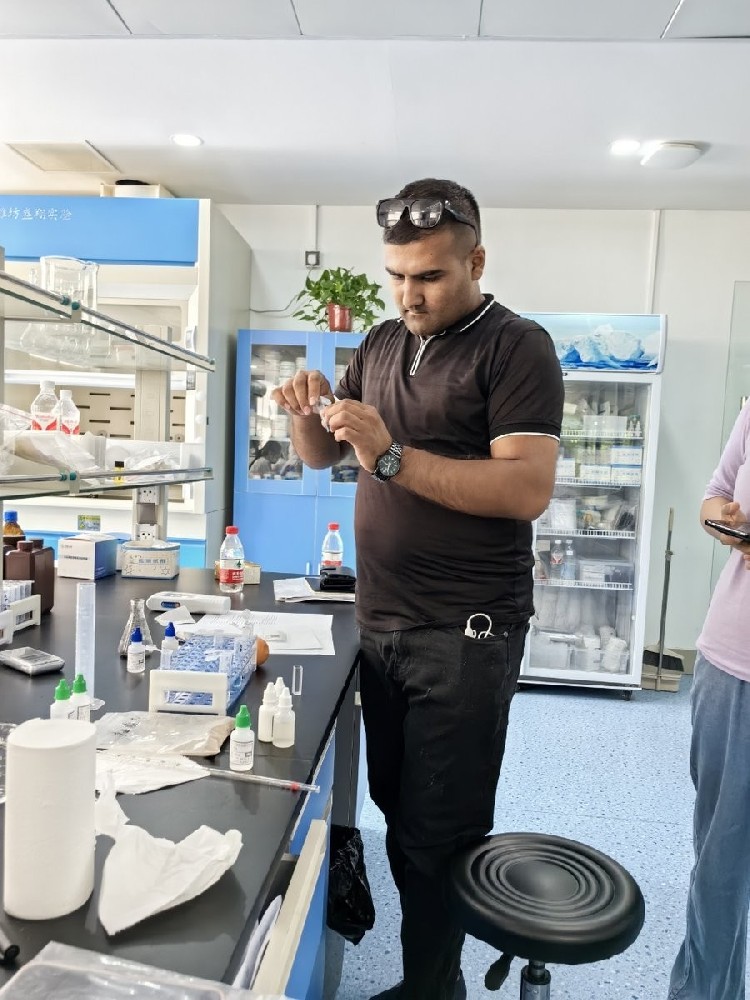
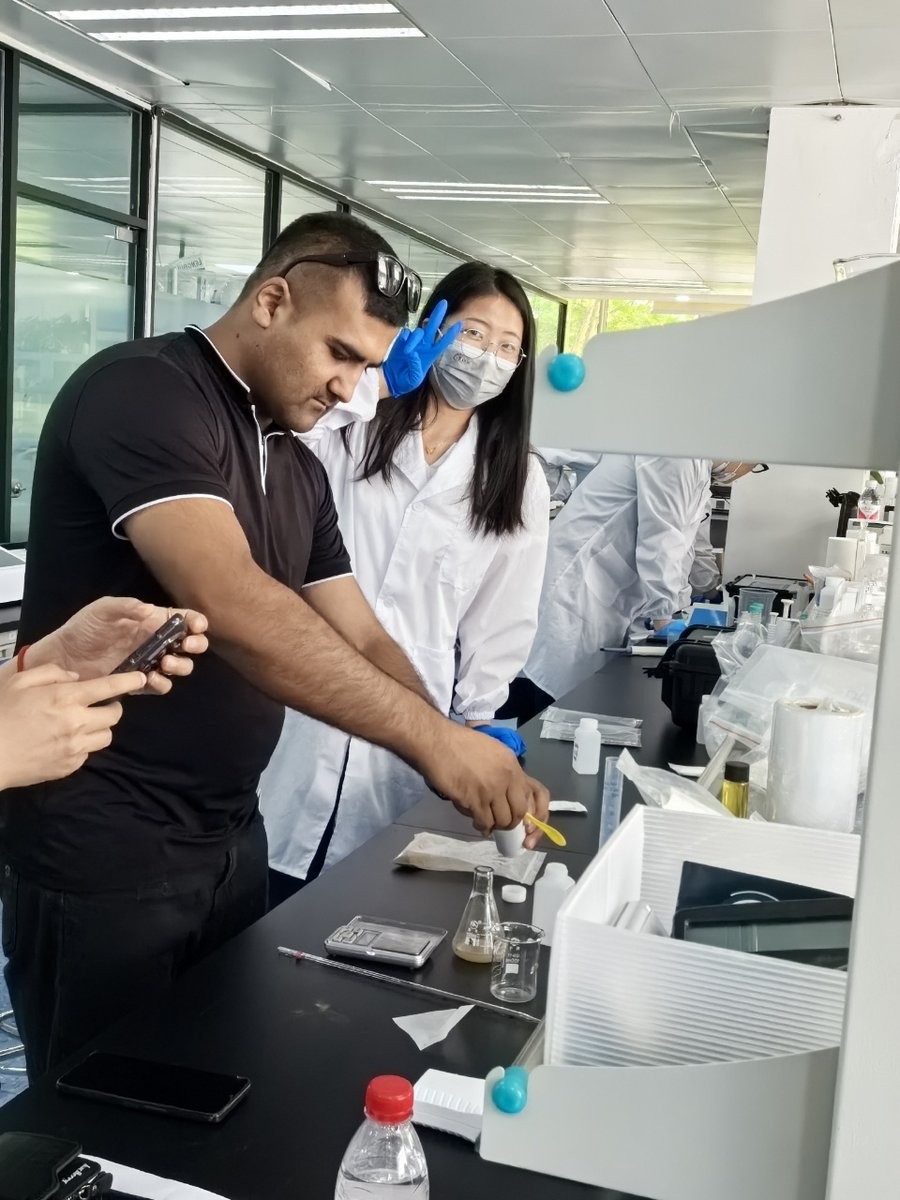
He weighed soil on the supplied 100 g / 0.01 g balance, performed the single simultaneous extraction that releases available nitrogen, phosphorus and potassium into one filtrate, dispensed the colour reagents from ready-to-use dropper bottles, and loaded the rotating cuvette carousel. Two observations from that morning decided the order.
First, the reagents arrive as finished solutions — no weighing of powders, no acid dilution, no fume hood. For a teaching laboratory where twenty-five students handle chemicals with limited supervision, this was the safety argument. Second, the sample pre-treatment videos stored inside the instrument meant that a student who forgets a step can replay it on the 7-inch touchscreen without waiting for the lecturer. The lecturer described this as the feature that would decide whether a practical session finished on time.
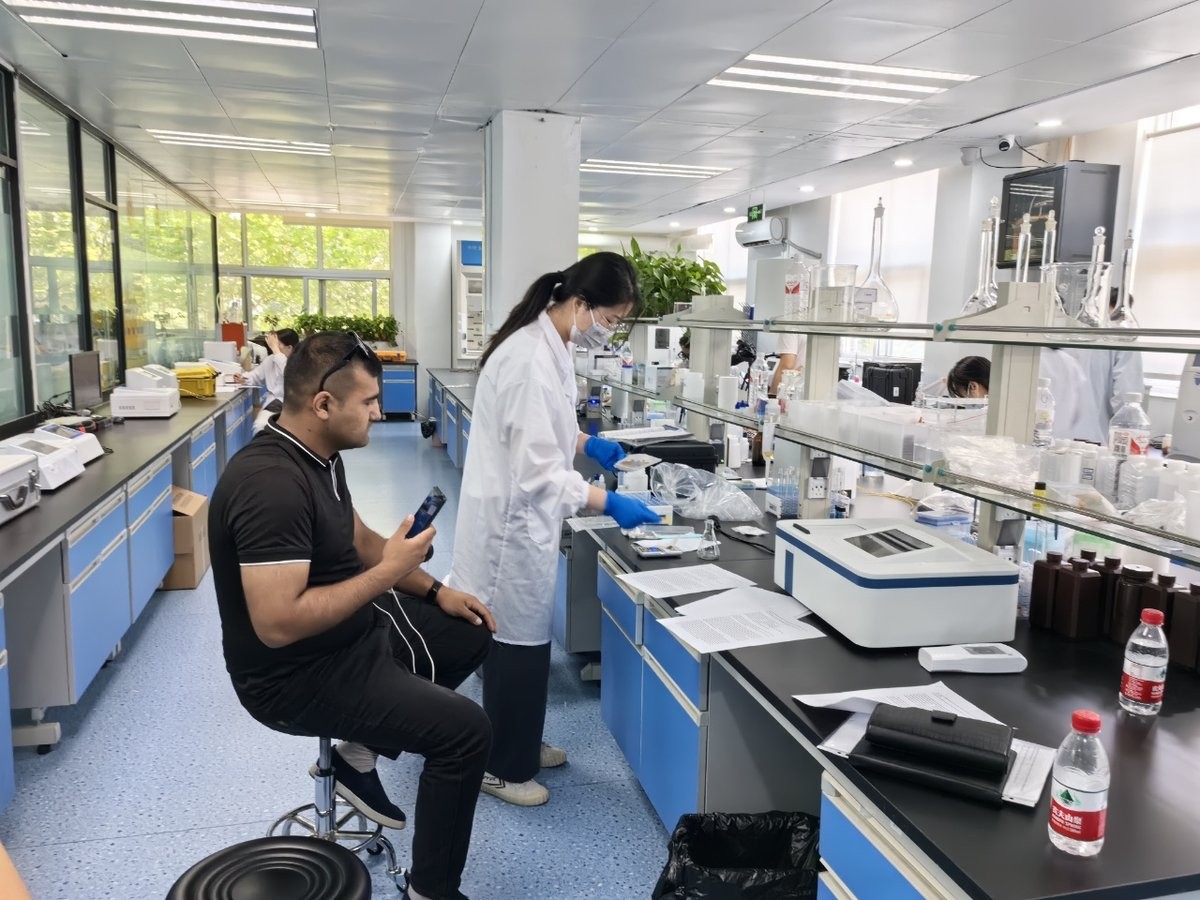
The afternoon covered the parts a buyer normally never sees: how light intensity is auto-calibrated before each reading, how the built-in calibration function compensates supply fluctuation, and how absorbance values can be printed alongside the calculated nutrient content — which matters in teaching, because a student who sees only a final concentration learns nothing about the measurement behind it.
Why the HM-GT7 Rather Than a Smaller Model
The school compared three models in the same series. The decisive differences were channel count, the rotating cuvette design and the sensor interface.
| Requirement from the teaching brief | How the HM-GT7 answers it |
|---|---|
| Whole class group produces individual results in one session | 12 rotating detection channels read 12 samples in one cycle |
| Consistent readings across a teaching year with many untrained operators | Precision rotating cuvette design (patent ZL 2018 2 1777724.7) keeps light-source geometry consistent for every channel; standard 1 cm cuvette with no mechanical displacement or wear |
| Field practicals must include the growing environment, not only the soil | Aviation-plug sensor interface accepts an FDR soil three-parameter probe (moisture, temperature, EC) and a six-element environment sensor (air temperature, humidity, dew point, barometric pressure, illuminance, CO₂) |
| Data used for coursework and marking | Multi-account login, internal memory for the full test history, USB and Ethernet export, Wi-Fi upload to the cloud platform, GPS coordinates recorded for field samples |
| Teaching credibility of the numbers | Soil NPK error ≤1%, organic matter ≤2%, micronutrients ≤5% relative; working stability rated six times the requirement of metrological verification regulation JJG 179-90; calibration certificate from the National Institute of Metrology of China |
The methods themselves are the ones textbooks describe. Available phosphorus determination by colorimetry follows the logic introduced by Olsen and colleagues (USDA Circular 939, 1954), and organic matter uses the Tyurin oxidation approach, with an extraction alternative also available. Students therefore learn a recognised method rather than a proprietary shortcut.
Curriculum Mapping
The school built four practical modules around the instrument in its first teaching year.
| Module | Student task | Instrument function used |
|---|---|---|
| Soil fertility basics | Measure available N, P, K in samples from four field plots and rank them | Simultaneous NPK extraction; 12-channel colorimetric reading; printed absorbance and mg/kg values |
| Salinity and reaction | Compare pH and salinity between an irrigated plot and a fallow margin | pH 1–14 at 0.01 resolution, ±0.1 error; salinity 0.01%–1.00% at ±5% relative error |
| Field environment | Log soil moisture, soil temperature, soil EC, air temperature, humidity, dew point, pressure, light and CO₂ at one sampling point | FDR three-parameter probe plus six-element environment sensor |
| Fertilizer recommendation | Convert measured values into a target-yield fertilizer plan for a chosen crop and defend it | Built-in crop expert fertilization system covering more than one hundred crops and fruit trees; printed recommendation with crop, fertilizer type, target yield, total requirement and application plan |
The plant nutrition diagnosis atlas stored in the instrument became an unplanned favourite: students photograph a deficient leaf in the field, then compare it against the reference images before running the soil test, which forces them to form a hypothesis before they see a number.
Delivery, Consumables and Training
The unit shipped as a two-case kit — instrument case and reagent case — so the laboratory could run its first practical without local procurement. Supplied items include the analyzer, pH meter, TDS meter, balance, aluminium sample box, glass pipettes in 1, 2, 5 and 10 mL, printer paper, power adapter, and in the reagent case the NPK and organic matter reagent set, qualitative filter paper, cuvettes, glass and plastic test tubes, conical flasks, measuring cylinder, droppers, tube rack, brush, wash bottle and weighing spoons. Only purified water is supplied locally.
Because the lecturer had already run the full workflow in China, formal commissioning training was short. Support since delivery has followed three channels:
- Online sessions at the start of each teaching term, used mainly to review new practical designs rather than basic operation.
- In-instrument video library as the standing reference for students.
- Consumable replenishment ordered once per academic year, sized to the planned number of student determinations.
The interface runs in English as standard on export units; localised menu strings can be prepared on request, and the school received a translated one-page workflow card for each parameter so that first-year students can follow the procedure in their own language while the instrument itself stays in English. Warranty is 12 months whole-unit, with lifetime maintenance support and lifetime free training.
Outcomes Reported by the School
| Indicator | Before | With the HM-GT7 |
|---|---|---|
| Practical format | One demonstration per class, watched by the group | 12 individual determinations per cycle, students work in pairs |
| Parameters covered in one exercise | Nutrients or pH/EC, on separate devices | Nutrients, pH, salinity, moisture plus nine environment values in a single exercise |
| Field practicals | Sampling only; analysis postponed to the laboratory | Analysis performed on site on battery power, results tagged with GPS coordinates |
| Student records | Handwritten notebooks | Instrument memory and USB export, printed slips with absorbance, mg/kg value, channel, operator and timestamp |
| Preparation time per session | Reagent preparation the day before | Ready-to-use reagents, no preparation step |
Questions Education Buyers Ask
How many students can one instrument support? Twelve rotating channels produce twelve individual results per cycle. Working in pairs, a class of twenty-four each contributes to a determination in a single 90-minute session; a larger group is split across two sessions.
Does the laboratory need a fume hood or plumbed services? No. Reagents arrive as finished solutions and the kit includes its own balance, glassware, filter paper and printer. A bench and purified water are sufficient, which is why the same unit can be carried to a field plot.
What stops students from producing meaningless numbers? Three things: the instrument corrects light intensity automatically before each reading; absorbance is printed next to the calculated concentration, so an implausible value is visible as a measurement problem rather than hidden; and the stored procedure videos let a student verify the step they are on before consuming another sample.
Can coursework data be exported for marking? Yes — multi-account login attributes every record to its operator, and the full test history exports by USB or Ethernet, or uploads over Wi-Fi to the cloud platform where a lecturer can review it.
What does a field practical require beyond the instrument? Only the sensors and battery power. The FDR probe returns soil moisture, temperature and EC; the six-element sensor returns air temperature, humidity, dew point, barometric pressure, illuminance and CO₂; the internal lithium battery supports more than ten hours of continuous work, and GPS coordinates are logged with each measurement.
Notes for Other Education Buyers
Three practical points came out of this project that apply to any vocational college or university teaching laboratory considering the same class of instrument:
- Count operators, not samples. The relevant question is how many students must each produce a result in a 90-minute session. That number sets the channel count; everything else follows.
- Ready-to-use reagents are a safety specification. In a teaching setting, eliminating powder weighing and acid dilution removes the largest incident risk in the exercise.
- Insist on doing the method yourself before purchase. The buyer in this case discovered more in one morning at the bench than in three weeks of specification comparison.
Where the same platform is deployed commercially rather than for teaching, the priorities shift towards throughput and reagent logistics — see the 40-unit HM-GT4 district testing rollout in Zambia. Full technical detail for the system described here is on the HM-GT7 soil nutrient and environment analysis system product page.
HM Instruments is the export brand of a Chinese national high-technology enterprise with ISO 9001 quality management certification, an intellectual property management system certification, more than one hundred R&D engineers and around 150 core patents. Management system certificate metadata is notarised on the Zhixin (至信链) blockchain for independent verification.
Address of this article:https://www.kjhm.net/case/hm-gt7-soil-analysis-system-case-uzbekistan-school.html
 Related News
-
24 / 2026-07
HM Instruments Dispensing Station FAQ: Technical Answers
Learn more
-
08 / 2026-06
HM Instruments Portable Water Quality Analyzer FAQ Technical Questions
Learn more
-
19 / 2024-12
Fully automatic Kjeldahl nitrogen analyzer: an accurate and efficient protein analysis tool.
Learn more
-
08 / 2026-05
Contact Angle Goniometer Value Analysis-HENGMEI ZHIZAO vs Intl Brands
Learn more