

 Current
Location:
Microbial Detection Without Sample Preparation | HENG MEI Intelligent Manufacturing
Article Source: Hengmei Technology Release time:2026-11-16 17:36:51
Classical microbiological testing asks a laboratory to do three things before it learns anything: homogenise the sample, dilute it in series, and wait one to three days for colonies. A reagent-bottle system removes the first two steps and shortens the third, by putting the sample directly into a bottle of medium and measuring microbial growth instrumentally inside that bottle.
That sounds like a small convenience and is actually a different way of working. This article explains how the method operates, what the HM-W80 measures, which organisms it covers, and — the part buyers underestimate — how reagent consumption rather than instrument price determines the annual budget. It is written by the engineering team at HENG MEI Intelligent Manufacturing.
What "no sample preparation" actually means
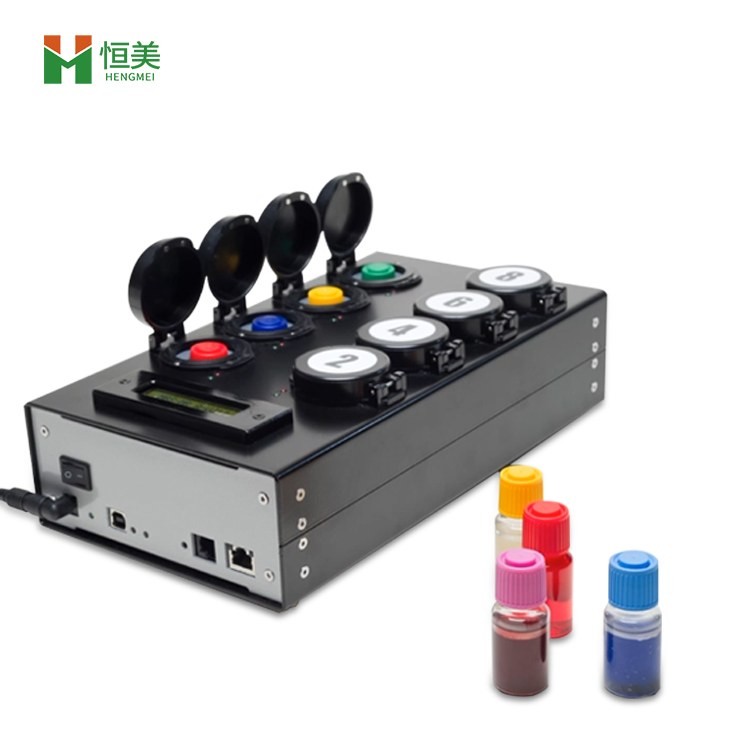
In a plate count, the sample is weighed, homogenised, serially diluted, plated and incubated. In a reagent-bottle system, a defined quantity of sample — 1 ml of liquid or 1 g of solid — is placed into a bottle containing a selective medium, shaken, and loaded into the instrument. From that point the instrument incubates and monitors the bottle, and reports a result as colony-forming units.
The removal of dilution series is the significant change. Serial dilution is where plate counts accumulate operator error: a ten-fold mistake in one tube propagates into a result that is wrong by a factor of ten and looks entirely normal. A system that measures growth in a single bottle removes that class of error at the cost of a narrower measurable range per bottle.
How the measurement works
The instrument monitors each bottle optically and detects the change associated with microbial growth. Because growth is continuous, the time to detection depends on the initial load: a heavily contaminated sample is detected quickly, a lightly contaminated one takes longer. That relationship is the basis of the quantitative result — the instrument converts detection time into a CFU estimate using the calibration for that medium.
Two consequences follow, and both should be explained to anyone using the results.
- A negative result is time-dependent. "No detection" after a short incubation means only that the load was below the level detectable in that time. The valid interpretation is the one the method defines, not "zero organisms".
- Highly contaminated samples are detected fast, clean samples slow. This is the opposite of the intuition many new operators bring from plate work, where every result takes the same two days.
Specifications and coverage
| Parameter | HM-W80 specification | Practical meaning |
|---|---|---|
| Sample types | Solid, liquid, surface swab, paste, slurry | Covers food matrices that plate methods handle with different diluents |
| Sample size | 1 ml or 1 g per bottle | Fixed portion; no dilution series |
| Capacity | 8 wells, independently temperature-controlled | Eight samples at different targets in one run; each well stops when its result is ready |
| Sensitivity | Down to 1 target organism | Detection capability, not a specification of the result's precision |
| Specificity | 99.999% (manufacturer figure) | Selectivity of the medium for the target organism |
| Output | CFU per sample, per-well data records, report export | Quantitative rather than presence/absence |
| Operation | Load bottle, select organism, start; no timing to watch | Each well terminates independently |
Target organisms include total viable count, coliforms and faecal coliforms, E. coli including O157, Staphylococcus aureus, Pseudomonas aeruginosa, Salmonella, Listeria and enterococci. The Listeria capability is the one that most often decides a purchase in dairy and ready-to-eat production, because several rapid systems on the market do not offer it.
What it replaces in a laboratory
It replaces the dilution-and-plating workflow for routine hygiene and product release checks, and it shortens the time to a decision from days to a working shift. It does not replace the reference method: where a standard names a plate count or an enrichment protocol, a result from a different method cannot be substituted for regulatory reporting without validation.
A workable division is to use the reagent-bottle system for in-process monitoring and release decisions, and to keep the reference method for confirmations, dispute resolution and method validation. That keeps the laboratory fast without putting its accreditation at risk.
The cost line buyers miss
Each test consumes one reagent bottle. In the HM-W80 configuration, bottles are supplied 20 to a box, one bottle per organism per sample, and the price per bottle is the dominant running cost — for a plant testing 10 samples a day for two organisms, that is 20 bottles a day, or 400 a month.
| Cost element | Behaviour | Planning note |
|---|---|---|
| Instrument | One-off | Indicative export price around USD 17,900 |
| Reagent bottles | Per test, per organism | The dominant annual cost; scales with sampling frequency |
| Storage | Room temperature 6 months, refrigerated 1 year | Order in line with consumption to avoid expiry write-off |
| Labour | Low per test | No dilution series and no colony counting |
A buyer comparing this system with a plate-count workflow should compare cost per reported result including labour, not instrument price. In plants with high sampling frequency, the labour saving is real and the reagent cost is the constraint; in plants testing a handful of samples a week, the reagent cost per result can exceed the labour it replaces.
Where the system fits
| Setting | Fit | Reason |
|---|---|---|
| Dairy and ready-to-eat production | Strong | Listeria and total count monitoring with same-shift results |
| Beverage and water bottling | Strong | Coliform and E. coli checks on line samples |
| Pharmaceutical hygiene monitoring | Moderate | Useful for environmental and utility samples; validation needed for release testing |
| Third-party testing laboratory | Moderate | Good for screening; reference methods still required for accreditation |
| Regulatory enforcement | Limited | Reporting follows the standard method named in regulation |
Operating discipline that keeps results comparable
- Fixed sample size. One gram or one millilitre, measured rather than estimated. The quantitation depends on it.
- Record the bottle lot. Medium performance varies between lots; a shift in detection times usually tracks a lot change.
- Respect the storage conditions. Bottles kept at room temperature have a shorter shelf life than refrigerated ones; rotate stock.
- Confirm positives. A presumptive positive on a selective medium should be confirmed by the reference method before it becomes a product decision.
How HENG MEI supports microbial programmes
HENG MEI Intelligent Manufacturing supplies the reagent-bottle system alongside ATP hygiene monitors and conventional incubation equipment, which allows a plant to run rapid hygiene screening on surfaces, rapid microbial quantification on product, and reference methods for confirmation, from one supplier. The economics of the ATP option for surface cleanliness are covered in our ATP detector guide.
To evaluate whether this system fits a plant, tell our sales contact the sample types, the organisms you must report, the samples per day and whether results are used for release or for internal monitoring. Those four facts determine whether the reagent cost is justified by the labour saved.
Contact: Kyra, Sales Contact, Kyra@hmdzkj.cn, +86 13792642016 (Tel / WhatsApp / WeChat).
Address of this article:https://www.kjhm.net/news/microbial-detection-without-sample-preparation.html
 Related News
-
08 / 2026-06
HM Instruments Doppler Flow Velocity Meter FAQ – Technical Questions Answered
Learn more
-
21 / 2025-11
Rice Heavy Metal Detector ( HM-FZ1) Product Knowledge Graph White Paper
Learn more
-
20 / 2025-10
Programmable Quantitative Sealer for Enzyme Substrate Method Water Testing
Learn more
-
16 / 2026-11
Animal Disease Diagnostics: Assays, Instruments and Workflow | HENG MEI Intelligent Manufacturing
Learn more