

 Current
Location:
Current
Location:HM Instruments Doppler Flow Velocity Meter FAQ – Technical Questions Answered
Article Source: Hengmei Technology Release time:2026-06-08 13:30:14
HM Instruments Doppler Flow Velocity Meter FAQ – Technical Questions Answered
When evaluating or deploying a Doppler flow velocity meter, engineers and procurement teams often have specific technical questions about measurement principles, accuracy, installation, and compatibility. This FAQ addresses the most commonly searched technical questions about the HM Instruments Doppler flow velocity meter lineup—covering the HM-DSL1, HM-DSL2, and HM-DSL3 models—to help you make informed decisions for river monitoring, open-channel flow measurement, municipal discharge, and irrigation applications.
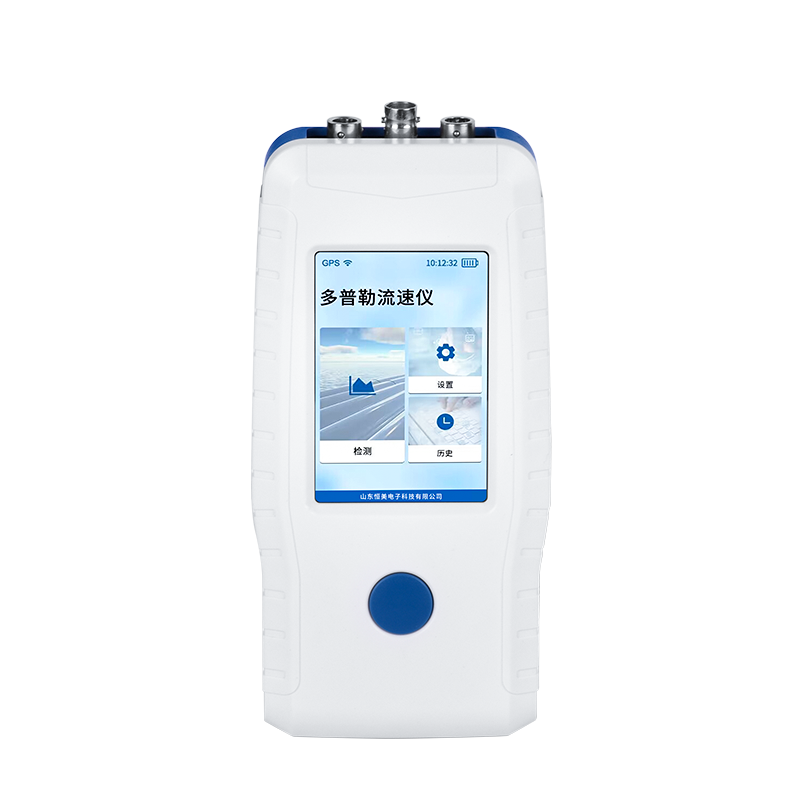
Quick Reference: HM Instruments Doppler Flow Velocity Meter Models
| Specification | HM-DSL1 | HM-DSL2 | HM-DSL3 |
|---|---|---|---|
| Operation | Button | Touchscreen | Touchscreen |
| Price | $786 | $929 | $2,000 |
| Velocity Range | 0.02–6.00 m/s | 0.02–6.00 m/s | 0.02–6.00 m/s |
| Velocity Accuracy | ±1.0% ±1 mm/s | ±1.0% ±1 cm/s | ±1.0% ±1 cm/s |
| Water Depth | 0.03–10 m | 0.03–5 m (10 m optional) | 0.03–5 m (10 m optional) |
| Bidirectional Monitoring | No | No | Yes |
| IP Rating | — | — | IP65 |
| Battery | 1800 mAh / 8 h+ | 6000 mAh | 6000 mAh |
| Storage | 10,000 records | 1,000,000 records / 6 GB | 1,000,000 records / 6 GB |
| WiFi / GPS | No | Yes | Yes |
Frequently Asked Technical Questions
The HM Instruments Doppler flow velocity meter operates on the acoustic Doppler effect principle. The meter's transducer emits a 2 MHz ultrasonic signal (on HM-DSL2 and HM-DSL3) into the water column. When this acoustic pulse encounters suspended particles, sediment, or air bubbles moving with the flow, the reflected signal experiences a frequency shift proportional to the particle velocity. The meter calculates this Doppler shift to determine flow velocity in real time. On the HM-DSL1, the operating frequency is optimized for its button-operated design, while the HM-DSL2 and HM-DSL3 both use 2 MHz acoustic frequency for consistent measurement performance. This non-intrusive method avoids obstructing the flow path, making it well suited for rivers, open channels, and pipelines where traditional mechanical meters would create head loss or accumulate debris.
Accuracy varies by model. The HM-DSL1 achieves velocity accuracy of ±1.0% of reading ±1 mm/s, which provides high precision for low-velocity applications such as slow-moving irrigation canals or calm river reaches. The HM-DSL2 and HM-DSL3 offer accuracy of ±1.0% of reading ±1 cm/s, designed for broader field conditions where the additional resolution at very low velocities is less critical. Across all three models, the velocity range spans 0.02 to 6.00 m/s, covering typical conditions found in municipal discharge monitoring, open-channel flow surveys, and river gauging stations. For users needing the tightest low-velocity precision, the HM-DSL1's ±1 mm/s specification offers a measurable advantage, while the touchscreen models provide enhanced data logging and connectivity.
The blind zone—also called the dead zone—is the minimum distance from the transducer face within which the meter cannot reliably measure velocity. On the HM-DSL2 and HM-DSL3, the blind zone is 6.5 to 7 cm. Within this region, the transmitted signal has not yet separated from the received echo, so velocity data is unreliable. In practice, this means you should install the sensor at least 7 cm below the water surface when measuring downward, or ensure the transducer is positioned so the measurement volume falls beyond the blind zone. For shallow-water applications (water depths under 15 cm), this blind zone represents a significant portion of the water column, so users should evaluate whether the remaining measurable depth is sufficient for representative velocity sampling. The HM-DSL1's blind zone specifications follow similar acoustic physics.
Only the HM-DSL3 supports bidirectional flow monitoring. This model can detect and report flow direction—whether water is moving toward or away from the transducer—making it suitable for tidal estuaries, combined sewer overflows, and other environments where flow reversal occurs. The HM-DSL1 and HM-DSL2 measure velocity magnitude but do not distinguish flow direction. If your application involves potential reverse-flow conditions—such as storm surge backflow, tidal channels, or bidirectional pipeline flow—the HM-DSL3's directional capability eliminates the risk of misreporting reversed flow as positive velocity. This is one of the primary differentiators justifying the HM-DSL3's $2,000 price point compared to the unidirectional HM-DSL2 at $929.
The HM-DSL1 supports water depth measurement from 0.03 m up to 10 m, making it suitable for deeper river cross-sections and substantial open channels. The HM-DSL2 and HM-DSL3 have a standard depth range of 0.03 to 5 m, with a customizable option extending to 10 m to match deeper deployment scenarios. All models include a 20-meter signal cable, providing adequate reach for most bank-side or bridge-mounted installations. When selecting a model, consider your typical deployment depth: if you regularly monitor channels deeper than 5 m, the HM-DSL1's native 10 m range avoids the need for a custom depth configuration, while the HM-DSL2 and HM-DSL3 can be factory-configured for the same range upon request.
All three HM Instruments Doppler flow velocity meter models support Modbus RTU over RS-485, the dominant industrial communication protocol for environmental monitoring and SCADA integration. This allows direct connection to data loggers, PLCs, and telemetry systems commonly deployed at river gauging stations and municipal discharge monitoring points. Additionally, the HM-DSL2 and HM-DSL3 include built-in WiFi for wireless data transfer and configuration, plus GPS for geo-tagging measurement locations—features not available on the HM-DSL1. The WiFi capability simplifies field data retrieval without requiring physical cable connections, while GPS coordinates embedded in data records support spatial mapping across multiple monitoring sites in irrigation networks or sponge city projects.
The HM-DSL1 is equipped with an 1800 mAh battery providing 8 hours or more of continuous operation, which covers a standard day of field measurements at river sites or open-channel survey points. The HM-DSL2 and HM-DSL3 feature a substantially larger 6000 mAh battery, enabling extended multi-day deployments without recharging—particularly valuable for unattended monitoring at remote locations, continuous discharge monitoring stations, or week-long irrigation assessment campaigns. For all models, battery life varies with measurement interval, backlight usage, and WiFi/GPS activity (on DSL2/DSL3). Disabling WiFi and GPS when not needed can meaningfully extend operating time on the touchscreen models. The USB charging capability allows recharging from portable power banks in the field.
Yes, Doppler-based velocity meters actually perform more reliably in turbid water than in very clear water. The acoustic Doppler principle depends on suspended particles, sediment, or air bubbles to reflect the ultrasonic signal—these scatterers are the measurement targets. In highly turbid rivers, irrigation canals carrying silt, or municipal discharge channels with suspended solids, the HM Instruments Doppler meters receive strong return signals and produce stable velocity readings. Conversely, in exceptionally clear water with minimal suspended material, the signal may weaken, potentially reducing measurement reliability. For very clear water conditions, users can sometimes introduce artificial scatterers (such as small air bubbles) near the measurement volume to improve signal return. This characteristic makes Doppler meters particularly well suited for sediment-rich environments.
The HM Instruments Doppler flow velocity meters can measure velocities as low as 0.02 m/s (2 cm/s) across all three models. This low-velocity sensitivity is critical for applications such as slow-moving irrigation canals, low-flow river reaches during dry seasons, and seepage monitoring in sponge city infrastructure. The HM-DSL1's accuracy specification of ±1.0% ±1 mm/s provides the tightest precision at very low velocities—1 mm/s versus 1 cm/s on the DSL2 and DSL3—making it the preferred choice when accurate measurement near the minimum threshold is important. When velocity drops below 0.02 m/s, the Doppler frequency shift becomes too small to distinguish from system noise, and readings should be treated as below the reliable measurement threshold.
Proper installation is essential for reliable Doppler velocity measurements. First, select a measurement cross-section with stable, relatively uniform flow—avoid areas immediately downstream of bends, weirs, or junctions where turbulence distorts velocity profiles. Mount the sensor on a firm structure (bridge rail, channel wall, or mounting pole) ensuring the transducer face is parallel to the flow direction and submerged at least beyond the 6.5–7 cm blind zone below the water surface. The 20-meter cable on all HM Instruments models provides flexibility for various mounting positions. For the HM-DSL2 and HM-DSL3, enable GPS to record the installation coordinates. Verify the water depth reading matches a manual measurement, and confirm velocity readings respond logically to visible flow conditions before leaving the site. Secure cables to prevent damage from debris or vandalism.
Calibration of Doppler flow velocity meters involves verifying velocity readings against a known reference. A common field method is the velocity-area approach using a current meter or tracer dilution as reference. Zero-velocity calibration can be performed by placing the sensor in still water and confirming the reading is at or below the minimum threshold. For depth calibration, compare the meter's depth reading against a manual staff gauge or tape measurement at the installation site. The HM Instruments meters ship factory-calibrated, and under normal conditions, routine field verification every 6 to 12 months is adequate. Avoid attempting internal parameter adjustments without manufacturer guidance. For applications requiring formal calibration certificates—such as regulatory compliance monitoring—contact HM Instruments or an accredited calibration laboratory to schedule documented verification procedures.
Data storage varies significantly across the three models. The HM-DSL1 stores up to 10,000 records, adequate for short-term field surveys, spot measurements, and daily monitoring routines where data is retrieved frequently. The HM-DSL2 and HM-DSL3 offer substantially more capacity: 1,000,000 records with 6 GB of internal storage, designed for extended unattended deployments at continuous monitoring stations. At a typical 15-minute measurement interval, the DSL2/DSL3 can store over 10 years of data before reaching capacity—far exceeding typical deployment cycles. Combined with WiFi data transfer on the DSL2 and DSL3, users can also configure remote data retrieval schedules, reducing the need for site visits. For large-scale irrigation networks or multi-site sponge city monitoring programs, the expanded storage eliminates data-loss risk from delayed maintenance visits.
Model Selection Guidance by Application
| Application | Recommended Model | Key Reason |
|---|---|---|
| River gauging stations | HM-DSL2 or HM-DSL3 | Large storage, WiFi/GPS, extended battery |
| Irrigation canal monitoring | HM-DSL1 | Cost-effective, high low-velocity accuracy |
| Municipal discharge compliance | HM-DSL3 | Bidirectional monitoring, IP65 rating |
| Tidal or estuarine flow | HM-DSL3 | Bidirectional flow detection |
| Pipeline flow surveys | HM-DSL1 or HM-DSL2 | Compact size, adequate for unidirectional flow |
| Sponge city infrastructure | HM-DSL2 or HM-DSL3 | WiFi connectivity, GPS tagging, large data logs |
| Rapid field assessments | HM-DSL1 | Lightweight, button operation, quick deployment |
Key Technical Specifications Summary
| Parameter | Value |
|---|---|
| Measurement Principle | Acoustic Doppler Effect |
| Velocity Range | 0.02–6.00 m/s (all models) |
| Water Temperature Range | -10 °C to 60 °C |
| Acoustic Frequency | 2 MHz (HM-DSL2 / HM-DSL3) |
| Communication | Modbus / RS-485 (all models) |
| Cable Length | 20 m |
| Main Unit Dimensions (DSL2/3) | 176 × 85 × 38 mm |
| Blind Zone (DSL2/3) | 6.5–7 cm |
If you have additional technical questions about the HM Instruments Doppler flow velocity meter lineup that are not addressed above, refer to the product documentation for the HM-DSL1, HM-DSL2, or HM-DSL3, or contact the HM Instruments technical support team for application-specific guidance.
Address of this article:https://www.kjhm.net/news/894.html
 Related News
-
08 / 2024-10
Revealing The Multifunctional Advantages And Applications Of High-precision Soil Detectors.
Learn more
-
24 / 2026-07
HM Instruments: Reliable Dispensing Station Brand Guide
Learn more
-
16 / 2025-09
Total Phosphorus Analyzer: Essential for Water Quality and Environmental Monitoring
Learn more
-
24 / 2024-10
Transform Water Quality Monitoring with Our Advanced COD Ammonia Nitrogen Total Phosphorus Total Nitrogen Analyzer.
Learn more