

 Current
Location:
ATP Hygiene Monitoring and RLU Limits | HENG MEI Intelligent Manufacturing
Article Source: Hengmei Technology Release time:2026-11-16 17:37:02
An ATP detector reports a number in relative light units. That number is not a microbial count, and treating it as one is the most common misuse of the technique. What the instrument measures is the ATP present on the swab — from food residue, from cleaning chemicals, from hands, and only partly from living microorganisms. Its value is that it is immediate, so a surface that failed sanitation can be re-cleaned before production starts rather than discovered two days later.
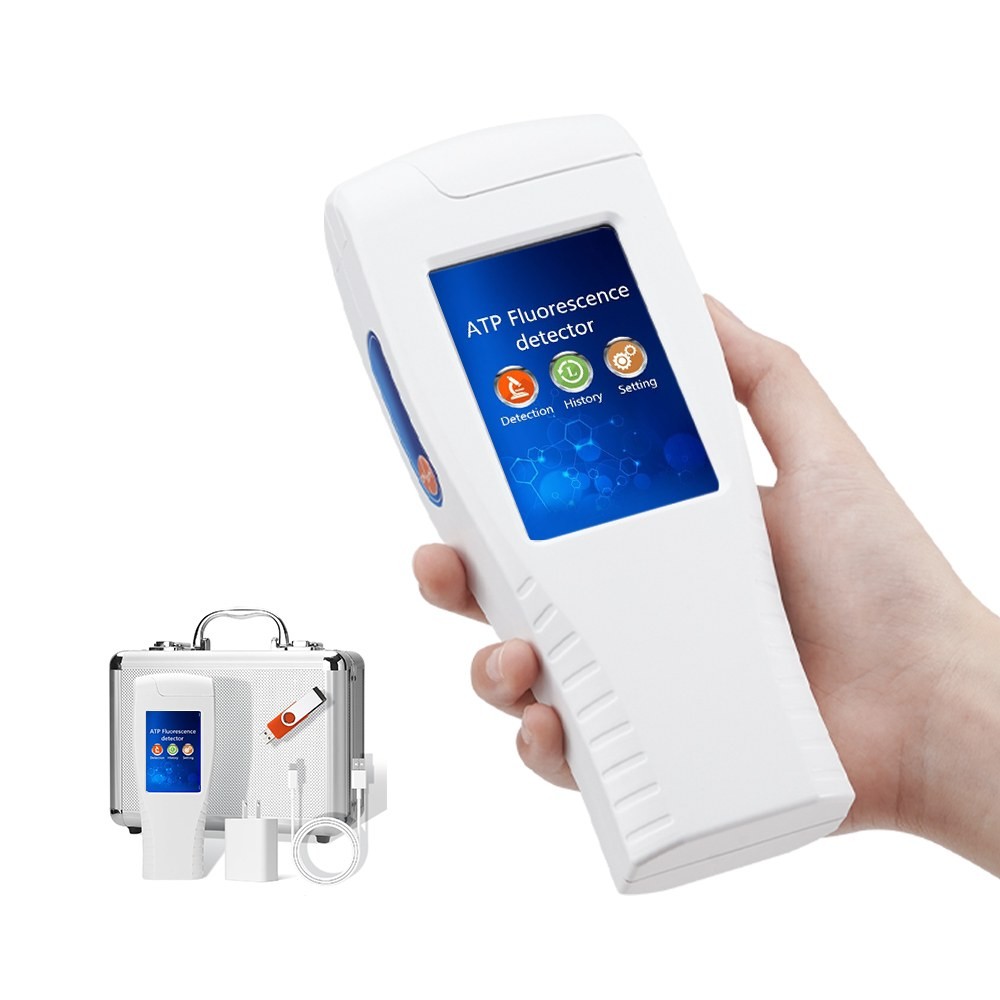
This article explains what the reading means, how to set limits that hold up, and how the HM-ATP+ is specified. It is written by the engineering team at HENG MEI Intelligent Manufacturing for hygiene and quality managers building a sanitation verification routine.
What the measurement actually is
The swab collects biological material from a defined area. A reagent releases ATP from that material, and luciferase converts the ATP into light in proportion to its amount. The instrument counts photons and reports RLU. The whole reaction is complete in seconds, which is why ATP testing sits inside a cleaning shift rather than after it.
Because ATP is present in food residues and in microbial cells alike, a high reading tells you the surface was not cleaned, but not whether the residue was lettuce juice or Listeria. That distinction matters: ATP is a hygiene indicator, not a pathogen test, and a sanitation programme needs both.
Specifications that matter in daily use
| Parameter | HM-ATP+ specification | Practical effect |
|---|---|---|
| Sensitivity | 1×10⁻¹⁵ to 1×10⁻¹⁸ mol ATP | Detects residues far below visible soiling |
| Measuring range | 0–999,999 RLU | No dilution step for heavily soiled surfaces |
| Interference | ±5% or ±5 RLU | Run-to-run variation when comparing swabs |
| ATP recovery | 90–110% | Extraction efficiency from the swab |
| Test time | 15 s | A 30-point sanitation check takes under ten minutes |
| Limit handling | User-set upper and lower limits; automatic pass/fail | Operator does not interpret the number in the field |
| Self-check | Internal calibration light source; 30 s start-up check | Confirms the optics before a shift, not after a complaint |
| Data | 100,000 records in 4 GB; miniUSB and Wi-Fi upload | Trend analysis by line, shift and sampling point |
| Size / power | 188 × 77 × 37 mm; 3,000 mAh battery | Handheld, a full shift on one charge |
Setting limits: why borrowed numbers fail
Suppliers of ATP systems are often asked for a standard pass limit. There is no universal one, because RLU depends on the swab, the reagent, the sampled area, the surface material and the residue type. A limit copied from another plant, or from a different instrument brand, produces a programme that either passes everything or fails everything.
A workable method has four steps, and it takes two weeks rather than a day.
- Fix the technique first. Swab a defined area — commonly 10 × 10 cm — with consistent pressure and pattern, using the swab supplied with the system. Change the technique and every historical reading becomes incomparable.
- Measure clean. After validated cleaning, sample 30–50 points across the surfaces you will monitor. The distribution of those readings defines what "clean" looks like on your lines.
- Measure soiled. Sample the same points before cleaning, or deliberately soil a test coupon. The gap between the two distributions is the range your limits sit in.
- Set two thresholds. A pass limit and a fail limit with an action band between them: pass, re-clean and retest, or stop and investigate. A single threshold forces every borderline reading into an argument.
Where ATP fits and where it does not
| Use | Suitable | Reason |
|---|---|---|
| Post-sanitation verification on food contact surfaces | Yes | Immediate result inside the shift |
| Trend monitoring by line and shift | Yes | Large record capacity and upload make trends visible |
| Training and operator feedback | Yes | Visible consequence for technique |
| Product release testing | No | Not a microbial count; release needs a validated method |
| Pathogen detection | No | ATP does not identify organisms |
| Water hygiene as a standalone check | Partial | Useful as a rapid indicator; microbiological confirmation still required |
Making the data useful
An ATP programme generates more data than most plants use. The value appears when readings are grouped by sampling point rather than by date: a single point that repeatedly reads just under the limit is a design problem — a hard-to-clean weld, a dead corner, a worn gasket — that no amount of re-cleaning will fix. Reviewing by point once a month converts the instrument from a pass/fail gate into a maintenance tool.
For systems that upload over Wi-Fi, the practical requirement is that the exported record carries the sampling point identity. A reading without a location cannot be trended, and re-keying locations by hand is where programmes quietly die.
Swab handling, the most common failure
- Swabs have a shelf life and a storage condition. A swab left in a warm vehicle loses reagent activity and reads low, which is the dangerous direction of error.
- Sample before cleaning chemicals dry. Residual sanitiser can both suppress and inflate readings depending on chemistry; follow the system's instructions on neutralisation.
- Do not re-use a swab. Obvious, and still the cause of more anomalous readings than instrument faults.
- Record the operator. Technique differences between operators are larger than instrument variation, and only a named record reveals them.
How HENG MEI supports hygiene programmes
HENG MEI Intelligent Manufacturing supplies the HM-ATP+ handheld detector alongside reagent-bottle microbial systems and conventional incubation equipment, so a plant can pair rapid surface verification with quantitative microbial testing and reference methods. The instrument is supplied with 20 swabs as standard, and data can be transferred by cable or Wi-Fi to a monitoring platform.
To build a programme around it, tell our sales contact the surfaces you monitor, the number of points per shift, whether results must be uploaded to a customer or audit platform, and the microbial method used for confirmation. Those four facts determine the swab type, the limit-setting study and the reporting format.
Contact: Arthur, Sales Contact, Arthur@hmdzkj.cn, +86 18353666151 (Tel / WhatsApp / WeChat).
Address of this article:https://www.kjhm.net/news/atp-hygiene-monitoring-rlu-limits.html
 Related News
-
13 / 2026-11
HENG MEI Intelligent Manufacturing Planning an Online Particle Monitoring System
Learn more
-
13 / 2026-05
HengMei SmartBuild Turbidity Meter FAQ
Learn more
-
29 / 2024-09
Fatty Acid Value Meter: A New Tool For Grain Quality Testing.
Learn more
-
22 / 2026-05
Top Biological Toxicity Analyzer Manufacturers: HM Instruments & Global Leaders
Learn more