

 Current
Location:
Pine Wood Nematode Detection with 48-Well PCR | HENG MEI Intelligent Manufacturing
Article Source: Hengmei Technology Release time:2026-11-16 17:37:10
Bursaphelenchus xylophilus — the pine wood nematode — is a quarantine concern in most timber-importing countries because it kills mature pines and spreads in wood, wood packaging and the insects that travel with them. Detection is a laboratory task with an operational deadline: a container of wood packaging either clears or is held, and the laboratory result decides which.
That makes quarantine nematode testing a throughput problem as much as an analytical one. This article sets out how the workflow is organised, what a 48-well real-time PCR instrument contributes, and which specifications matter when hundreds of samples arrive in a week. It is written by the engineering team at HENG MEI Intelligent Manufacturing.
Why the sampling stage dominates the result
Nematodes are not distributed evenly through a piece of wood. They concentrate in resin canal tissue around the pupal chambers of the vector beetle, which means a sample taken from the surface of a board may contain none while the same board contains many. The recognised practice is to take chips or shavings from several positions, including discoloured or blue-stained areas, and to extract nematodes from the combined material.
Two extraction routes are used. The classical Baermann funnel method relies on nematodes swimming out of the wood into water, and it is followed by morphological identification under a microscope. Molecular detection amplifies species-specific DNA from the extracted material and is used for rapid screening, for confirming morphologically ambiguous specimens, and for samples where nematodes are dead or too few to identify visually.
The practical conclusion is uncomfortable but true: an instrument cannot recover a sample that was taken from the wrong part of the board. Laboratories that improve molecular throughput without improving sampling see no reduction in disputed results.
What the 48-well format changes
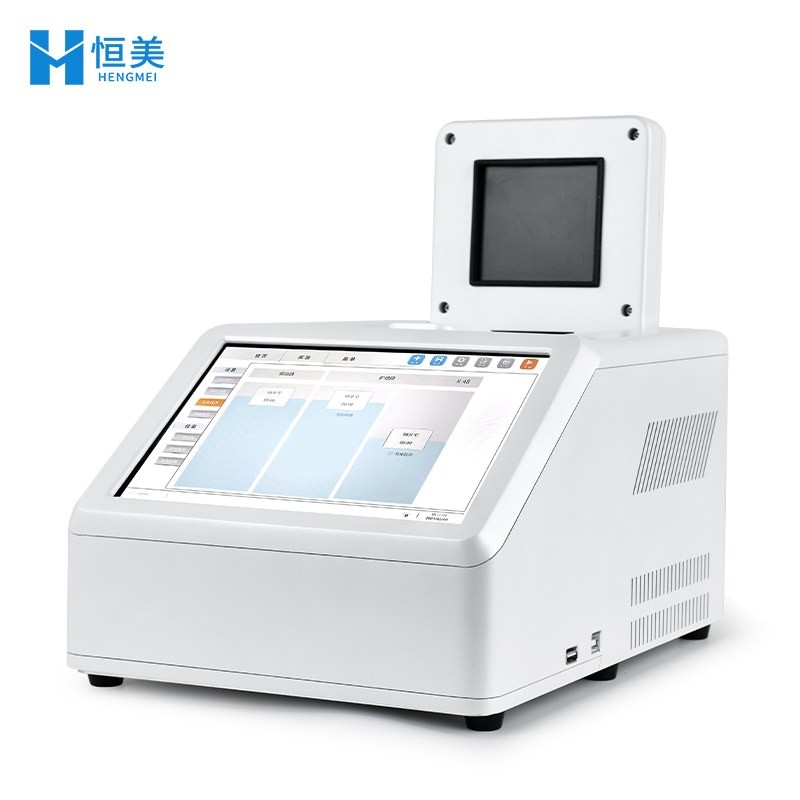
A 16-well instrument suits a plant laboratory; a quarantine laboratory receiving pallet samples from multiple consignments needs more. The HM-P48 accepts 48 × 0.2 mL tubes with sample volumes of 15–100 µL and reads real-time fluorescence across the amplification.
| Parameter | HM-P48 specification | Quarantine consequence |
|---|---|---|
| Sample capacity | 48 × 0.2 mL | A full consignment batch plus controls in one run |
| Temperature range | 4–99 °C | Covers hot-start activation through amplification |
| Ramp rate | ≥3.5 °C/s maximum | Shorter protocol, results within a working shift |
| Control accuracy | ≤±0.01 °C | Replicate agreement, which matters when Ct differences are small |
| Temperature accuracy | ≤±0.1 °C | Consistency between runs and between operators |
| Well uniformity | ≤±0.3 °C | Edge wells behave like centre wells, so a full plate is usable |
| Sample volume | 15–100 µL | Accommodates typical reaction volumes without a hardware change |
| Footprint / weight | 235 × 385 × 175 mm, 5.8 kg | Bench instrument, no dedicated thermal cycler room |
The uniformity figure deserves attention. On an instrument with poor well-to-well uniformity, laboratories compensate by leaving edge columns empty, which silently reduces a 48-well plate to a 32-well plate. A uniformity specification of ≤±0.3 °C is what allows the advertised capacity to be used in practice.
Controls that a quarantine result needs
A molecular detection result used for a regulatory decision must show that the run was valid, not only that a sample amplified. Four controls carry that burden.
- Positive control — reference DNA at a defined concentration, proving the assay worked.
- Negative control — water instead of template, proving no contamination entered the reaction.
- Extraction blank — a tube carried through extraction, proving the extraction reagents were clean.
- Internal amplification control — added to each sample to prove the reaction was not inhibited by wood extractives, which are a genuine problem with resin-rich material.
On a 48-well plate, four controls consume positions but are not optional. A batch of 44 samples with four controls is the realistic maximum for a defensible run.
Extraction from wood: the step that decides sensitivity
Wood is a difficult matrix. Polyphenols, resins and polysaccharides co-purify with DNA and inhibit amplification. A protocol that works on nematode culture will often fail on wood shavings unless the extraction includes a precipitation or column clean-up step designed for plant material.
Practically, laboratories should validate extraction against their own matrices — fresh pine, blue-stained wood, kiln-dried pallet timber — rather than relying on a protocol validated elsewhere. The internal amplification control is what reveals an inhibition problem before a false negative is reported.
Data and traceability
Quarantine results are read by people outside the laboratory: inspectors, importers, and sometimes a dispute process. The record needs to carry sample identity, consignment number, extraction batch, assay name, run date and the Ct values, not only positive or negative. Two USB 2.0 ports allow run data to be exported directly; the file format should be confirmed against the laboratory's record system before the instrument is installed, not after.
Where the instrument sits in the programme
| Activity | Method | Role |
|---|---|---|
| Initial screening of consignments | Real-time PCR | Fast negative clearance; flags positives |
| Confirmation of positives | Morphology plus PCR, or sequencing | Species-level certainty for regulatory action |
| Survey of forest trees | Sampling plus PCR | Early warning in standing timber |
| Wood packaging compliance | Inspection plus PCR where symptoms appear | Supports ISPM 15 compliance checks on imported packaging |
The ISPM 15 standard for wood packaging in international trade is the reason pallet material is inspected at all; the standard itself sets treatment requirements rather than laboratory methods, and the laboratory method follows the national plant protection organisation's protocol. Buyers should confirm which protocol their authority accepts before specifying an instrument.
Selecting for a quarantine workload
- Count samples per peak week, not per day. Quarantine demand is episodic and arrives in batches.
- Confirm the accepted assay and extraction protocol with the authority, then check that the instrument's channel configuration supports the assay's chemistry.
- Check well uniformity, because it determines whether the full plate is usable.
- Confirm data export format against the record system.
- Plan the extraction bench separately from the amplification area; a PCR instrument in a single room with extraction will produce contamination events.
How HENG MEI supports plant quarantine work
HENG MEI Intelligent Manufacturing builds real-time PCR instruments in 16-well and 48-well formats from the same platform, which lets a laboratory standardise protocols, consumables and training across screening and confirmation benches. For nematode work specifically, the 48-well instrument accommodates a full consignment batch with controls while keeping the benchtop footprint at 235 × 385 × 175 mm and 5.8 kg.
To match a configuration to a quarantine programme, tell our sales contact the assay your authority accepts, the samples per peak batch, the number of fluorescence channels required and the record system in use. Those four facts determine the model and the extraction workflow around it.
Contact: Grace, Sales Contact, graceliu@hmdzkj.cn, +86 17853698681 (Tel / WhatsApp / WeChat).
Address of this article:https://www.kjhm.net/news/pine-wood-nematode-detection-48-well-pcr.html
 Related News
-
13 / 2026-05
HengMei SmartBuild Turbidity Meter FAQ
Learn more
-
13 / 2026-11
HENG MEI Intelligent Manufacturing Choosing a PCR System for Fish and Shrimp Virus Tests
Learn more
-
15 / 2026-06
FAQ: Full-Wavelength Microplate Reader Technical Questions Answered by HM Instruments Experts
Learn more
-
29 / 2025-09
How Soybean Protein Analyzers Achieve Rapid Multi-Index Detection?
Learn more