

 Current
Location:
GMO Screening in Agricultural Products with 16-Well PCR | HENG MEI Intelligent Manufacturing
Article Source: Hengmei Technology Release time:2026-11-16 17:37:21
Genetically modified material in grain, feed and processed food is tested in two stages, and confusing them causes most of the arguments. The first stage asks whether transgenic material is present at all — a screening question. The second asks which transformation event it is, and in some jurisdictions what percentage of the product it represents. A 16-well real-time PCR instrument serves both, but only if the laboratory has planned which question each run answers.
This article sets out how a screening programme is structured, what the HM-P16 provides, and where the limits lie. It is written by the engineering team at HENG MEI Intelligent Manufacturing.
Stage one: screening for elements, not events
Most transgenic constructs share a small number of regulatory elements: the CaMV 35S promoter, the NOS terminator, and a few commonly used marker or trait genes. A screening assay targets those elements rather than a specific event, which means one assay can flag a wide range of constructs — including ones the laboratory has never seen before.
The trade-off is interpretive. A positive 35S result proves that transgenic material is present; it does not identify the event, and it cannot support a labelling decision on its own. Screening is a triage step that decides which samples proceed to event-specific testing.
Stage two: event-specific confirmation
Event-specific assays target the junction between the inserted construct and the plant genome, and are unique to one transformation event. Confirming an event requires knowing which events are approved and which are relevant to the commodity being tested — maize, soya, rice and rapeseed have different candidate lists, and the list changes as approvals change.
A practical programme keeps a small panel of element assays for screening and a larger, updated panel of event assays for confirmation, and reviews the event panel annually. Laboratories that freeze the panel discover, eventually, that they have been confirming last year's approvals.
Quantification is a different method
Detecting an event is qualitative. Reporting a percentage — the figure labelling rules usually refer to — requires quantitative real-time PCR with a calibration curve built from certified reference materials, and it requires that the assay be validated for the specific matrix. Processed products degrade DNA and change the ratio between the transgenic target and the reference gene, which is why quantification in refined ingredients is materially harder than in raw grain.
An instrument that performs well qualitatively is a precondition for quantification, not a guarantee of it. Buyers who intend to report percentages should confirm that reference materials for their target events are obtainable before committing to the method.
The instrument specification
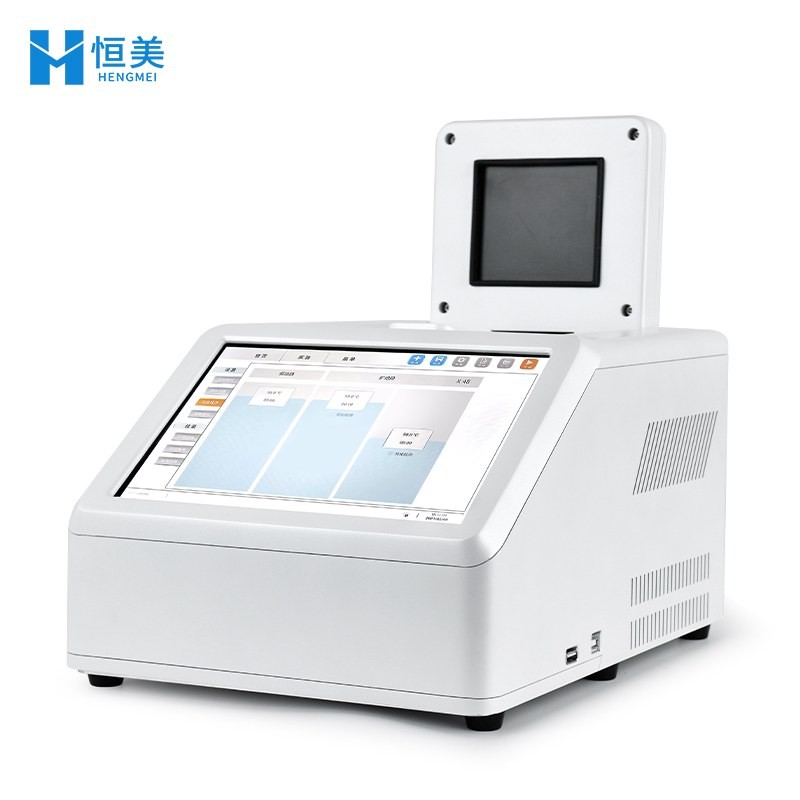
| Parameter | HM-P16 specification | Effect on GMO work |
|---|---|---|
| Sample capacity | 16 × 0.2 mL | Sufficient for screening batches with controls; not a high-throughput plate |
| Sample volume | 15–100 µL | Standard reaction volumes without hardware change |
| Temperature range | 4–99 °C | Covers hot-start and amplification |
| Ramp rate | ≥3.5 °C/s maximum | Run completes within a working shift |
| Control accuracy | ≤±0.01 °C | Replicate agreement for Ct comparison |
| Well uniformity | ≤±0.3 °C | All 16 positions usable, including edge wells |
| Footprint / weight | 235 × 385 × 175 mm, 5.6 kg | Bench instrument for a modest laboratory |
| Data interface | USB 2.0 × 2 | Run files exported for the record system |
A 16-well instrument suits a laboratory screening a handful of lots per day, or a grain purchaser checking incoming deliveries. Laboratories processing hundreds of samples a week should specify a 48-well platform; the decision is arithmetic, not preference.
Controls and the inhibition problem
Grain and feed are inhibitory matrices. Polysaccharides, polyphenols and residual extraction chemicals suppress amplification, and a suppressed reaction looks exactly like a negative result unless the run includes an internal amplification control. A screening programme without an internal control is a programme that reports false negatives with confidence.
- Positive control — certified reference material or a validated plasmid, at a defined copy number.
- Negative control — no template, to detect contamination.
- Extraction blank — carried through the whole procedure.
- Internal amplification control — in every sample reaction, to prove the reaction worked.
On a 16-well instrument, controls consume a quarter of the capacity. That is the honest cost of a defensible result, and it should be built into throughput planning rather than discovered later.
Extraction from processed matrices
Raw grain is comparatively easy. Flour, oil, syrup and processed feed are not: DNA is fragmented, and in refined oils it may be present at concentrations below reliable detection. Laboratories should validate extraction against the matrices they actually receive, using the national standard methods for nucleic acid extraction and real-time PCR where a jurisdiction specifies them — in China, the GB/T 19495 series covers nucleic acid extraction, qualitative PCR and quantitative PCR for genetically modified products.
Where a result will be used for labelling or for a regulatory decision, the method must be the one the authority recognises. An instrument does not confer method status.
Where a 16-well workflow fits
| Setting | Fit | Reason |
|---|---|---|
| Grain and oilseed purchaser | Strong | Incoming lot screening, few samples per day |
| Feed mill quality control | Strong | Screening incoming materials against specification |
| Regional testing laboratory | Moderate | Fine for screening; volume may push toward 48-well |
| Export certification | Conditional | Requires the importing country's accepted method and, where stated, quantification |
How HENG MEI supports GMO testing programmes
HENG MEI Intelligent Manufacturing supplies the 16-well HM-P16 and the 48-well HM-P48 from the same real-time PCR platform, so a laboratory can start with screening and add capacity without changing protocols or training. Reagents for the customer's chosen assay are supplied with the instrument as a starting configuration; the assay panel itself is selected by the laboratory or its authority.
To specify a configuration, tell our sales contact the commodities tested, whether results must be qualitative or quantitative, the samples per day, and the method standard your authority recognises. Those four facts determine the instrument and the extraction workflow around it.
Contact: Kyra, Sales Contact, Kyra@hmdzkj.cn, +86 13792642016 (Tel / WhatsApp / WeChat).
Address of this article:https://www.kjhm.net/news/gmo-screening-agricultural-products-16-well-pcr.html
- Previous: Pine Wood Nematode Detection with 48-Well PCR | HENG MEI Intelligent Manufacturing
- Next: no more
 Related News
-
13 / 2026-05
HengMei SmartBuild Turbidity Meter FAQ
Learn more
-
12 / 2024-11
Unlock the Secrets of Photosynthesis with Portable Photosynthesis Meter.
Learn more
-
16 / 2026-11
Animal Disease Testing by Sector: Farm, Abattoir, Lab and Clinic | HENG MEI Intelligent Manufacturing
Learn more
-
07 / 2026-08
HM Instruments Phthalate Detector Technical FAQ
Learn more