

 Current
Location:
How to Choose a Fluorescence Chlorophyll-a Water Analyzer: Portable Meter vs. Online Sensor
Article Source: Hengmei Technology Release time:2026-11-27 14:12:12
Monitoring chlorophyll-a in lakes, reservoirs, drinking-water intakes, aquaculture ponds, and coastal surveys gives water managers an early, quantitative indicator of phytoplankton biomass before visible algal blooms or oxygen depletion occur. Unlike laboratory acetone extraction—which requires filtering water samples, grinding cells, extracting pigments in solvent, and reading absorbance on a benchtop spectrophotometer—in-situ fluorescence chlorophyll-a analyzers excite phytoplankton pigments with a targeted light wavelength and measure the resulting red fluorescence directly in water within seconds.
When procuring fluorescence chlorophyll-a instrumentation, buyers typically choose between two deployment architectures: a portable handheld meter for multi-site field surveys, or an online submersible sensor for continuous 24/7 station monitoring. Within the HENG MEI Intelligent Manufacturing catalog, the FT-SS15S portable chlorophyll-a analyzer and the FT-S15S online chlorophyll-a sensor share the same 0–400 µg/L fluorescence measurement core, 0.01 µg/L resolution, R² > 0.999 linearity, and automatic self-cleaning wiper, while differing in housing material, power architecture, and data interface.
Why In-Situ Fluorescence Outperforms Manual Extraction for Routine Screening
Chlorophyll-a molecules absorb blue-spectrum light—such as the 469 nm excitation wavelength used in the FT-S15S optical design—and re-emit a fraction of that energy as longer-wavelength fluorescence. Because fluorescence intensity is proportional to chlorophyll-a concentration across natural algal populations, an optical probe can quantify phytoplankton density non-destructively without reagents or sample transport.
For environmental agencies, water-utility intake operators, and aquaculture technicians, this translates into two practical benefits. First, measurements are immediate: technicians can profile vertical depth layers in a reservoir or check ten ponds in a single morning without waiting for lab extraction. Second, because temperature shifts affect fluorescence quantum yield, built-in automatic temperature compensation (ATC) corrects readings in real time across seasonal water temperatures.
Comparing Portable FT-SS15S and Online FT-S15S Specifications
Choosing between a handheld kit and a fixed-station probe depends on whether your team moves between sampling points or logs continuously at a single intake, buoy, or outflow weir. The table below compares the verified specifications of the FT-SS15S portable analyzer and the FT-S15S online sensor.
| Parameter / Feature | FT-SS15S (Portable Handheld Kit) | FT-S15S (Online Submersible Sensor) |
|---|---|---|
| Measurement Principle | Fluorescence method | Fluorescence method (469 nm wavelength) |
| Measurement Range | 0–400 µg/L | 0–400 µg/L |
| Resolution | 0.01 µg/L | 0.01 µg/L |
| Linearity / Accuracy | R² > 0.999 | R² > 0.999 |
| Temperature Compensation | Automatic temperature compensation | Automatic temperature compensation |
| Self-Cleaning Mechanism | Integrated cleaning brush | Automatic cleaner (0.7 W; configurable interval and cycles) |
| Sensor Housing / Protection | Injection-molded probe, IP68; Host IP65 | 316L stainless steel housing, IP68 |
| Communication Protocol | RS485 Modbus RTU (2× 485 ports on QS2 host) | RS485 Modbus RTU (4-core shielded cable) |
| Cable Length | 5 m standard (customizable; single or multi-drop) | 5 m standard (5-core aviation plug cable) |
| Display & Operation | 3.5-inch color LCD (320 × 480), tactile buttons (wet-hand safe) | Connects to PLC, RTU, or data logger via RS485 |
| Data Storage & Export | 8 GB memory (280M records); USB virtual disk Excel export | Managed by external controller / SCADA / DTU |
| Power Supply | 3800 mAh rechargeable lithium battery + Type-C (5V/2A) | DC 12–24 V (0.4 W measurement power at 12 V) |
| Operating Environment | Host: 0–40 °C, ≤85% RH non-condensing | 0–50 °C, <0.2 MPa pressure; storage -5 to 65 °C |
| Mounting / Form Factor | Handheld host 167 × 80 × 30 mm, 263 g; aluminum case | 3/4 NPT immersion thread (fixed bracket installation) |
| Optional Expansions | Blue-green algae sensor (0–200.0 Kcells/mL), GNSS, DTU-4G | Two-point calibration via host software or Modbus commands |
When to Select the FT-SS15S Portable Chlorophyll-a Meter
The FT-SS15S is engineered for mobile field teams—lake survey crews, environmental inspection agencies, river-basin patrol boats, and multi-pond aquaculture operations. Its QS2 handheld host weighs just 263 g (167 × 80 × 30 mm) and pairs a 3.5-inch 320 × 480 color LCD with pure-button navigation (where the Set/OK key works reliably even with wet hands or gloves, unlike capacitive touchscreens that misfire in rain). Its 3800 mAh lithium battery charges over Type-C and supports adjustable logging intervals (5, 10, 15, 30, 60, or 300 seconds) into 8 GB of internal memory—holding up to 280 million single-parameter records. Back at the office, plugging the host into a PC via USB mounts it as a virtual drive with daily Excel spreadsheets, requiring no proprietary driver software.
Because the QS2 host includes two RS485 ports and supports multi-sensor harnesses, buyers can also expand the kit with a blue-green algae (cyanobacteria) sensor (0–200.0 Kcells/mL, R² > 0.999, 0.1 Kcells/mL resolution) or add optional GNSS location tagging and an external DTU-4G telemetry module.
When to Select the FT-S15S Online Chlorophyll-a Sensor
The FT-S15S is built for unattended, continuous deployment at water-treatment plant intakes, reservoir monitoring buoys, river automatic monitoring stations, and coastal aquaculture inflows. Its 316L stainless steel body resists corrosion in brackish and marine environments while withstanding pressures up to 0.2 MPa and temperatures from 0 to 50 °C. Powered by a standard 12–24 V DC supply (drawing just 0.4 W during measurement and 0.7 W during wiper cycles), it integrates directly into existing SCADA systems, PLCs, or solar-powered telemetry RTUs over RS485 Modbus RTU using a 4-wire interface (red 12–24 V+, black GND, yellow 485A, green 485B) and a 3/4 NPT mounting thread.
Key Engineering Details That Affect Field Accuracy
Regardless of whether you choose a portable or fixed-station unit, three hardware details determine how well a fluorescence chlorophyll-a analyzer performs after the first month in natural water.
1. Automatic Optical Window Cleaning
Biofouling—algal biofilm, silt, and attached microorganisms—coats submerged optical windows within days in eutrophic water, causing signal drift and false low readings. Both FT-SS15S and FT-S15S incorporate a mechanical self-cleaning brush across the optical window. On the FT-S15S online sensor, operators can program both cleaning intervals and wipe counts via Modbus. According to the FT-S15S maintenance schedule, a brush-equipped sensor extends manual lens-cleaning intervals from every 0.5–3 days (typical of brush-less probes) to once every 4–8 weeks.
2. Ambient Light Interference and Calibration Vessels
Bright sunlight entering the sample volume can elevate background scatter during portable spot checks. That is why the FT-SS15S standard kit ships with a dedicated black calibration/measurement bucket: immersing the probe inside the opaque black container blocks stray ambient light during field verification and zero checks. Similarly, two-point calibration of the FT-S15S sensor uses a brown beaker (with the sensor tip held at least 10 cm above the beaker bottom) to shield the optical path from room or solar light.
3. Proper Submerged Clearance and Flow Orientation
For fixed-station installations using the FT-S15S, mounting geometry directly affects data quality. The sensor must be rigidly mounted—using its 3/4 NPT thread or a fixed bracket—rather than hung loosely on a drag chain. The probe tip should remain at least 10 cm below the water surface, at least 10 cm above the tank or riverbed, and at least 3 cm away from side walls so water flows cleanly across the optical window without stagnant pockets or wall reflections.
Standard Packing Lists and Optional Accessories
Reviewing the factory packing list prevents missing cables or calibration containers when commissioning a new site:
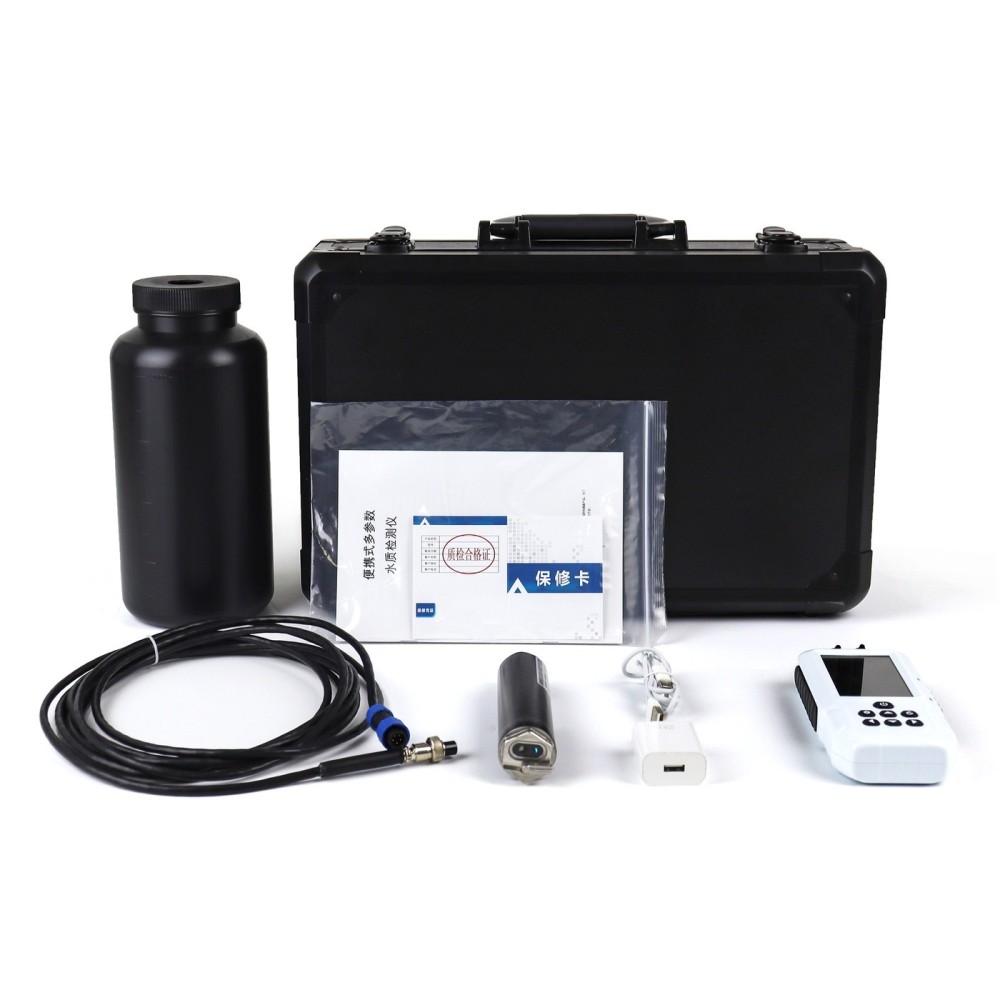
- FT-SS15S standard kit (10 items): 1 QS2 handheld host, 1 5V-2A power charger, 1 USB-to-Type-C cable, 1 injection-molded chlorophyll-a sensor with cleaning brush, 1 black light-shielding bucket, 1 5-meter RS485 cable, 1 aluminum-alloy carrying case (310 × 435 × 140 mm), 1 warranty card, 1 certificate of conformity, and 1 A5 instruction manual. Optional factory add-ons include GNSS positioning and an external DTU-4G module.
- FT-S15S standard kit (5 items): 1 316L stainless steel chlorophyll-a sensor, 1 5-meter 5-core aviation-plug communication/power cable, 1 instruction manual, 1 certificate of conformity, and 1 warranty card.
Application Fit Across Watersheds, Drinking-Water Intakes, and Aquaculture
Because phytoplankton dynamics vary widely across water bodies, matching the instrument format to the monitoring objective prevents both data gaps and unnecessary field labor:
- Drinking-water reservoirs and treatment intakes: Early detection of spring and summer algal blooms at raw-water intakes helps plant operators adjust pre-oxidation, coagulation, or activated-carbon dosing before filter clogging or taste-and-odor compounds reach distribution lines. Fixed FT-S15S sensors mounted at intake depths provide continuous 0–400 µg/L feedback to plant SCADA screens.
- Lakes, rivers, and coastal surveys: Environmental agencies and research teams conducting transect surveys across multiple sampling stations benefit from the FT-SS15S portable kit. Its 5-meter cable reaches surface and mid-column depths from a survey boat, while optional GNSS tags each reading with coordinates and daily Excel files export directly over USB.
- Intensive aquaculture ponds: In shrimp and fish ponds, moderate phytoplankton density supports natural productivity and oxygen generation during daylight, whereas excessive blooms crash suddenly and deplete dissolved oxygen overnight. Pond managers use the FT-SS15S to track chlorophyll-a trends across multiple ponds before bloom collapse occurs.
- Cyanobacteria risk screening: Where eutrophic lakes or reservoirs experience mixed algal and blue-green algal blooms, pairing chlorophyll-a measurement with the optional blue-green algae probe (0–200.0 Kcells/mL) on the QS2 handheld host separates total phytoplankton pigment from cyanobacterial cell density.
Procurement Decision Matrix for Water Quality Teams
- Define your deployment pattern: Choose FT-SS15S for multi-pond, boat, or shoreline spot checks; choose FT-S15S for continuous 24/7 intake, buoy, or SCADA stations.
- Check water salinity and mounting: If deploying continuously in brackish or marine water, the 316L stainless steel housing and 3/4 NPT thread of the FT-S15S provide long-term corrosion resistance and rigid pipe mounting.
- Confirm telemetry and logging needs: If field crews need standalone Excel logs without cloud fees, FT-SS15S exports daily Excel files directly via USB. If you need live remote alarms, pair FT-SS15S with DTU-4G or connect FT-S15S via Modbus RTU to your station RTU.
- Plan multi-parameter expansion: If your monitoring program also tracks cyanobacteria (blue-green algae), turbidity, or dissolved oxygen, verify RS485 multi-drop harness options for the QS2 handheld host at order time.
Frequently Asked Questions About Chlorophyll-a Analyzers
What is the measurement range of the FT-SS15S and FT-S15S?
Both the FT-SS15S portable meter and the FT-S15S online sensor measure chlorophyll-a from 0 to 400 µg/L with a resolution of 0.01 µg/L and linearity of R² > 0.999.
Can the FT-SS15S host read other sensors besides chlorophyll-a?
Yes. The QS2 handheld host uses two RS485 Modbus RTU ports and supports single or multi-sensor harnesses, allowing compatible sensors such as the blue-green algae probe (0–200.0 Kcells/mL) to be connected alongside chlorophyll-a.
How often does the FT-S15S online sensor need manual cleaning?
Because the FT-S15S includes an integrated automatic cleaning wiper, routine manual cleaning is typically extended to every 4 to 8 weeks, with general sensor inspection every 6 months and O-ring replacement every 1 to 2 years.
Requesting a Quotation from HENG MEI Intelligent Manufacturing
Shandong Hengmei Electronic Technology Co., Ltd., operating under the brand HENG MEI Intelligent Manufacturing, provides both the FT-SS15S portable chlorophyll-a analyzer and the FT-S15S online 316L chlorophyll-a sensor. To request pricing, cable-length customization, or multi-parameter harness options, share your target application (portable survey or fixed SCADA station), required cable length, and whether GNSS, DTU-4G, or blue-green algae expansion is needed.
Contact: Grace, Sales Contact, graceliu@hmdzkj.cn, +86 17853698681 (Tel / WhatsApp / WeChat).
Address of this article:https://www.kjhm.net/news/how-to-choose-chlorophyll-a-water-analyzer.html
 Related News
-
20 / 2026-11
COD Analyzer Model Comparison for HM-SCOD, HM-BLC, HM-T04L and HM-T04 | HENG MEI Intelligent Manufacturing
Learn more
-
22 / 2024-10
Enhance Dairy Excellence With Our Rapid Milk Analyzers.
Learn more
-
13 / 2026-11
HENG MEI Intelligent Manufacturing Selecting a Multifunction Food Safety Analyzer
Learn more
-
14 / 2024-09
How To Use Soil Rapid Detector To Optimize Farmland Fertilization Strategy.
Learn more