

 Current
Location:
How to Choose a Sulfide Acidification Purging Apparatus: 4-Position, 6-Position, and HJ 1226-2021 Models
Article Source: Hengmei Technology Release time:2026-11-27 14:12:16
Accurate determination of dissolved sulfide in wastewater, surface water, and groundwater depends heavily on sample pretreatment before spectrophotometric or iodometric analysis. Because turbid, colored, or complex water matrices interfere directly with methylene blue color development, environmental testing laboratories rely on a sulfide acidification purging apparatus to acidify the water sample, strip hydrogen sulfide gas under a controlled nitrogen stream in a heated water bath, and trap the sulfide ions cleanly into an absorption solution (zinc acetate–sodium acetate or 2% sodium hydroxide).
When specifying a sulfide pretreatment system for a third-party testing laboratory, municipal wastewater plant, or environmental monitoring station, buyers must evaluate three practical criteria: the number of parallel sample positions (4-position vs. 6-position), alignment with legacy standards (GB/T 16489-1996 / HJ/T 600-2000) versus the updated 2022 national standard (HJ 1226-2021), and whether the lab tests freshwater or high-volume seawater samples. In the HENG MEI Intelligent Manufacturing lineup, three models—HM-LHW4, HM-LHW6, and HM-LHW60—address these exact procurement tiers.
How Sulfide Acidification and Nitrogen Purging Works
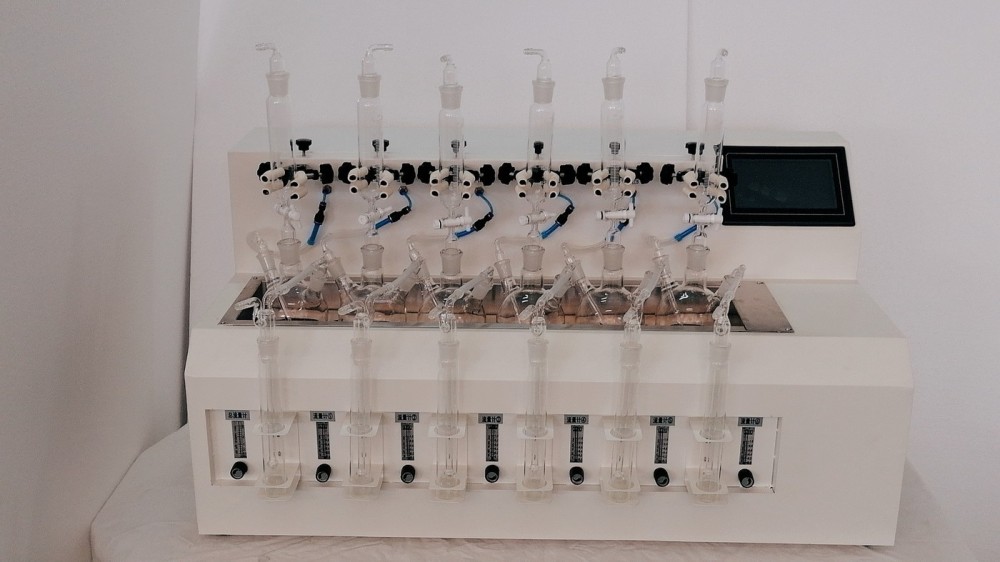
All three models—HM-LHW4, HM-LHW6, and HM-LHW60—operate on the same chemical pretreatment principle. A measured water sample is placed inside a glass reaction flask seated in a thermostatic water bath (adjustable from room temperature up to 99.9 °C). After hydrochloric acid is introduced through an isolated acid-addition port, sulfide species in the water convert into volatile hydrogen sulfide (H2S) gas.
Purified nitrogen gas (at 0.1 MPa inlet pressure) enters through an independent gas inlet and bubbles through the acidified sample, carrying the released H2S out through the gas outlet into an absorption bottle or colorimetric absorption tube filled with zinc acetate–sodium acetate solution or 2% sodium hydroxide solution. Once purging is complete, the clean absorbed sulfide solution is ready for methylene blue spectrophotometry or iodometric titration without matrix turbidity interference.
Comparing HM-LHW4, HM-LHW6, and HM-LHW60 Specifications
Choosing between the standard 4-position, standard 6-position, and intelligent 6-position units comes down to daily sample throughput, temperature precision, control interface, and standard-method alignment. The table below compares the verified specifications of all three models.
| Specification | HM-LHW4 (Standard 4-Position) | HM-LHW6 (Standard 6-Position) | HM-LHW60 (Intelligent 6-Position) |
|---|---|---|---|
| Sample Positions | 4 positions | 6 positions | 6 positions |
| Applicable Standard Tier | Legacy standard tier (GB/T 16489-1996 / HJ/T 600-2000); also listed with HJ 1226-2021 | Legacy standard tier: GB/T 16489-1996, HJ/T 600-2000 | 2022 new standard: HJ 1226-2021 |
| Control Interface | Digital display | Digital display | 7-inch large LCD touchscreen |
| Heating Method & Power | Automatic thermostatic water bath, 1000 W | Automatic thermostatic water bath, 1000 W | Automatic thermostatic water bath, 1000 W |
| Temperature Range | Room temp to 99.9 °C | Room temp to 99.9 °C | Room temp to 99.9 °C |
| Temperature Control Accuracy | ±1 °C | ±1 °C | ±0.5 °C |
| Total Nitrogen Flowmeter | 0–3 L/min | 0–3 L/min | 0–3 L/min |
| Branch Nitrogen Flow Control | 0–0.6 L/min (independent per channel) | 0–0.6 L/min (independent per channel) | 0–1 L/min (independent per channel) |
| Nitrogen Inlet Pressure | 0.1 MPa | 0.1 MPa | 0.1 MPa |
| Reaction Flask & Absorption Tube | 4 reaction flasks; 4 × 50 mL + 4 × 10 mL tubes | 6-position reaction flasks & absorption tubes | 6 × 500 mL reaction flasks; 6 × 100 mL absorption tubes |
| Acid Addition Mode | Manual acid addition (standard) | Manual acid addition (standard) | Manual acid addition (standard); automatic acid addition optional |
| Power Supply | AC (220 ± 22) V, 50 Hz | AC (220 ± 22) V, 50 Hz | AC 220 V, 50 Hz |
| Operating Environment | 5–35 °C, 0–95% RH | 5–35 °C, 0–95% RH | 5–35 °C, 0–95% RH |
1. HM-LHW4: Compact 4-Position Pretreatment for Lower Sample Volumes
The HM-LHW4 is a 4-position acidification purging unit suited for laboratories that process smaller batches of wastewater or surface water samples. It uses a 1000 W automatic thermostatic water bath (room temperature to 99.9 °C, ±1 °C accuracy), a 0–3 L/min total nitrogen flowmeter, and four independent 0–0.6 L/min branch needle-valve flowmeters. Each position features a three-port glass assembly that keeps the hydrochloric acid inlet, nitrogen gas inlet, and gas outlet physically separated to prevent cross-interference during operation. It ships with 4 reaction flasks, 4 acid-addition funnels, 4 × 50 mL absorption tubes, 4 × 10 mL absorption tubes, gas tubing, and spare fuses.
2. HM-LHW6: Standard 6-Position Throughput on a Practical Budget
The HM-LHW6 expands batch capacity to 6 parallel samples while retaining the same digital temperature controller (±1 °C), 1000 W water bath, and 0–0.6 L/min per-channel nitrogen needle valves as HM-LHW4. Built around the classic GB/T 16489-1996 (methylene blue spectrophotometric method) and HJ/T 600-2000 (iodometric method) workflows, it is a cost-effective fit for industrial wastewater stations and testing labs that continue operating under legacy standard protocols and want six-channel productivity without paying for touchscreen automation.
3. HM-LHW60: Intelligent 6-Position System for HJ 1226-2021 Compliance
The HM-LHW60 is the flagship intelligent 6-position sulfide distillation and purging apparatus developed for the 2022 updated standard HJ 1226-2021 (Water Quality—Determination of Sulfide—Methylene Blue Spectrophotometry). It upgrades the operator interface to an integrated 7-inch color LCD touchscreen, tightens water-bath temperature control to ±0.5 °C, widens per-branch nitrogen flow adjustment to 0–1 L/min, and standardizes glassware on 6 × 500 mL reaction flasks paired with 6 × 100 mL absorption tubes. For third-party environmental laboratories that undergo method accreditation audits under HJ 1226-2021, HM-LHW60 provides the tighter thermal stability and larger absorption volume required by modern protocols.
Standard Method Alignment: GB/T 16489-1996, HJ/T 600-2000, and HJ 1226-2021
A frequent procurement question from third-party testing laboratories and industrial wastewater stations is whether to specify a unit built around legacy sulfide methods or the 2022 updated national standard. In practice, both standard tiers remain active across different client contracts and regional monitoring programs, so matching the apparatus to your laboratory's accredited method is essential:
- Legacy Methylene Blue & Iodometric Methods (GB/T 16489-1996 & HJ/T 600-2000): Both HM-LHW4 (4-position) and HM-LHW6 (6-position) are standard digital water-bath purging units designed around these established protocols, offering ±1 °C bath stability and 0–0.6 L/min per-branch nitrogen flow control at a lower capital cost.
- 2022 Updated Methylene Blue Method (HJ 1226-2021): The intelligent HM-LHW60 (6-position) is purpose-built for HJ 1226-2021, upgrading to a 7-inch LCD touchscreen, tighter ±0.5 °C water-bath control, 0–1 L/min per-branch nitrogen regulation, 500 mL reaction flasks, and 100 mL absorption tubes.
- Downstream Analytical Compatibility: Regardless of which model performs the acidification and nitrogen purging step, the resulting absorbed sulfide solution (in zinc acetate–sodium acetate or 2% sodium hydroxide) is compatible with both methylene blue spectrophotometry (for trace to moderate concentrations) and iodometric titration (for higher-concentration industrial effluents).
Key Engineering and Customization Factors Before Ordering
Beyond choosing between 4 and 6 positions, three practical configuration details should be confirmed before placing a purchase order:
- Manual vs. automatic acid addition: On all three standard configurations—HM-LHW4, HM-LHW6, and HM-LHW60—acid addition is performed manually via the dedicated acid funnel/port. However, HM-LHW60 can be custom-ordered with an automatic acid-addition module (an optional upgrade with a roughly three-week production lead time) for labs seeking reduced operator contact with hydrochloric acid.
- Freshwater (500 mL) vs. seawater (2000 mL) reaction flasks: Standard HM-LHW60 units ship with 500 mL reaction flasks, which fit municipal, industrial, and surface-water protocols. If your laboratory tests low-concentration seawater or marine samples requiring larger sample volumes, 2000 mL reaction flasks can be specified as a factory customization.
- Front-access lifting sample rack: All three models include a lifting and rotating sample rack with a position-locking knob, allowing technicians to mount reaction flasks and glassware from the front of the bench rather than reaching across a hot water bath.
Procurement Checklist for Environmental and Third-Party Labs
- Verify your governing test standard: Confirm whether your lab's accreditation or client contracts specify GB/T 16489-1996 / HJ/T 600-2000 (served by HM-LHW4 and HM-LHW6) or HJ 1226-2021 (served by HM-LHW60).
- Match batch capacity to daily queue: If you run duplicate blanks, spikes, and 2–4 field samples per batch, a 6-position unit (HM-LHW6 or HM-LHW60) completes a full QA/QC batch in a single 1000 W heating cycle.
- Check nitrogen supply readiness: All models require a 0.1 MPa regulated nitrogen gas source (cylinder or nitrogen generator) capable of supplying up to 3 L/min total flow.
- Confirm flask volume and acid-dosing preference: Specify at quote time if you need 2000 mL flasks for marine/seawater samples or the optional automatic acid-addition configuration on HM-LHW60.
- Plan fume-hood bench space: Because hydrochloric acid and H2S gas are handled during purging, install the apparatus inside or directly adjacent to a chemical fume hood with AC 220 V, 50 Hz power.
Frequently Asked Questions About Sulfide Acidification Purging Apparatus
What is the main difference between HM-LHW6 and HM-LHW60?
Both are 6-position water-bath sulfide purging units, but HM-LHW6 uses a digital display with ±1 °C control and 0–0.6 L/min branch flowmeters for legacy standards (GB/T 16489-1996 / HJ/T 600-2000), whereas HM-LHW60 adds a 7-inch LCD touchscreen, ±0.5 °C temperature accuracy, 0–1 L/min branch flowmeters, 500 mL reaction flasks, and 100 mL absorption tubes designed for HJ 1226-2021.
Is automatic acid addition standard on HM-LHW60?
No. Manual acid addition is standard on HM-LHW4, HM-LHW6, and HM-LHW60. Automatic acid addition is available as a custom factory option on HM-LHW60 with an extended production lead time.
Can these units handle seawater sulfide testing?
Yes, with flask customization. Standard HM-LHW60 units include 500 mL reaction flasks, while laboratories testing seawater samples can request 2000 mL reaction flasks as a factory configuration option.
Installation, Utility, and Accessories Planning
Before delivery of an HM-LHW4, HM-LHW6, or HM-LHW60 unit, laboratory managers should verify three benchtop infrastructure items: a chemical fume hood with sufficient vertical clearance for the glass reaction flasks and acid-addition funnels, a regulated AC 220 V, 50 Hz power outlet rated for the 1000 W water-bath heater, and a 0.1 MPa nitrogen gas supply line capable of delivering up to 3 L/min total flow.
Standard shipments include the main water-bath unit, lifting sample rack, reaction flasks, acid-addition funnels, absorption tubes, gas tubing, power cord, spare fuses (on HM-LHW4), operation manual, and warranty documentation. Keeping spare reaction flasks and absorption tubes in stock helps high-throughput third-party labs rotate clean glassware between consecutive batches without waiting for drying cycles.
Requesting a Quotation from HENG MEI Intelligent Manufacturing
Shandong Hengmei Electronic Technology Co., Ltd., operating under the brand HENG MEI Intelligent Manufacturing, supplies the HM-LHW4, HM-LHW6, and HM-LHW60 sulfide acidification purging units for environmental and industrial water laboratories. When requesting a quotation, share your target model (4-position or 6-position), applicable test standard (GB/T 16489-1996, HJ/T 600-2000, or HJ 1226-2021), sample matrix (freshwater or seawater), and whether standard manual acid addition or custom automatic acid dosing is required.
Contact: Arthur, Sales Contact, Arthur@hmdzkj.cn, +86 18353666151 (Tel / WhatsApp / WeChat).
Address of this article:https://www.kjhm.net/news/how-to-choose-sulfide-acidification-purging-apparatus.html
 Related News
-
20 / 2026-11
Colloidal Gold Reader Model Comparison for HM-JD01, HM-JD02, HM-JD03 and HM-JD04 | HENG MEI Intelligent Manufacturing
Learn more
-
16 / 2026-11
Portable Pesticide Residue Detector for Field Screening | HENG MEI Intelligent Manufacturing
Learn more
-
16 / 2026-11
Meat Species Identification by Real-Time PCR | HENG MEI Intelligent Manufacturing
Learn more
-
26 / 2024-11
Microwave digestion instrument: an efficient and environmentally friendly sample pretreatment tool.
Learn more