

 Current
Location:
How to Choose a Mercury-Free BOD Analyzer for Wastewater and Environmental Labs
Article Source: Hengmei Technology Release time:2026-11-27 14:12:08
Selecting a biochemical oxygen demand (BOD) analyzer for a wastewater treatment plant, industrial discharge facility, third-party testing laboratory, or university research lab starts with matching the measurement principle and sample throughput to your daily testing load. Traditional dilution-and-titration methods require multiple dilution ratios, dissolved oxygen (DO) meter checks before and after five days of incubation, and careful volumetric glassware handling. By contrast, mercury-free differential pressure (respirometric) BOD analyzers automate oxygen-uptake tracking inside sealed culture bottles over 1 to 30 days, displaying BOD concentration directly in mg/L without manual titration or mercury manometers.
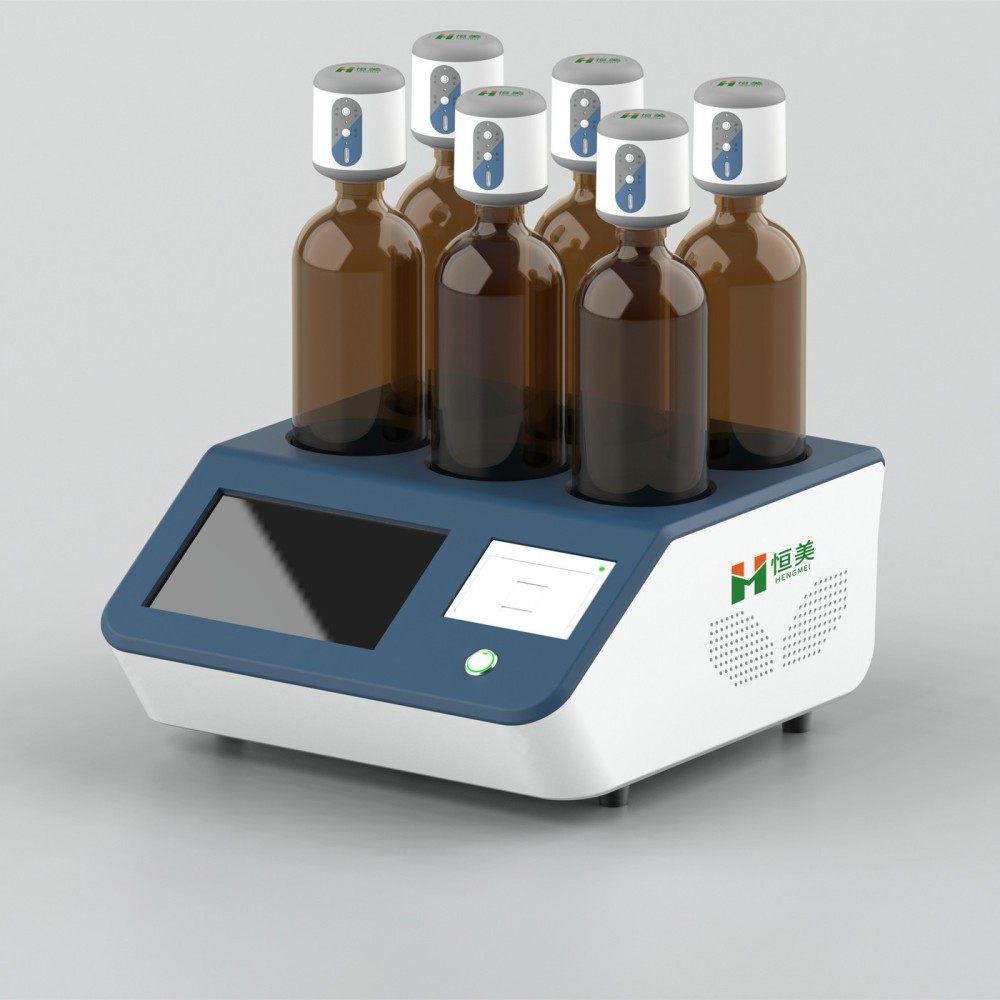
Within the product portfolio of HENG MEI Intelligent Manufacturing, two 6-position mercury-free BOD analyzers—the basic HM-BOD and the intelligent cloud-enabled HM-BOD5—cover the same 0–4000 mg/L direct measurement range while offering distinct levels of display, wireless telemetry, printing, and logging flexibility. Understanding where these two models overlap and where they diverge helps procurement teams specify the right instrument without overbuying unused automation or under-specifying data traceability.
Why Mercury-Free Differential Pressure Sensing Replaces Legacy Manometers
In a differential pressure BOD test—aligned with the biological degradation principles referenced in national standard HJ 505-2009 (5-day incubation method)—microorganisms consume dissolved oxygen in a sealed 580 mL brown culture bottle as they oxidize organic matter at 20 ± 1 °C. As oxygen is consumed, carbon dioxide is released into the headspace and absorbed by granular sodium hydroxide placed in a reagent absorption cup above the water sample. This produces a net pressure drop in the closed bottle headspace that is proportional to the oxygen consumed by microbial respiration.
Older manometric BOD instruments relied on liquid mercury columns to indicate that pressure drop, creating breakage hazards, vapor exposure risks, and laboratory hazardous-waste disposal burdens. Modern mercury-free differential pressure sensors measure headspace pressure electronically inside each bottle's independent test head. Because there are no external tubing lines connecting bottles to a central manifold, labs avoid tubing aging, seal cracking, and cross-channel air leaks that historically ruined five-day runs.
Key Operational Advantages of Independent 6-Position Heads
- Zero mercury hazard: Electronic pressure transducers eliminate mercury spills and regulatory disposal costs while maintaining direct mg/L concentration readouts.
- Independent sample scheduling: Both HM-BOD and HM-BOD5 feature 6 independent test terminals. Technicians can start a new sample group in an open position without interrupting ongoing 5-day or extended runs in the remaining bottles.
- No external gas tubing: Sealing each 580 mL bottle directly beneath its dedicated sensor head eliminates tubing joints, reducing leak points during 20 °C incubation.
- Built-in terminal battery backup: Each test head contains an internal lithium battery rated for 2 years or more of service life, protecting active tests against brief laboratory power interruptions.
Comparing HM-BOD and HM-BOD5: Basic vs. Intelligent Cloud Configurations
Although both instruments share the same 6-position, 580 mL bottle architecture and 0–4000 mg/L direct measurement range, they target different laboratory workflows and documentation requirements. The table below summarizes the verified technical specifications and reference pricing for both models.
| Specification | HM-BOD (Basic 6-Position) | HM-BOD5 (Intelligent Cloud 6-Position) |
|---|---|---|
| Measurement Principle | Mercury-free differential pressure | Mercury-free differential pressure |
| Reference Standards | HJ 505-2009 | HJ 505-2009, JJG 824-1993 |
| Measurement Range (Direct) | 0–4000 mg/L (no dilution required within range) | 0–4000 mg/L (no dilution required within range) |
| Resolution | 0.01 mg/L | 0.01 mg/L |
| Test Positions | 6 independent groups | 6 independent groups |
| Culture Bottle Volume | 580 mL (brown glass) | 580 mL (brown glass) |
| Incubation Period | 1–30 days (adjustable) | 1–30 days (adjustable) |
| Incubation Temperature | 20 ± 1 °C (used with biochemical incubator) | 20 ± 1 °C (used with biochemical incubator) |
| Stirring Method | Program-controlled magnetic stirring | Program-controlled magnetic stirring |
| Display & OS | Large LCD screen | Android smart OS, 7-inch LCD touchscreen |
| Terminal-to-Host Link | Integrated test terminals on stirring tray | Bluetooth wireless transmission from heads to host |
| Logging Interval / Sampling | Every 2 hours; up to 60 sampling points per cycle | Adjustable from 5 minutes to 24 hours |
| Data Storage | 10-year test data retention | 10-year test data retention |
| Data Export & Printing | Direct LCD readout | USB export, Wi-Fi cloud platform upload, built-in thermal printer |
| Accuracy / Standard Check | ±8% | Glucose-glutamic acid standard check: 180–230 mg/L BOD5 |
| Power Supply | AC 220 V ± 10%, 50–60 Hz (DC 15V/2A adapter) | AC 220 V ± 10%, 50–60 Hz (12V/5A adapter; 6-port USB charging base) |
| Dimensions / Packaged Weight | 275 × 185 × 305 mm; packaged 490 × 360 × 260 mm, 8 kg | 324 × 335 × 350 mm (with bottles); packaged 550 × 390 × 410 mm, 9.7 kg |
| Reference SKU Price (USD) | $750 | $1,600 |
When to Choose HM-BOD
The basic HM-BOD ($750 reference SKU price) is built for wastewater treatment plants, small industrial effluent stations, and routine compliance labs that need reliable 6-channel respirometric BOD5 results on a controlled budget. With a 2-hour fixed logging interval (up to 60 sampling points per cycle) and a clear LCD screen, technicians can read BOD values directly without chemical titration or manual conversion formulas. If your lab already records test results into an internal LIMS or paper logbook and does not require wireless cloud sync or on-board thermal printing, HM-BOD delivers the core mercury-free measurement capability at less than half the capital cost of the cloud model.
When to Choose HM-BOD5
The intelligent HM-BOD5 ($1,600 reference SKU price) is designed for third-party environmental testing laboratories, municipal monitoring centers, and university research groups that prioritize audit trails, multi-curve visualization, and flexible sampling intervals. Its Android 7-inch touchscreen displays multiple BOD degradation curves simultaneously on one screen, and Bluetooth wireless communication lets each test head transmit readings to the host base without wired clutter. Built-in Wi-Fi uploads results directly to a cloud platform for PC or mobile review, while the integrated thermal printer outputs test parameters and results on demand. Additionally, the host base integrates six USB charging ports that recharge the test heads—delivering over six months of operation per full charge—and includes built-in instructional demonstration videos to shorten onboarding for new lab staff.
Evaluating Measurement Range, Incubation Control, and Standard Verification
A common procurement pitfall in BOD instrumentation is confusing instrument range with sample preparation requirements. Both HM-BOD and HM-BOD5 measure 0 to 4000 mg/L directly without dilution, which covers domestic sewage, municipal influent and effluent, surface water, and most industrial wastewaters. For high-strength food-processing, fermentation, or chemical effluents above 4000 mg/L, operators simply dilute the sample with pure water into the instrument's operating window and apply the dilution factor.
Equally important is temperature stability. Biochemical oxygen demand is defined at 20 ± 1 °C because microbial respiration rates shift significantly with temperature. Neither HM-BOD nor HM-BOD5 includes an integrated refrigerated incubator cabinet; instead, the compact stirring base and bottles (275 × 185 × 305 mm for HM-BOD; 324 × 335 × 350 mm for HM-BOD5) are placed inside a standard 20 ± 1 °C biochemical incubator. Buyers should verify internal shelf height and depth—allowing at least 350 mm of vertical clearance for HM-BOD5 with bottles mounted—before finalizing an order.
For quality assurance, laboratories routinely verify system performance using a 220 mg/L glucose-glutamic acid standard solution. Under standard five-day incubation conditions, a properly functioning analyzer and viable microbial seed produce BOD5 readings within the 180 to 230 mg/L acceptance window specified for standard solution verification.
What Comes in the Standard Kit and Reagent Consumables
Procurement teams should confirm that starter consumables and glassware are included so the lab can run validation checks immediately upon delivery. Both models ship with six 580 mL brown culture bottles, six test heads, six magnetic stirring bars, bottle racks, power adapters, and starter chemical kits.
- HM-BOD standard configuration (16 items): 6 BOD test terminals, 1 stirring tray, 6 brown 580 mL culture bottles, 1 bottle rack, 6 stirring bars (Φ8 × 50 mm), 6 reagent absorption cups (for sodium hydroxide), 1 DC 15V/2A power adapter, 1 plastic spoon, 1 pack of precision pH test paper (pH 5.5–9.0), 1 user manual, 1 packing list, 2 sets of 220 mg/L reference standard material, 1 set of nutrient salts, 1 set of buffer, 1 bottle of granular sodium hydroxide, and 3 sets of microbial seed strain.
- HM-BOD5 standard configuration (14 items): 1 host unit, 6 detection heads, 6 Type-C data cables (1 m, 5 A), 1 12V/5A power adapter, 6 Type-C high-magnetic stirring bars (8 × 50 mm), 6 reagent bottles (550-B1, 77 mm diameter × 188 mm height), 6 medicine cups, 6 sealing rings (24.5 × 36.5 mm), 1 set of BOD detection reagents, 4 reagent bottles (250 mL), 1 reagent bottle rack, 1 instruction manual, 1 product qualification certificate, and 1 warranty card.
Note that the starter BOD reagents—comprising powdered 220 mg/L standard solution, nutrient salts (calcium chloride and magnesium sulfate), phosphate buffer, microbial seed (E. coli powder), and granular sodium hydroxide—are dry-form consumables rather than flammable liquids. According to CPK product logistics records, the standard reagent kit (220 mg/L standard solution for ~100 tests, buffer, nutrient salts, microbial seed, and 1 bottle of sodium hydroxide for ~30 tests) is non-hazardous powder, simplifying international air freight and customs clearance.
Procurement Checklist for Wastewater and Environmental Labs
Before issuing a purchase order, confirm five operational details with your laboratory team and supplier:
- Incubator clearance and power: Verify your biochemical incubator interior accommodates the host footprint (275 × 185 × 305 mm or 324 × 335 × 350 mm) and that your lab power matches AC 220 V ± 10%, 50–60 Hz (or request voltage/plug adaptation if operating in a 110 V region).
- Data compliance needs: Choose HM-BOD if manual LCD logging suffices, or HM-BOD5 if your QA/QC program requires 5-minute to 24-hour curve logging, thermal printouts, USB export, or Wi-Fi cloud archiving.
- Sample matrix and seeding: Industrial effluents that are sterile, chlorinated, or pH-extreme require pH adjustment (using the included pH 5.5–9.0 test paper) and microbial seeding before sealing the 580 mL bottles.
- Consumable stock: Order spare reagent sets alongside the instrument if you run 6 samples per week, as sodium hydroxide granules are consumed at roughly 30 tests per bottle.
- Spare seals and stir bars: Keep extra sealing rings and magnetic stir bars on hand to avoid downtime across back-to-back 5-day cycles.
Frequently Asked Questions About Mercury-Free BOD Analyzers
Can HM-BOD and HM-BOD5 test samples with BOD above 4000 mg/L?
Yes. While both instruments measure 0 to 4000 mg/L directly without dilution, higher-strength industrial or agricultural wastewaters can be diluted with pure water into the 0–4000 mg/L range and multiplied by the dilution factor to obtain the true BOD concentration.
Do these analyzers require a separate biochemical incubator?
Yes. Both HM-BOD and HM-BOD5 are benchtop respirometric units designed to sit inside a temperature-controlled biochemical incubator maintained at 20 ± 1 °C throughout the 1- to 30-day test cycle.
How long does the test head battery last on HM-BOD5?
Each wireless detection head on HM-BOD5 contains an internal lithium battery with a service life of more than 2 years. When recharged via the six USB ports integrated into the HM-BOD5 host base, a full charge supports more than six months of operation.
Are the BOD starter reagents classified as hazardous dangerous goods for shipping?
No. The starter reagent kit uses dry powders (standard solution, nutrient salts, buffer, and microbial seed) and granular sodium hydroxide, which are non-flammable and non-explosive, avoiding dangerous-goods air-freight restrictions.
Requesting a Quotation from HENG MEI Intelligent Manufacturing
Shandong Hengmei Electronic Technology Co., Ltd., operating under the brand HENG MEI Intelligent Manufacturing, supplies both the HM-BOD and HM-BOD5 mercury-free BOD analyzers with starter reagents, 580 mL brown culture bottles, and bilingual documentation. To receive a formal quotation, shipping estimate, or incubator compatibility check, share your preferred model (HM-BOD or HM-BOD5), local power supply voltage, and estimated monthly sample volume with our sales contact.
Contact: Grace, Sales Contact, graceliu@hmdzkj.cn, +86 17853698681 (Tel / WhatsApp / WeChat).
Address of this article:https://www.kjhm.net/news/how-to-choose-mercury-free-bod-analyzer.html
 Related News
-
10 / 2026-07
HM Instruments Integrated Chemiluminescence Imaging System: Reliable Manufacturer & Brand Guide
Learn more
-
13 / 2026-05
HengMei SmartBuild Turbidity Meter Cost-Effectiveness Review
Learn more
-
19 / 2024-12
High-precision infrared oil detector: an important tool to improve the efficiency of water quality detection.
Learn more
-
13 / 2026-11
HENG MEI Intelligent Manufacturing Soil Nutrient Analyzers for Farm Testing
Learn more