

 Current
Location:
Fluorescence Antibiotic Residue Analyzer FAQ for Food Laboratories | HENG MEI Intelligent Manufacturing
Article Source: Hengmei Technology Release time:2026-11-20 08:52:45
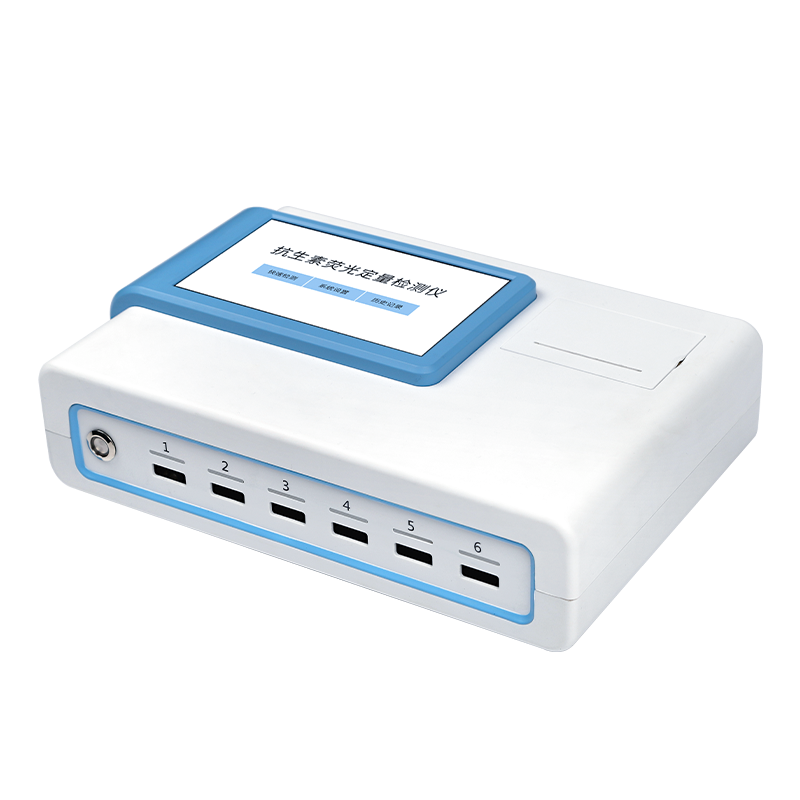
A fluorescence antibiotic residue analyzer can read a compatible assay and calculate or classify a response under that assay's instructions. The important qualification is compatibility. A target list, food matrix, reporting range and decision level belong to the combination of reader, test material and method. Buyers evaluating the HM-L04 should request the configuration for their actual food and antibiotic panel.
What does the reading represent?
Fluorescence readers measure signals under defined optical conditions. Some assays use the relationship between a test signal and a reference signal to estimate concentration. In a competitive assay, a larger amount of the target may produce a lower test signal. The direction and interpretation depend on the design of the particular assay. The reader's display should be interpreted through the exact kit instructions and its configured calibration or cutoff.
How do I check whether a kit covers the target?
Start with the named antibiotic or group, then check the kit's stated selectivity and cross-reactivity. A class assay may respond differently to individual compounds in that class. A response expressed as equivalents of one substance cannot automatically be assigned to a specific member of that group. Record the target description as it appears in the method, along with the matrix and range. That detail matters when a laboratory must choose a confirmatory test.
Does one calibration work for every kit lot?
Use the calibration and lot identification scheme specified by the test manufacturer. If a kit relies on a curve or lot code, confirm that the code on the device matches the consumables in use. Store the kit lot with the result. When a new lot is introduced, apply the laboratory's lot acceptance checks before routine use. A smooth curve on the display provides limited support if the wrong method or kit is selected.
What determines whether the result is quantitative?
A reported number needs a defined unit, valid calibration range, suitable matrix and evidence that the method performs near the decision level. Ask what the software reports below the reporting limit or above the range. A display that rounds both a very low result and an out-of-range result to zero creates an obvious interpretation problem. Confirm the actual output during acceptance testing and document how such results should be recorded.
If the result refers to a prepared sample and the lab must express it on the original food basis, use the conversion defined by the procedure. Preserve the original response or result, applicable factor and final value. Avoid comparing a result in micrograms per liter of liquid with a limit in micrograms per kilogram of food unless the method provides the necessary basis.
How can we distinguish a reader problem from an assay problem?
Review instrument checks, control materials, sample and assay lot identities, the selected method and timing. If several assays shift together immediately after a configuration change, examine the shared steps first. If a control is acceptable but one unusual food matrix produces a different response, investigate suitability of that matrix and compare the result using the laboratory's established process. Record observed facts and scope before attributing the change to the reader or test kit.
What does a screening result require before release?
Use the product's governing specification and decision rule. Screening can help prioritize further work and protect a lot while a case is reviewed. Confirmation may be necessary when the result affects a regulatory or contractual decision. A laboratory should know which compounds to request, how to transfer material under its handling plan and how to link the final report to the original screening record.
How do screening cutoffs differ from reporting limits?
A cutoff is the threshold used to decide how the screening workflow classifies a result. A reporting limit describes the lowest value that a particular procedure is able to report under its stated conditions. They can be related, but they are defined for different purposes. Ask the supplier for both if the lab expects a quantitative result. The purchase specification should state what happens when a number is reportable but close to the screening cutoff, and when a result is below the reportable range.
For example, a laboratory might configure a review threshold of 10 micrograms per kilogram for a particular substance and product under its quality plan. Readings of 9.8 and 10.2 are numerically on opposite sides of that threshold. If the laboratory has an approved review band that encompasses both values, the same follow-up may apply to both. The threshold and band come from the verified method and the governing decision procedure. The displayed decimal places alone cannot resolve the uncertainty.
What can be learned from an agreement study?
An agreement study can show how the reader and kit perform for representative samples relative to an agreed comparison method. Include relevant foods, several concentrations around the decision point, and appropriate controls. Decide in advance what counts as agreement and how to investigate differences. If a kit detects a broad class while the comparison method reports its individual members, map the target definitions before analyzing the results.
Track the actual denominators. If a trial has forty samples with valid paired results and two require adjudication, both the two differences and the forty valid comparisons belong in the evaluation. Keep invalid, missing or unsuitable samples visible in a separate log with reasons. A trial that silently drops difficult samples gives staff limited information about how often the same obstacles will occur in routine work.
How can buyers compare single and grouped testing?
Estimate the number of tests and controls needed per sample and the rate at which preparations reach the reader. A bench can be constrained by the assay window, sample preparation or report review even when the optical reading is quick. Observe a representative shift and record active staff time and elapsed time from sample receipt. This is particularly useful when the same analyst is responsible for labeling, controls and communication with production.
Plan for repetition or referral before the installation. The procedure should say what happens to the result if an assay is invalid and how an unresolved case is transferred between shifts. Estimate kit supply from sample positions plus controls and repeats. If there is more than one test target per food, forecast each target separately so the most commonly used kit does not run out while other supplies remain on hand.
How should a laboratory manage an instrument replacement?
When replacing an existing reader, identify which kit types and procedures the current records depend on. Compare the offered system with representative samples and the laboratory's defined controls before changing routine reporting. Record model, software and method versions in the transition plan, and save enough of the earlier results to explain the change in future supplier reviews.
Train operators to recognize a wrong kit selection, a report with missing units and a result the method cannot interpret. During the trial, ask another operator to retrieve an old and a new result and explain which method produced each. That verifies that the change can be reviewed later even if the original operator is unavailable.
What belongs in a technical support request?
Provide the model, software version, kit lot, target and sample matrix. Include the control status and nature of the problem without exposing unrelated supplier or production information. Describe whether the issue affects one card, one position or all samples. That detail helps technical staff determine whether the appropriate first check concerns the test material, procedure or reader.
What should an HM-L04 quotation include?
List the food groups, target compounds, requirement for qualitative or quantitative reporting, expected volume and decision limits. Ask for documentation of compatible kits, supported calibration, control materials and records. Include representative samples and documented acceptance criteria in the equipment evaluation. HENG MEI Intelligent Manufacturing is the instrument brand of Shandong Hengmei Electronic Technology Co., Ltd.. Review the reader, test materials and support arrangements as part of the same purchase decision.
Address of this article:https://www.kjhm.net/news/fluorescence-antibiotic-residue-analyzer-faq-for-food-laboratories-heng-mei-intelligent-manufacturing.html
 Related News
-
05 / 2026-06
Coefficient of Friction Tester Manufacturers & Brand Guide
Learn more
-
13 / 2026-11
HENG MEI Intelligent Manufacturing Choosing a Chemiluminescence Imaging System
Learn more
-
18 / 2026-11
HENG MEI Intelligent Manufacturing | Choosing a Methanol and Ethanol Analyzer for Spirits
Learn more
-
10 / 2026-07
HM Instruments Integrated Chemiluminescence Imaging System: Reliable Manufacturer & Brand Guide
Learn more