

 Current
Location:
Current
Location:HM-TYC Soil Fertilizer Tester: Inner Mongolia Case Study
Article Source: Hengmei Technology Release time:2026-08-05 14:25:16
On a winter afternoon in early 2020, eight matching aluminium flight cases were lined up on the polished conference table of a rural-service platform in Inner Mongolia. The wall behind the table told the story before anyone spoke: Beautiful Countryside · Wulian Agriculture · 360-degree Comprehensive Service, with a printed mission to develop modern agriculture, build a new beautiful countryside, and turn Inner Mongolia into the largest source of green and healthy food in the country. The instruments inside the cases were the HM Instruments HM-TYC soil fertilizer rapid tester, and the agronomists in the room were about to learn how a single suitcase-sized kit could replace a one-week round trip to a provincial soil laboratory.
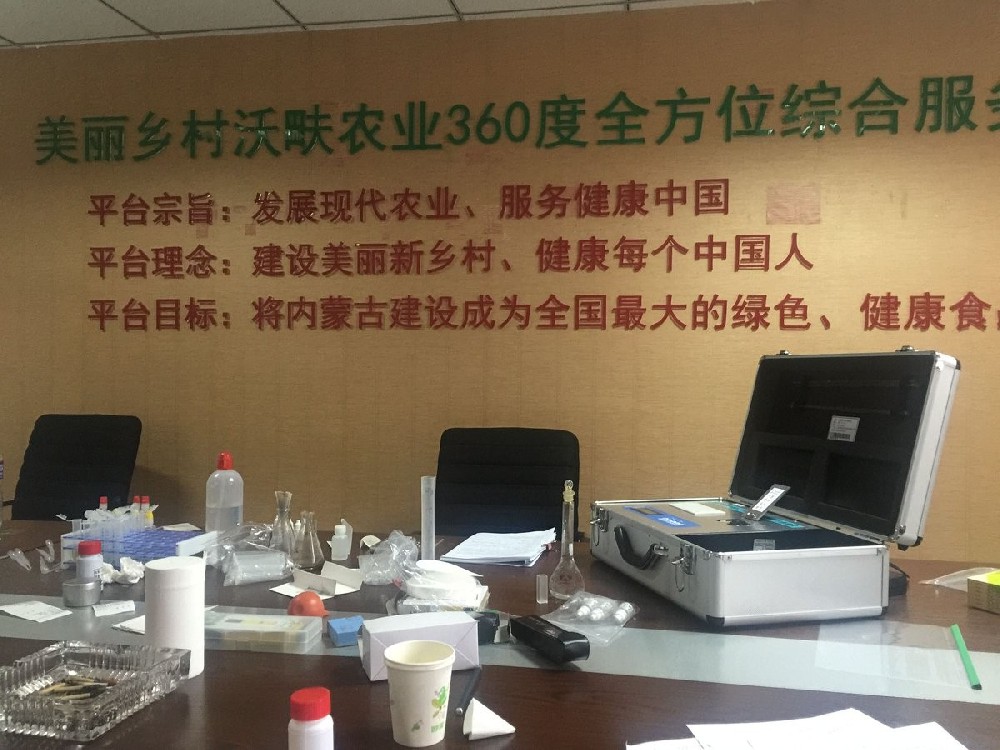
This case study documents the procurement, training, and field rollout of eight HM-TYC soil fertilizer rapid testers delivered to an Inner Mongolia agricultural service company in 2020. The platform — a state-aligned operator that connects smallholder herders, crop farmers, and cooperatives with soil testing, fertiliser recommendation, and traceability services — needed a portable, battery-capable, Chinese-language analyser that could be carried to pasture plots during the brief spring soil-sampling window. The HM-TYC, a member of the HM-TYC portable soil fertilizer rapid tester family, was selected after side-by-side evaluation against two competing portable photometry kits and an outsourced laboratory workflow.
Project Snapshot
| Item | Detail |
|---|---|
| Country / Region | China — Inner Mongolia Autonomous Region |
| Customer type | Rural agriculture 360-degree service platform operating across pastoral, arable, and agro-pastoral transition zones |
| Project year | 2020 |
| Model supplied | HM-TYC portable soil fertilizer rapid tester (aluminium-cased, integrated reagent & instrument case) |
| Quantity | 8 units |
| Configuration | Two-box kit per unit: instrument case (host with built-in thermal printer, electronic balance, pH/TDS probes, glassware, 12 V DC lead) + reagent case (ready-to-use NPK + organic matter + pH + salinity + Ca/Mg/S/B/Cl/Si reagents, 100 tests) |
| Training model | On-site classroom training at the platform's Inner Mongolia headquarters, followed by one-train-the-trainer cascade to cooperative agronomists |
| Interface language | Simplified Chinese (with English service manual supplied alongside) |
| Third-party standards referenced | ISO 10390 (soil pH), ISO 11265 (soil electrical conductivity), JJG 179-90 (Chinese photometric instrument verification regulation), 4R Nutrient Stewardship framework |
| Warranty & support | 12-month whole-unit warranty, lifetime maintenance, lifetime free training, lifetime software upgrades, 24-hour response via the 280-service-centre network |
Why the Customer Bought — The Starting Point
Before the HM-TYC arrived, the platform's agronomists relied on a hybrid of two inconvenient workflows. The first was to bag and label soil samples in the field, then ship them by refrigerated truck to a provincial soil-testing laboratory in Hohhot, where turnaround time ranged from seven to fourteen working days during the busy spring sampling window. The second was to use a pocket colorimetric card set, which gave only a rough three-band estimate of available nitrogen, phosphorus, and potassium and could not quantify organic matter, pH, or salinity — the four indicators the platform's recommendation engine needed to balance fertiliser prescriptions against the region's livestock manure and rotational grazing patterns.
Three pain points drove the 2020 procurement decision:
Decision latency. A 7–14 day lab turnaround meant that fertiliser top-dressing decisions for the spring oat and spring wheat sowing window were effectively made on stale data. Cooperative leaders repeatedly reported missing the first split-application timing.
Spatial blindness. The platform's service zones stretch across several hundred thousand mu of pasture and cropland. Out-sourcing every sample to a centralised lab was prohibitively expensive at the spatial density needed for variable-rate fertilisation, so only a small fraction of fields were actually tested each season.
Method fragmentation. Different field officers used different colour cards and hand-held probes with non-comparable scales, which made it impossible to aggregate results into a single regional soil-fertility map. The platform's data team needed a single, reproducible method backed by an internationally recognisable photometric principle.
The platform's procurement brief was therefore unusually specific: a portable analyser that could measure ammonium-N, available P, available K, organic matter, moisture, pH, salinity, and the secondary nutrient suite (Ca, Mg, S, B, Cl, Si) from a single air-dried soil sample, with stable optics, a built-in printer for chain-of-custody records, and a Chinese-language user interface. The HM-TYC matched every line of that brief.
Why the HM-TYC Was Selected
After a one-week side-by-side trial in late 2019, the platform's evaluation panel ranked three candidate systems: a pocket NPK colour card set already in widespread regional use, a competing portable photometry kit from a domestic peer, and the HM-TYC portable soil fertilizer rapid tester. The pocket cards were ruled out immediately for the reasons given above. The competing portable kit was competitive on raw optics but required a separate laptop for data export and did not offer an integrated reagent kit. Five decisive factors pushed the platform toward the HM-TYC:
All-in-one aluminium case. The integrated instrument-and-reagent aluminium case, marked 铝合金仪器箱 on the lid, allowed the agronomist to carry the entire workflow to a remote pasture or a cooperative meeting room without auxiliary packaging. The case is rated for field transport and was visible in the on-site training image on the platform's conference table.
Photometric performance aligned with JJG 179-90. The HM-TYC's stated working stability is described as outperforming the JJG 179-90 photometric verification regulation by a factor of six, with repeatability reaching the level of a grating-type spectrophotometer. That gave the platform's quality team a defensible technical basis for replacing outsourced lab work with on-site results.
Built-in thermal printer for traceable records. Every result is printed on the spot, which closes the chain-of-custody gap that had been a recurring complaint from the platform's traceability auditors. The one-button thermal printer is covered by utility model patent ZL 2018 2 1777724.7.
Wide parameter coverage. Beyond the standard NPK + organic matter + pH + moisture + salinity set, the HM-TYC also covers six secondary nutrients (Ca, Mg, S, B, Cl, Si), which matched the platform's whole-element recommendation engine.
Battery + vehicle power. The instrument runs from AC 180–240 V mains, an internal rechargeable battery, or a 12 V vehicle supply, which made it usable in spring pasture plots that have no grid connection.
The platform's purchase committee also weighed the after-sales footprint. HM Instruments operates more than 280 service centres across China with a published 24-hour response commitment, which the platform's procurement lead flagged as a primary risk-mitigation factor for a deployment of this size.
Deployment, Installation, and Training
Delivery was scheduled in two tranches during the first quarter of 2020: the first four units reached the Inner Mongolia headquarters for central-level training, and the second four followed two weeks later for direct distribution to four pilot cooperatives. Each unit was delivered in the standard HM-TYC two-box configuration: one aluminium instrument case containing the host, electronic balance, pH and TDS probes, glassware, and a 12 V DC lead; and one reagent case containing ready-to-use NPK, organic matter, pH, salinity, and secondary-nutrient reagent packs sized for approximately 100 tests.
On-site training was held in the platform's main conference room — the same room shown in the case photograph, with the platform's 360-degree rural service mission statement visible on the back wall. The agenda covered instrument start-up, blank calibration, soil sample preparation (air-drying, grinding, sieving, and weighing on the supplied 100 g / 0.01 g electronic balance), the standard NPK + organic matter extraction procedure, photometric reading, pH electrode calibration, and result printing. Operators then ran a paired-sample exercise against a small set of reference soils supplied by the platform's quality team.
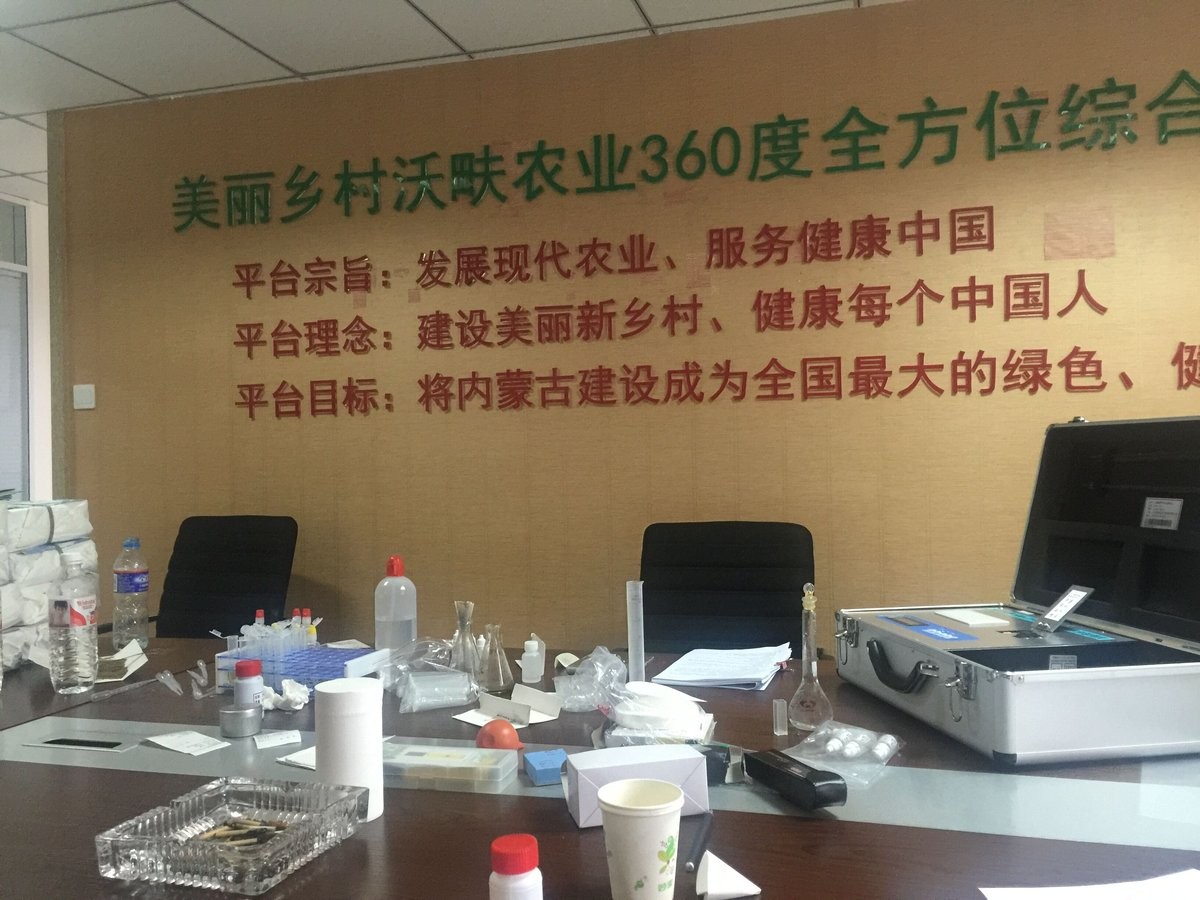
A second image documents the preparation bench in finer detail. Volumetric flasks, reagent dropper bottles, a wash bottle, reaction tubes, a red rubber pipette bulb, a smartphone used as a stopwatch, and a power strip with multiple USB power supplies are arranged alongside the open aluminium case, which carries the HM-TYC label and a colour-coded quick-reference card. This is the standard operating configuration the agronomists were taught to recreate in every cooperative meeting room, so that any visiting field officer could perform a soil test on demand.
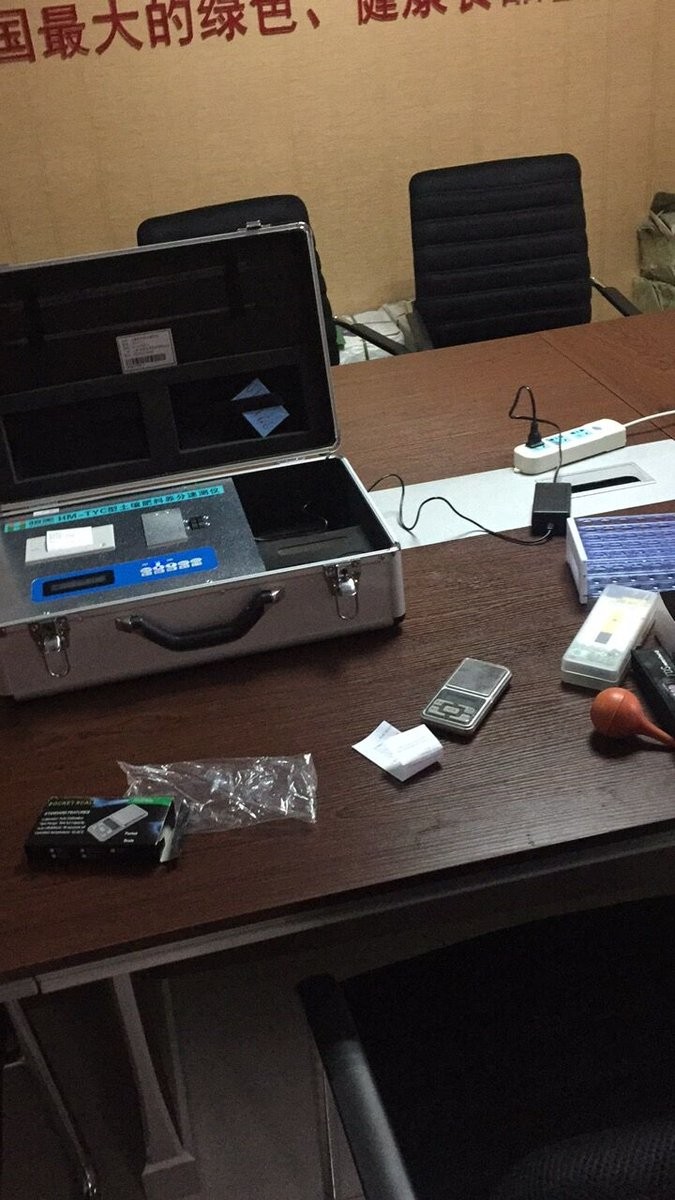
A close-up of the aluminium case shows the HM-TYC model label, the colour-coded quick-reference card sitting in the lid pocket, and the built-in one-button thermal printer in the lower bay of the host. The case itself is the standard two-section aluminium flight case, with the instrument section in the lower half and the reagent section in the upper half — a layout the trainers used as a teaching anchor, because every agronomist could identify the same case layout regardless of which of the eight units they picked up.
After the central training, the platform adopted a train-the-trainer model. Each of the four pilot cooperatives nominated two lead agronomists who had completed the headquarters session; these eight leads then cascaded the operating procedure to roughly thirty additional field officers over the following month. To keep the rollout auditable, the platform required every printed result slip to be photographed and uploaded to its traceability platform within 24 hours of the test.
Results Reported
| Indicator | Before HM-TYC rollout | After HM-TYC rollout |
|---|---|---|
| Soil sample turnaround time | 7–14 working days (outsourced provincial lab) | ≤30 minutes per soil sample, ≤60 minutes for a batch of 8 (per kit specification) |
| Field coverage per season | Estimated <5% of service-zone fields tested | 8 units × ~3 samples/day × spring + autumn windows, supporting variable-rate fertilisation across pilot cooperatives |
| Parameter coverage per sample | NPK band estimate + visual pH strip; no organic matter, no salinity, no secondary nutrients | NPK, organic matter, moisture, pH, salinity, plus Ca, Mg, S, B, Cl, Si on a single air-dried sample |
| Result traceability | Hand-written notebook entries, no machine-readable record | Built-in thermal printer slip, photographed and uploaded to platform traceability database |
| Decision timing for spring top-dressing | Decisions made on stale, lab-delayed data | Decisions made on the same day as sampling, within the spring split-application window |
| Operator consistency across cooperatives | Multiple non-comparable methods in use | Single method, single instrument family, train-the-trainer cascade documented |
Specifications Relevant to This Deployment
| Parameter | Specification |
|---|---|
| Measurement principle | LED-based photometry, dual-wavelength (red 620 ± 8 nm, blue 440 ± 8 nm), silicon semiconductor receiver, single-channel dual-beam cuvette design with no mechanical displacement |
| Range and resolution | 0.001–9999 |
| Stability | Drift < 0.003 within three minutes |
| Linearity error | ≤ 3% (0.03, copper sulfate test) |
| Repeatability error | ≤ 0.5% (0.005, potassium dichromate solution) |
| Light source lifetime | ≈ 100,000 hours class (high-brightness LED) |
| Power supply | AC 180–240 V, 50 Hz; DC 5 V–12 V internal rechargeable battery; 12 V vehicle lead supported |
| Soil moisture range | 0–100% (% g/100 g), accuracy ± 0.5% |
| Test throughput | One soil sample (N, P, K) ≤ 30 minutes including pre-treatment; up to 8 samples ≤ 1 hour including pre-treatment |
| Soil parameters covered | Ammonium-N, available P, available K, moisture, organic matter, pH, salinity; plus Ca, Mg, S, B, Cl, Si (secondary nutrients) |
| Built-in printer | One-button thermal printer, utility model patent ZL 2018 2 1777724.7 |
| Instrument dimensions / weight | 492 × 305 × 165 mm; package 550 × 245 × 375 mm; net package weight 5.3 kg |
| Regulatory benchmark | Working stability cited as outperforming JJG 179-90 by a factor of 6; repeatability cited at the level of a grating-type spectrophotometer |
Methodology Note: How the HM-TYC Result Maps to International Reference Methods
One of the questions the platform's quality team raised during the trial was how a 30-minute field reading could be reconciled with the wet-chemistry reference methods they had previously relied on. The HM-TYC's photometric channels are designed so that the red 620 ± 8 nm channel and the blue 440 ± 8 nm channel cover the routine colorimetric finishes used for ammonium-N, available P, available K, and organic matter, with ready-to-use reagent packs sized for roughly 100 tests per case. Soil pH is measured with a dedicated electrode rather than by colour, and the moisture channel is a separate mass-loss calculation supported by the 100 g / 0.01 g electronic balance that ships with the kit.
Internationally, soil pH is defined by ISO 10390 (Soil quality — Determination of pH) and soil electrical conductivity is defined by ISO 11265 (Soil quality — Determination of the specific electrical conductivity). The HM-TYC's pH and salinity channels provide a field reading that is directly comparable to the laboratory procedures described in those two standards, while the photometric NPK channels map to the colorimetric finish used by the corresponding reference wet-chemistry methods. The platform's agronomists were trained to record both the field reading and the field conditions (sampling depth, air-drying time, extraction reagent batch) on the printed slip, so that any reading can later be re-interpreted against the same reference methods if a cooperative requests a laboratory cross-check.
For fertiliser recommendation, the platform's recommendation engine was re-tuned to consume the HM-TYC's output directly, applying the 4R Nutrient Stewardship framework — right source, right rate, right time, right place — promoted by the global fertiliser industry. The HM-TYC's combined ammonium-N, available P, available K, and organic matter reading is the input the engine uses to balance the right source and right rate decisions; the moisture and pH readings inform the right time decision (avoiding top-dressing on saturated or strongly acidic soils); and the geo-tagged printed slip supports the right place decision by closing the loop between a specific field parcel and a specific fertiliser prescription.
Operational Considerations for a Multi-Unit Field Rollout
An 8-unit rollout is a meaningful logistical exercise even for a single procurement event. Three operational details proved decisive in the Inner Mongolia deployment.
First, the reagent shelf-life and cold-chain question. The HM-TYC reagent case is designed to be carried alongside the instrument case and used at ambient temperature, which removed the cold-chain logistics that had previously constrained outsourced lab workflows. The platform's quality team nevertheless instituted a quarterly reagent stock check across all eight units to keep expired packs out of field use.
Second, the calibration discipline. The HM-TYC's blank calibration is performed on power-up and re-checked before each reading batch. The platform's lead agronomist instituted a weekly blind-sample round-robin across the eight units — the same air-dried soil sample is read on each instrument, and the results are compared to catch drift before it propagates into the recommendation engine. This round-robin has so far kept the spread between instruments well within the kit's published repeatability of ≤ 0.5%.
Third, the field data workflow. The built-in thermal printer produces a paper slip that includes the test value, the parameter, the date, and the operator. Every slip is photographed with a smartphone and uploaded to the platform's traceability database within 24 hours, which closes the chain of custody and gives the platform's auditors a paper-plus-digital record for every recommendation. The same data path is used to feed the regional soil-fertility map that the platform's data team is now able to update on a season-by-season basis rather than on a multi-year cycle.
Why Eight Units — Sizing the Rollout
The decision to standardise on eight units — rather than on a single instrument, or on a larger fleet of more than twenty — was driven by the platform's pilot-cooperative structure. The 2020 rollout covered four pilot cooperatives plus four units retained at the headquarters and the three regional service nodes. Each of the four cooperatives operates across roughly fifty thousand mu of mixed pasture and arable land, and the platform's internal analysis indicated that one HM-TYC unit per cooperative, plus a rotating reserve unit at each regional node, was the minimum fleet needed to cover the spring and autumn sampling windows without overstretching the agronomist team.
The platform deliberately avoided scaling beyond eight units in the first season. By keeping the pilot fleet small and uniform, the quality team could compare results across instruments under near-identical operating conditions and prove the methodology before any expansion. The two-box aluminium-cased form factor made the scale-up economics attractive: a single carrying case per unit, no auxiliary laptop or tablet, and a single 12 V vehicle lead that doubles as a vehicle or field power source.
Internal Links and Related Reading
The HM-TYC sits in HM Instruments' portable soil fertilizer tester family. Operators evaluating the HM-TYC for similar rural-service deployments may also want to read the dedicated product page for the HM-TYC portable soil fertilizer rapid tester and the platform's earlier case study on the HM-GT4 soil and fertilizer compound fertilizer analyzer at an Ordos agricultural company . For a higher-throughput, channel-based alternative, the HM-TYB soil nutrient rapid tester is the closest sibling model and shares the same JJG 179-90 performance benchmark and the same patented one-button thermal printer.
Company Endorsement
HM Instruments is the international brand of Shandong Hengmei Electronic Technology Co., Ltd. (恒美智造), a national high-technology enterprise and Shandong gazelle enterprise, listed on China's New Fourth Board under equity code 306008. The company holds ISO 9001 quality management certification (No. 06524Q02062ROM), an intellectual property management system certification (472IP190206R0S), a 3A credit enterprise rating (HXZC201968486), an after-sales service certification (78323SC0008R0S), an occupational health and safety certification (06524S00854ROM), and an environmental management certification (06524E00905ROM). Its research and development team numbers more than one hundred engineers, and the company holds around 150 core patents, including utility model patent ZL 2018 2 1777724.7 covering the one-button thermal printer used in the HM-TYC series.
Service is delivered through more than 280 service centres across China, with a 24-hour response commitment. The standard warranty is 12 months on the whole unit, supplemented by lifetime maintenance, lifetime free training, and lifetime software upgrades. Certificate metadata for the company's calibration and conformance records is notarised on the Zhixin (至信链) blockchain and is independently verifiable at zxscan.qq.com.
Address of this article:https://www.kjhm.net/case/hm-tyc-soil-fertilizer-rapid-tester-case-inner-mongolia-agricultural-company.html
 Related News
-
20 / 2025-10
Programmable Quantitative Sealer for Enzyme Substrate Method Water Testing
Learn more
-
23 / 2024-09
Innovative Application Of Multi-parameter Water Quality Detector In Water Resource Management.
Learn more
-
26 / 2024-09
What Is The Use Of A Dust Particle Counter?
Learn more
-
18 / 2026-05
Karl Fischer Moisture Analyzer Reliable Manufacturer Recommendation | HM Instruments Brand Analysis
Learn more