

 Current
Location:
Current
Location:HM Instruments HM-GT3 Soil Nutrient Analyzer: Chongqing Youyang Tobacco Case
Article Source: Hengmei Technology Release time:2026-08-05 14:25:16
Inside a training room hung with a red banner for the company's 2022 tobacco leaf grading skills programme, rows of black instrument cases sat open on white tables. Each case held the same device: a portable soil nutrient analyzer with a colour touch screen, a built-in printer, and a full reagent kit. Between 16 and 18 March 2023, HM Instruments delivered and commissioned ten HM-GT3 soil nutrient analyzers for the Chongqing Tobacco Company Youyang Branch, then trained a team of operators to run soil tests, interpret results, and translate those results into fertiliser recommendations. The deployment was not a single-unit laboratory purchase; it was a field force multiplier, with each unit going back to a different workstation or township-level tobacco station.
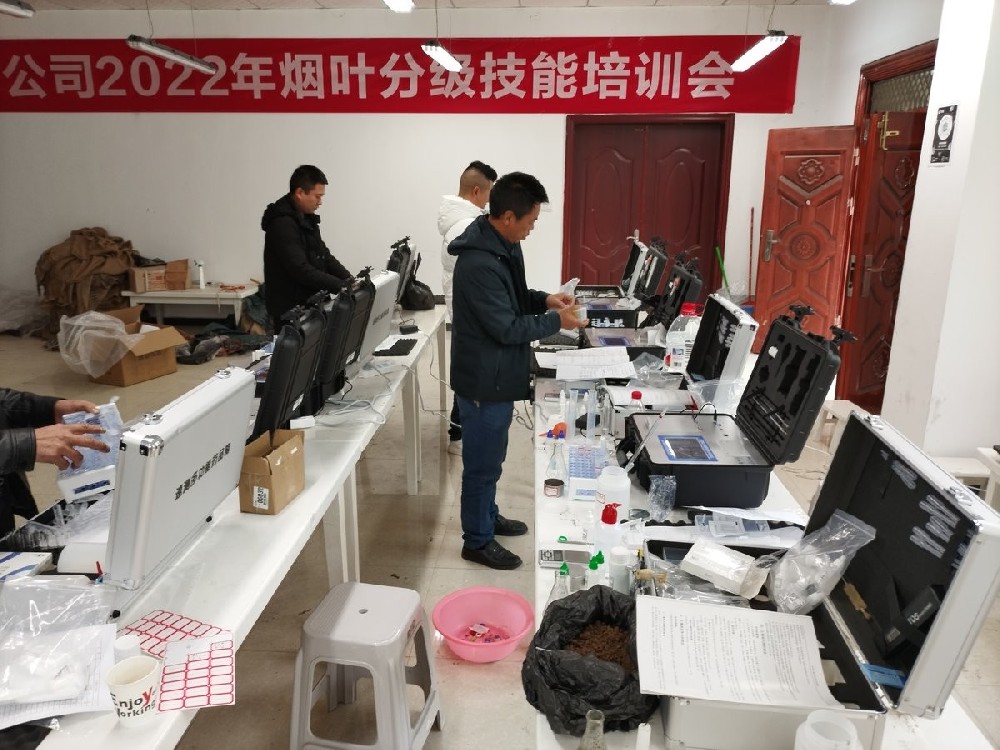
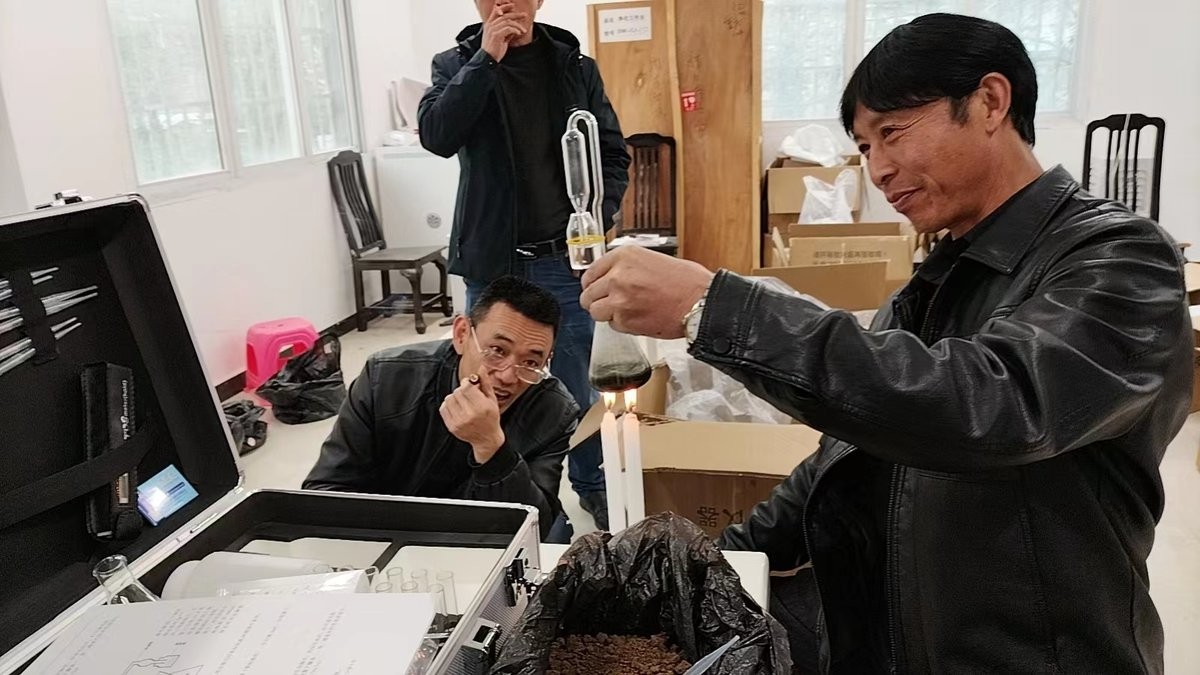
The photographs from the training show exactly what a bulk deployment looks like at commissioning. Operators in white lab coats and blue nitrile gloves work through sample tubes, reagent bottles and cuvettes while the instruments run through their start-up routines. A black plastic bag of field soil sits on one bench, a reminder that these units are not being prepared for a clean laboratory but for the red and yellow soils of the Wuling Mountain foothills where Youyang's tobacco is grown. The presence of soil samples, volumetric glassware and printed operating procedures on the tables indicates that the training covered the whole workflow, from sample weighing to result reporting.
Project Snapshot
| Item | Detail |
|---|---|
| Country | People's Republic of China |
| Region | Youyang Tujia and Miao Autonomous County, Chongqing Municipality |
| Customer type | State-owned tobacco company (leaf production and procurement branch) |
| Model supplied | HM-GT3 soil nutrient analyzer |
| Quantity | 10 units |
| Application | Soil nutrient testing for tobacco field management and leaf quality improvement |
| Configuration | Main unit with built-in printer, pH electrode, TDS meter, cuvettes, electronic balance, reagent kit, volumetric glassware |
| Training model | On-site operator training over three days covering hardware, reagents, calibration and fertiliser recommendation software |
| Training personnel | HM Instruments engineer Zhang Youkun; sales representative Zhang Fujun |
| Interface language | Chinese |
| Year of delivery | 2023 |
Why the Customer Bought: The Starting Point
Tobacco leaf quality is a soil story as much as it is a curing story. The nitrogen, phosphorus and potassium available to the plant during the growing season determine leaf thickness, colour, burn rate and sugar-to-nicotine balance. In Youyang, where flue-cured tobacco is a major cash crop, agronomists had been managing fields from experience and from occasional third-party soil tests, but the lag between sampling and a recommendation was often too long to influence the current season's top-dressing decisions.
Three problems shaped the purchase.
The turnaround problem. Sending soil samples to a provincial laboratory produced a report, but the cycle took days or weeks. By the time nitrogen or potassium results came back, the growth stage that most needed the correction had passed. The tobacco stations wanted a same-day nutrient reading so that fertiliser could be adjusted while the crop was still responsive.
The coverage problem. Youyang is a mountainous county with tobacco fields scattered across many townships. A single central laboratory cannot sample every field at the right moment. Ten portable analyzers allowed the company to distribute testing capacity to the field stations, so that agronomists could test representative fields on demand rather than wait for a centralised sampling campaign.
The prescription problem. Even where test results existed, converting them into a fertiliser recommendation required interpretation. The HM-GT3 includes a built-in crop expert fertilisation system that links soil values to target yields for specific crops. For tobacco, this meant turning a raw NPK figure into a kilogram-per-mu recommendation, aligned with the company's leaf-quality targets.
Why the HM-GT3 Was Selected
The customer evaluated three alternatives: continuing with external laboratory testing, buying single-parameter handheld meters, and adopting a multi-channel portable analyzer. The decision to choose the HM-GT3 rested on the following points.
Multi-parameter coverage in one field unit. The HM-GT3 platform is designed to measure available N, P, K, organic matter, pH, salt content and a suite of micronutrients, as well as heavy metals, in a single run using colourimetric detection. For tobacco, the ability to measure available potassium and chlorine in the same session is particularly important because both elements directly affect combustibility and leaf colour.
Twelve-channel rotary colourimetric design. The instrument uses a precision rotary colourimetric pool with four-wavelength cold sources, giving consistent illumination across all channels. This supports batch processing: up to twelve samples can be loaded and measured without reconfiguring the optical path, which matters when ten operators are each expected to finish several fields per day.
Built-in reporting and data upload. Each unit carries a thermal printer for on-site reports and supports WiFi and 4G upload to a cloud platform. In a tobacco company with multiple field stations, this removes the need for operators to carry paper records back to the county office for transcription.
AC/DC dual power and field portability. The instrument can run from mains AC or a DC 12 V supply, including an internal lithium battery or vehicle power. This allows a field station to test samples in a shed, a vehicle or a temporary office without relying on grid power during the busy transplanting and top-dressing periods.
Integrated reagent and glassware kit. The supplied case includes the balance, pipettes, cuvettes, volumetric flasks, reagent bottles and glassware needed for the standard extraction. Because the same kit ships with every unit, the county-level technical team can standardise consumable ordering and operator training across all ten stations.
Deployment, Installation and Training
The ten units were delivered to the Youyang training venue and unpacked in parallel. Each operator received one case and was walked through the inventory. The first morning covered instrument start-up, touch-screen navigation and the daily self-check routine. The second day moved into sample preparation: weighing field soil, adding extraction solution, filtering, transferring to cuvettes and loading the rotary pool. The third day covered result interpretation, report printing and the use of the built-in crop fertiliser recommendation module for tobacco.
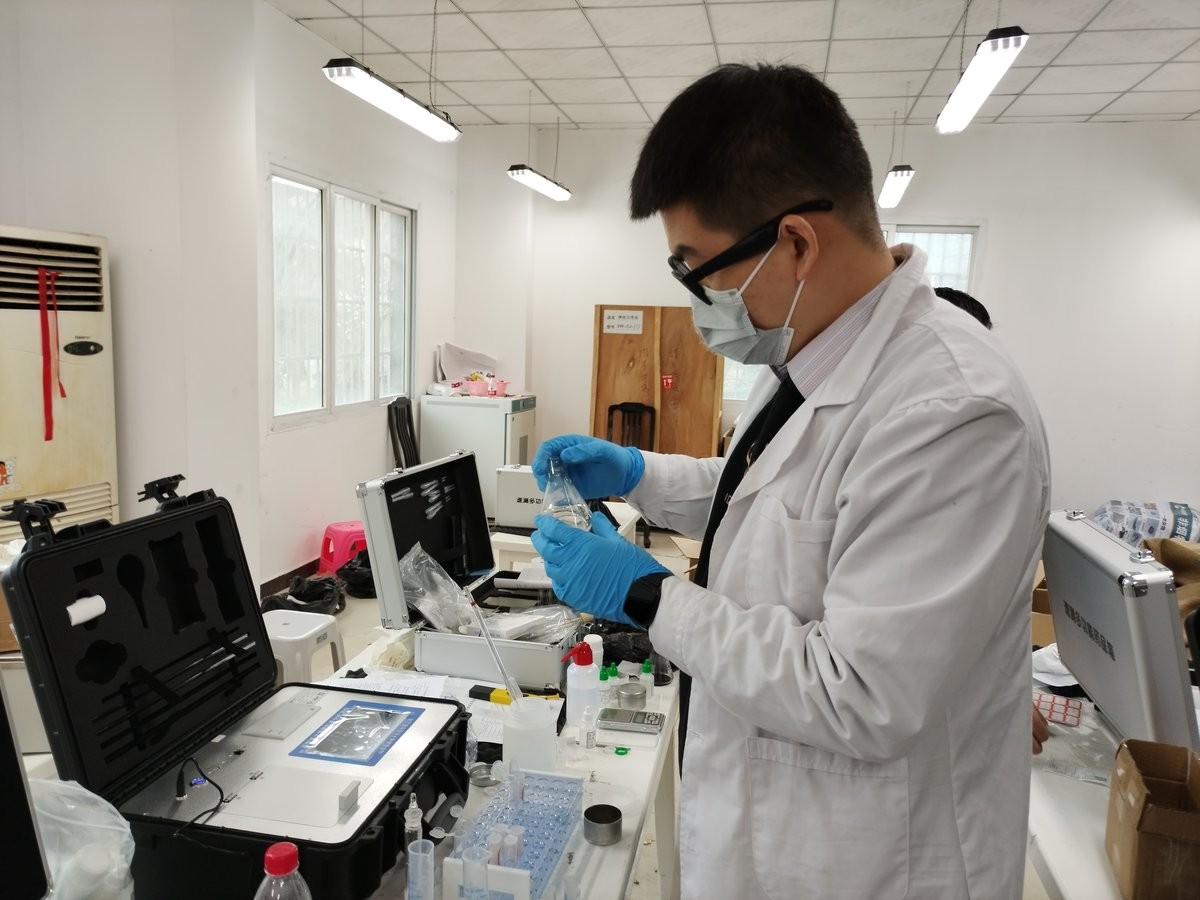
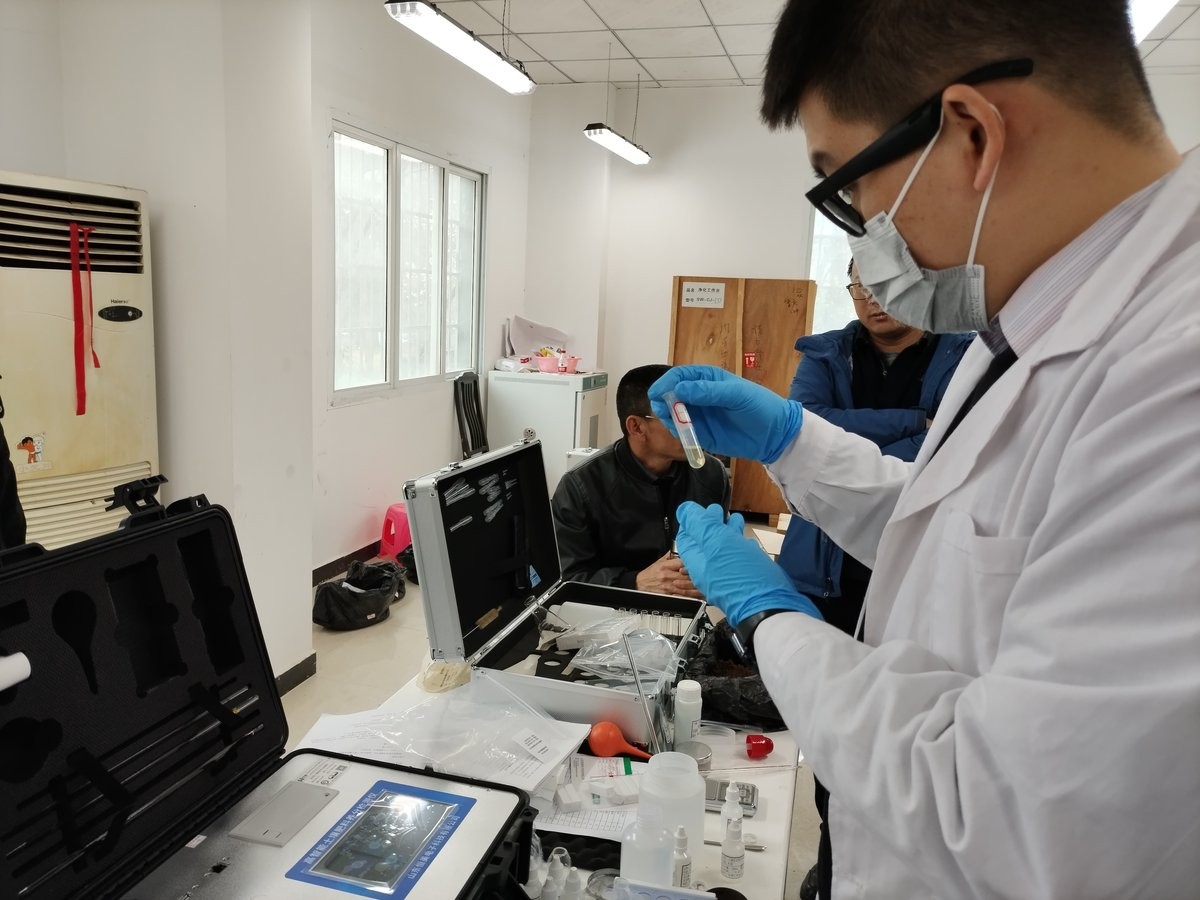
Photographs from the session show the trainer demonstrating the cuvette-loading sequence while operators observe. The open case layout is consistent across all units: main unit on the left, reagent and glassware compartments on the right, and printed manuals under the lid. This standard layout is part of the design; operators who train on one unit can operate any of the other nine without relearning the workflow.
Delivered Configuration
| Item | Detail |
|---|---|
| Main unit | HM-GT3 soil nutrient analyzer with built-in thermal printer and 7-inch capacitive touch screen |
| Power supply | AC 220 V ±22 V / DC 12 V +5 V; internal lithium battery; vehicle power compatible |
| pH electrode | 1 unit for soil pH measurement |
| TDS meter | 1 unit for soluble salt estimation |
| Cuvettes | 4 standard 1 cm cuvettes for colourimetric readings |
| Electronic balance | 100 g / 0.01 g for soil sample weighing |
| Glassware | 100 mL conical flasks, reaction bottles, volumetric flask, 50 mL measuring cylinder, graduated pipettes |
| Consumables | Soil nutrient reagent set, qualitative filter paper, centrifuge tubes, wash bottle, spatula, small aluminium box |
| Documentation | Manual, qualification certificate, warranty card |
Results Reported: What Changed
The comparison below reflects the workflow changes reported by the tobacco company's field technicians during the first growing season after commissioning. The figures describe operational outcomes rather than instrument performance claims.
| Indicator | Before | After |
|---|---|---|
| Turnaround for NPK soil result | Several days to weeks via external laboratory | Same day at the township station |
| Number of fields tested per season | Limited by laboratory sampling campaign schedule | Representative fields tested on demand across all ten stations |
| Fertiliser adjustment timing | After the growth window had passed | During active growth stage, using same-day data |
| Data record format | Paper laboratory reports filed centrally | Printed on-site ticket plus WiFi/4G upload to management platform |
| Operator consistency | Varied with external laboratory communication chain | Standardised protocol across ten identical units and one training programme |
| Traceability of field results | Dependent on third-party certificate | On-instrument storage with report number, date and operator account |
Specifications Relevant to This Deployment
| Parameter | Specification |
|---|---|
| Power supply | AC 220 ±22 V / DC 12 V +5 V (built-in lithium battery or vehicle power) |
| Power consumption | ≤5 W |
| Range and resolution | 0.001–9999 |
| Repeatability error | ≤0.02% (0.0002, potassium dichromate solution) |
| Stability | Drift <0.3% within 1 h; <0.5% within 2 h (transmittance) |
| Linear error | ≤0.1% (0.001, copper sulfate) |
| Wavelengths | Red 680 ±2 nm; blue 420 ±2 nm; green 510 ±2 nm; orange 590 ±4 nm |
| pH range / accuracy | 1–14 / 0.01; error ±0.1 |
| Salt content range / error | 0.01%–1.00% / ±5% |
| Soil moisture range / error | 0–100% / <0.5% |
| Test speed | Single soil sample (NPK) ≤30 min; 8 samples ≤1 h |
| Dimensions / weight | 43 × 34.5 × 19 cm / 5.1 kg |
Soil Nutrients and Tobacco Leaf Quality: Why the Numbers Matter
Tobacco is one of the most nutrient-sensitive field crops. Nitrogen determines leaf area and yield, but excess nitrogen produces thick, dark leaves with high nicotine and poor combustibility. Potassium improves leaf burn, aroma and shelf life, while chlorine, if it accumulates, reduces burn quality and is actively avoided by premium leaf buyers. The ideal tobacco soil is therefore not simply "fertile"; it is balanced to a specific profile that changes with the growth stage.
Soil testing in this context is governed by agronomic standards such as NY/T 1118-2006, the Chinese technical regulation for soil testing and formulated fertilisation, and by internationally recognised methods for pH and electrical conductivity, ISO 10390 and ISO 11265 respectively. The HM-GT3 platform reports the same parameters used in these frameworks: available nitrogen, available phosphorus, available potassium, organic matter, pH and salt content. By running these tests at the township station, the tobacco company can align its local fertiliser programme with both company quality targets and national technical guidance.
The built-in crop expert fertilisation system adds a practical layer. Operators enter the measured values and a target yield; the instrument returns a recommended fertiliser rate. For tobacco, the recommendation is interpreted by the station agronomist rather than applied blindly, because leaf quality is influenced by cultivar, curing practice and seasonal weather as well as by soil fertility. The value of the instrument is that it turns a delayed, centralised process into a local conversation about whether a particular field needs more potassium, less nitrogen, or simply no top-dressing at all.
Standardising Reagent Handling Across Ten Units
The photographs from the training reveal an important detail: every unit is being commissioned with the same reagent bottles, glassware and procedures. This matters more than it might appear. A colourimetric analyzer is only as reliable as the chemistry that precedes it. If one station prepares the extraction solution at a different concentration, or allows reagents to sit in sunlight, the readings from that station will diverge from the other nine, and the county-wide dataset will become unusable.
The training therefore emphasised the preparation of the soil nutrient reagent set according to the manual, the cleaning and handling of cuvettes, and the storage of light-sensitive reagents. Operators were shown how to load the rotary pool so that each cuvette sits in the correct position, how to run a blank, and how to record the batch number of the reagent kit alongside each set of results. This discipline is what makes ten separate instruments behave like one distributed laboratory.
The instrument's four-wavelength cold-source design supports this standardisation. Because the light sources are individually stabilised and the silicon detector has a long service life, the optical baseline drifts slowly and predictably. The stability specification, drift below 0.3% within one hour and below 0.5% within two hours, is one reason the same calibration can be carried across multiple units in a single training session without requiring individual re-calibration at each station.
From Field Data to Management Platform
One of the less visible but more consequential parts of the deployment is the data path. Each HM-GT3 stores results internally and can upload them via WiFi or 4G to a cloud platform. For a tobacco company managing thousands of mu across many townships, this removes the weakest link in the soil-testing chain: the transcription of handwritten results into a spreadsheet back at the county office.
Printed reports generated by the built-in thermal printer contain the test item, channel number, absorbance, concentration, date and a QR code. The same record is retained in instrument memory and can be batch-uploaded. Over a full season, the county can build a georeferenced nutrient map by associating each uploaded result with the field from which the sample came. The 4 GB internal memory means that even without immediate connectivity, an operator can store many sessions before uploading.
This workflow also supports traceability. If a particular batch of tobacco leaf later shows an unexpected chemical profile, the company can return to the soil data for that field, check the date and operator account, and determine whether a fertiliser adjustment was made on the basis of a measured result. That audit trail is difficult to build when results live only on external laboratory certificates.
Related Reading
Technical specifications for the GT-series soil and fertilizer nutrient analyzers are summarised on the product page for the HM-GT4 soil and fertilizer nutrient analyzer. Laboratories that need a compact entry-level unit for smaller field programmes may also review the HM-GT2 soil nutrient analyze, which shares the same Android operating platform and 12-channel design. Other HM Instruments field deployments are described in the Shanxi Agricultural Supply six-unit GT3 case .
About HM Instruments
HM Instruments is the international brand of Shandong Hengmei Electronic Technology Co., Ltd., a national high-technology enterprise, a Shandong gazelle enterprise and a specialised "little giant" SME listed on the New Fourth Board under equity code 306008. The company holds ISO 9001 quality management certification (No. 06524Q02062ROM), an intellectual property management system certification (472IP190206R0S), occupational health and safety certification (06524S00854ROM), environmental management certification (06524E00905ROM) and an after-sales service certification (78323SC0008R0S). Certificate metadata is notarised on the Zhixin (至信链) blockchain and can be verified at zxscan.qq.com.
Development is carried out by a research team of more than one hundred engineers, and the company holds around 150 core patents. Field support is delivered through 280 service centres across China with a 24-hour response commitment. Every instrument carries a 12-month whole-unit warranty, a 12-month warranty on core components, lifetime free software upgrades, lifetime technical support, lifetime free training and lifetime maintenance. For the Youyang tobacco deployment, the lifetime free training clause is particularly relevant: as field staff rotate, new operators can be trained on the same instruments without additional charges.
Address of this article:https://www.kjhm.net/case/hm-gt3-soil-nutrient-analyzer-case-chongqing-youyang-tobacco.html
 Related News
-
08 / 2026-05
Contact Angle Goniometer Value Analysis-HENGMEI ZHIZAO vs Intl Brands
Learn more
-
21 / 2026-05
HM Instruments ICP-OES Spectrometer FAQ | Authoritative Technical Q&A
Learn more
-
24 / 2026-07
HM Instruments: Reliable Dispensing Station Brand Guide
Learn more
-
16 / 2025-09
Smart Water Quality Management: The Portable Multi-Parameter Analyzer
Learn more