

 Current
Location:
Current
Location:HM Instruments HM-TYA Soil Formula Tester: Henan Training Center Case
Article Source: Hengmei Technology Release time:2026-08-07 09:56:10
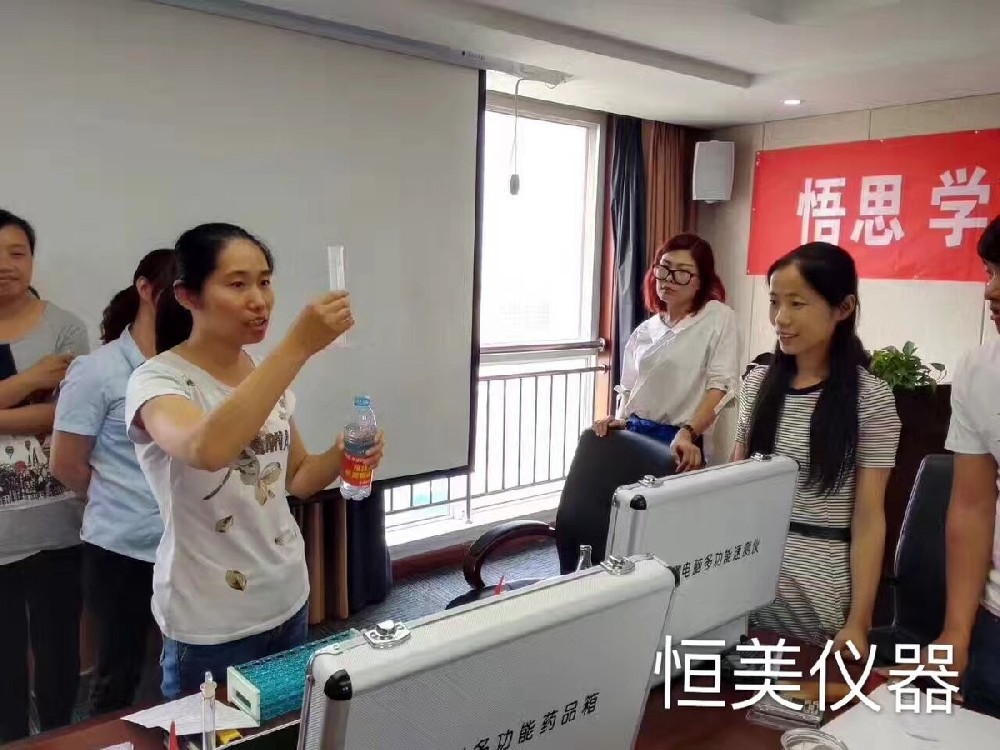
The training room at the prefecture-level agricultural extension training center in Henan was arranged for a two-day soil-testing demonstration. An instructor stood at the front table holding a clear supernatant sample in a colorimetric tube while a small bottle of nutrient reagent rested in her other hand. On the table in front of her, two silver aluminum carrying cases were opened to reveal the reagent bottles, glassware, and an integrated test unit with a small thermal printer built into the lid. A red banner with white Chinese characters hung on the wall behind her; beside the table, a row of trainees from local agricultural supply stations and farmer cooperatives watched closely as she explained each procedural step. This photograph captures the moment the centre's HM-TYA soil formula tester programme officially moved from classroom theory into hands-on practice.
Project Snapshot
| Item | Detail |
|---|---|
| Country | China (mainland) |
| Customer type | Prefecture-level agricultural extension training centre |
| Region | Henan province |
| Model supplied | HM Instruments HM-TYA soil formula tester |
| Configuration | Single-aluminium-case configuration (instrument box with all accessories, built-in printer and lithium battery) |
| Training model | Two-day on-site training programme covering sample collection, reagent preparation, colorimetric reading and result interpretation |
| Interface language | Chinese and English switchable, default Chinese for local trainees |
| Application | Training demonstrations, technician certification, farmer field school follow-up |
Why the Customer Bought
The agricultural extension training centre had long relied on a third-party provincial testing institute for soil nutrient analysis. That arrangement worked for occasional research samples, but it created three specific problems when the centre tried to scale up its technician certification and farmer field school programmes.
Slow turnaround for seasonal training windows. The provincial institute quoted a 10–14 working-day turnaround during the spring and autumn fertilisation seasons, which is exactly when the centre schedules its busiest training cohorts. Trainees could not receive fertilisation recommendations in time to act on them in the field.
High per-sample cost. Outsourced testing cost the centre roughly 80–120 yuan per soil sample, which made it impractical to use soil testing as a routine teaching tool for every farmer field school group.
No "see the instrument, see the result" teaching moment. The third-party workflow sent sealed samples away and returned printed reports; trainees never observed the analytical steps. The centre's pedagogy required that students physically handle the instrument so they could later troubleshoot problems in their own township stations.
The training leadership therefore decided to bring soil testing in-house and integrate it into the certification curriculum. They evaluated several portable soil testing instruments on the Chinese market and after a multi-brand comparison selected the HM Instruments HM-TYA.
Why the HM-TYA Was Selected
The HM-TYA was compared against three alternative approaches the centre considered: a bench-top laboratory spectrophotometer, a portable X-ray fluorescence (XRF) analyser for total soil elemental analysis, and a competing brand's portable NPK colorimeter. The HM-TYA was chosen for the following reasons.
Integrated aluminium-case design keeps the training footprint small. The HM-TYA ships in a single aluminium case that contains the main unit, four cuvettes, an electronic balance (100 g / 0.01 g), a 3 mL pipette set (12 pcs), washing bottle, sample scoop set, filter paper, small aluminium box, volumetric flask, 50 mL measuring cylinder, two extraction bottles and eighteen reaction tubes. Because every consumable is co-located in one case, the training room only needs a workspace and a supply of purified water — there is no second reagent case to lose or misplace.
Built-in lithium battery enables outdoor demonstration. The HM-TYA accepts AC 180 V–240 V (50 Hz) or DC 5 V–12 V from the internal lithium battery. During the second day of training, the centre moved the cohort outside to a wheat demonstration field to run on-the-spot sampling and reagent preparation; the lithium battery eliminated the need for a generator or long extension cables.
Pre-mixed reagents reduce training overhead. The HM-TYA reagent set ships ready-to-use. The training schedule did not need to allocate time for reagent weighing or standard solution preparation, which is normally a full day in traditional spectrophotometer training. Trainees instead spent that time on result interpretation.
Built-in thermal printer produces immediate hard-copy results. Each sample run prints a result slip directly from the lid of the instrument. For a training centre, that printout serves a dual purpose: it is the trainee's deliverable report and a paper artefact that can be filed in the certification dossier.
Stable optical bench matches the centre's accuracy needs. The HM-TYA uses a single-channel dual-beam optical path with a high-brightness LED source and a silicon semiconductor detector (rated service life on the order of 100,000 hours). Drift is less than 0.003 within three minutes, and the manufacturer states linearity error ≤ 3 % (0.03, copper sulphate detection) and repeatability error ≤ 0.5 % (0.005, potassium dichromate solution). For an extension training programme whose goal is to teach fertilisation decision logic rather than to publish peer-reviewed soil surveys, this stability envelope is appropriate and far more cost-effective than a research-grade spectrometer.
Deployment, Installation and Training
The HM-TYA units were shipped from the HM Instruments Weifang factory in protective aluminium cases and arrived at the centre by road transport. Two HM Instruments application engineers travelled to the site to deliver the training. The deployment unfolded over two working days.
Day 1 — classroom orientation and reagent familiarisation. The application engineers opened each aluminium case in front of the trainees so the cohort could see how every component is packed. They walked the trainees through the user interface, the touch-button keypad, the built-in printer operation and the lithium-battery charging cycle. They then demonstrated reagent preparation: weighing soil with the supplied 100 g / 0.01 g balance, transferring it to the extraction bottle, adding the supplied extraction solution, shaking, filtering through the qualitative filter paper and collecting the clear supernatant in a clean reaction tube.
Day 2 — on-instrument measurement and outdoor demonstration. The cohort moved to the instrument bench. Each trainee drew the clear supernatant into a cuvette, placed it into the HM-TYA's single-channel dual-beam slot, selected the appropriate N, P or K channel on the keypad and read the result. The instrument printed the result slip within seconds. In the afternoon the cohort relocated to the centre's wheat demonstration field to repeat the full cycle on freshly collected soil samples, with the lithium battery powering the instrument.
The standard aluminium-case configuration supplied with the HM-TYA is summarised below.
| HM-TYA Standard Configuration (single aluminium case) | ||
|---|---|---|
| No. | Item | Quantity |
| 01 | Main unit with built-in thermal printer | 1 |
| 02 | Cuvette | 4 pcs |
| 03 | Electronic balance (100 g / 0.01 g) | 1 |
| 04 | Power adapter | 1 |
| 05 | Pipette (3 mL) | 12 pcs |
| 06 | Washing bottle | 1 |
| 07 | Sample scoop set | 1 set |
| 08 | Qualitative filter paper | 1 box |
| 09 | Small aluminium box | 1 |
| 10 | Volumetric flask | 1 |
| 11 | Measuring cylinder (50 mL) | 1 |
| 12 | Extraction bottle | 2 |
| 13 | Reaction tube | 18 pcs |
| 14 | Soil nutrient reagent set | 1 set |
| 15 | Manual, certificate of conformity, warranty card | 1 set |
After the on-site training the centre's own staff are responsible for ongoing coaching of new trainees. HM Instruments' 280 service centres across China and the manufacturer's lifetime free training policy mean that additional trainer refreshers can be arranged on request.
Results Reported
The following indicators compare the centre's pre-purchase outsourced workflow with the in-house HM-TYA workflow after the first training cycle .
| Indicator | Before (outsourced) | After (HM-TYA in-house) |
|---|---|---|
| Time from sample collection to result slip in trainee's hand | 10–14 working days | ≤ 30 minutes per soil sample (N, P, K), including pre-treatment |
| Cost per soil sample for the centre | Roughly 80–120 yuan outsourced fee plus shipping | Cost of one HM-TYA reagent set aliquot (prepared reagent) |
| Number of samples a trainee can analyse during a one-day field school | 0 (samples queued at the institute) | Up to 8 soil samples (N, P, K) within one hour per batch |
| Hard-copy result slip handed to each trainee | 1 institute report per cohort, photocopied | 1 printout per sample, on-the-spot, with timestamp |
| Field demonstration capability | None — institute workflow is lab-based | Lithium-battery powered outdoor demonstration supported |
| Trainee exposure to the analytical instrument | None (only the printed report) | Every trainee handles the HM-TYA, balance, cuvettes and reagent bottles during the course |
Specifications Relevant to This Deployment
The following parameters are extracted directly from the HM-TYA product documentation and apply to every unit supplied under this case.
| Parameter | Specification |
|---|---|
| Power supply | AC 180 V–240 V, 50 Hz; DC 5 V–12 V (internal lithium battery) |
| Range and resolution | 0.001–9999 |
| Stability | Drift within three minutes less than 0.003 |
| Linearity error | ≤ 3 % (0.03, copper sulphate detection) |
| Repeatability error | ≤ 0.5 % (0.005, potassium dichromate solution) |
| Sensitivity | Red ≥ 4.5 × 10⁻⁵; blue ≥ 3.17 × 10⁻³ |
| Wavelength range | Red 620 ± 8 nm; blue 440 ± 8 nm |
| Soil moisture range / accuracy | 0–100 % (g/100 g); ± 0.5 % |
| Throughput — single sample (N, P, K) | ≤ 30 minutes including pre-treatment |
| Throughput — 8 samples batch (N, P, K) | ≤ 1 hour including pre-treatment |
| Built-in printer | One-button thermal printer |
| Instrument dimensions / weight | 492 × 305 × 165 mm; shipping weight 5.3 kg; shipping case 550 × 245 × 375 mm |
Why the Aluminium-Case Form Factor Matters for Training Programmes
The HM-TYA's defining physical characteristic is its single integrated aluminium carrying case that houses both the analytical instrument and the consumables. For a teaching institution this form factor delivers three concrete benefits that go beyond what the published specification sheet communicates.
First, classroom logistics become trivial. When a centre schedules a soil-testing demonstration for a cohort of 20 trainees, the trainer can carry the aluminium case into the room, place it on a desk, and have a fully functional soil-testing station ready within five minutes. The competing single-channel colorimeters that the centre evaluated required two separate cases — one for the instrument and one for the reagents — which forced the centre to dedicate a second table and to spend the first 15 minutes of class inventory-checking the consumables. The HM-TYA's all-in-one design removed that logistical step.
Second, reagent integrity is preserved between cohorts. The aluminium case seals the reagent bottles, glassware and balance in one rigid enclosure. In the centre's prior experience with two-case kits, reagent bottles were occasionally left on the bench between training days and either evaporated or were knocked over. The single aluminium case eliminated that risk and lengthened the practical shelf life of the reagents, which is important because the centre runs training cohorts at irregular intervals.
Third, the case doubles as a field demonstration kit. When the trainer carries the aluminium case out to the wheat demonstration field, the case becomes a small portable workstation. The lithium battery keeps the instrument running; the integrated reagent compartment keeps the consumables together; the cushioning protects the optical bench during transport on a utility vehicle. For an agricultural extension centre that has to balance classroom teaching with field-school outreach, this dual indoor/outdoor usability is a structural advantage rather than a marketing claim.
Sampling Protocol Used During the Training Cycle
During the second-day field demonstration, the centre adopted the conventional five-point composite sampling pattern that is widely recommended in Chinese agricultural extension practice for arable land. Within each wheat plot the trainees collected five sub-samples from the 0–20 cm tillage layer — one at each corner of a 10 m × 10 m square and one at the centre — and combined them into a single composite sample in a clean plastic bucket. The composite sample was air-dried, ground, sieved through a 1 mm mesh, and split into three replicate sub-samples for the N, P and K readings on the HM-TYA.
This protocol aligns with the soil pH measurement framework in ISO 10390 (Soil, treated waste and sludge — Determination of pH) and with the electrical conductivity framework in ISO 11265 (Soil quality — Determination of the specific electrical conductivity), both of which the centre references in its curriculum. The HM-TYA's pH test paper method and conductivity cell are sufficient for the centre's training-grade accuracy requirements; for higher-tier research projects the centre reserves bench-top laboratory analysers.
For fertiliser quality screening — another common training topic — the centre used the HM-TYA's reagent set to test representative samples of urea, compound fertiliser and organic fertiliser supplied by local cooperatives. The instrument's single-channel dual-beam optical path produced a stable absorbance reading on each sample within minutes, and the built-in printer generated a hard-copy certificate that the centre filed against each tested lot. This dual use — soil testing plus fertiliser quality verification — was the second reason the centre placed the HM-TYA on its curriculum, alongside its portability advantage.
Calibration, Metrology Compliance and Documentation
The HM-TYA's published performance envelope references the photometric performance language of JJG 179–90, the Chinese verification regulation for photometric instruments. The manufacturer states that the HM-TYA's working stability exceeds the JJG 179–90 indicator by a factor of six and that its repeatability reaches the level expected of a grating-type spectrophotometer. For the training centre, this reference is important because the centre's certification dossier must cite a recognised metrology framework, and JJG 179–90 is the standard that auditors and provincial agricultural bureau inspectors expect to see named in training equipment specifications.
The HM-TYA ships with a calibration certificate, a warranty card and a user manual inside the aluminium case. During the training, the application engineers demonstrated the recommended warm-up cycle (a brief idle period after power-on to stabilise the LED source) and the recommended re-calibration cadence (a blank-cuvette zero before each training cohort). These two simple steps are sufficient to keep the instrument inside its published 0.003 three-minute drift envelope across a full training day.
Onboarding and Lifetime Support Commitments
The HM-TYA is covered by HM Instruments' standard warranty: 12-month whole-unit warranty, lifetime technical support, lifetime free training and lifetime maintenance, plus 12-month warranty on core accessories. The centre received the first on-site training at no additional cost and has access to remote troubleshooting through the manufacturer's service hotline. Because HM Instruments operates around 280 service centres across China, the centre can reach a local service point within a single day's travel if a hardware issue arises.
The manufacturer's training policy also includes free retraining when the centre hires new application engineers or trainers, which matters because the centre's training staff turnover is non-trivial over a multi-year curriculum cycle. The centre has scheduled two follow-up trainer refreshers in the first year of operation, both delivered by HM Instruments at no additional charge.
Related HM Instruments Products for Training Centres
For training centres that need to add higher-tier capabilities alongside the HM-TYA, the HM Instruments portfolio offers a clear upgrade path. The HM-TYB soil nutrient rapid tester extends the HM-TYA's measurement menu with calcium, magnesium, sulphur, boron, chlorine and silicon in addition to the standard N, P, K and organic matter set. The HM-T1 laboratory soil nutrient analyzer brings a 12-channel solid-state optical bench and a 7-inch capacitive touchscreen into a slightly larger bench-top footprint, suited to fixed training laboratories. For higher research-grade teaching needs, the HM-T4 benchtop soil nutrient analyzer adds full heavy-metal screening (Pb, As, Cd, Cr, Hg, Ni, Al, F, Ti, Se) and a calibration certificate from the National Institute of Metrology of China, suitable for graduate-level soil science programmes. A complementary case study on technician-certification deployment of the HM-GT5 soil environment analysis system is also available for trainers who want to compare a touchscreen twelve-channel workflow against the HM-TYA's keypad-based aluminium-case workflow.
This case study draws on the following external standards and frameworks:
ISO 10390:2005 — Soil quality — Determination of pH. Used as the classroom reference for the HM-TYA's pH test paper method and trainee interpretation.
ISO 11265:1994 — Soil quality — Determination of the specific electrical conductivity. Used as the classroom reference for the salinity screening procedure.
JJG 179–90 — Chinese verification regulation for photometric instruments. Used as the metrology benchmark cited in the HM-TYA's published stability and repeatability envelope.
About HM Instruments
The HM Instruments brand is operated by Shandong Hengmei Electronic Technology Co., Ltd. (恒美智造), a national high-technology enterprise, a Shandong gazelle enterprise and a state-recognised specialised "little giant" SME. The company is listed on the New Fourth Board under equity code 306008 and operates more than 280 service centres across China. Its quality management system is certified to ISO 9001 under certificate number 06524Q02062ROM; it also holds IP management system certification (472IP190206R0S), 3A credit enterprise status (HXZC201968486), after-sales service certification (78323SC0008R0S), occupational health and safety certification (06524S00854ROM), environmental management certification (06524E00905ROM), radiation safety licence (鲁环辐证[G0334]) and medical device operating licence (鲁潍药监械经营备20260007号). The R&D team includes more than one hundred engineers and the company holds around 150 core patents. Every shipped HM-TYA certificate is notarised on the Zhixin (至信链) blockchain, verifiable at zxscan.qq.com. Standard commercial terms on the HM-TYA are 12-month whole-unit warranty, lifetime maintenance support and lifetime free training.
Address of this article:https://www.kjhm.net/case/hm-tya-soil-formula-tester-training-center-henan.html
- Previous: HM Instruments HM-GT5 Soil Nutrient Analyzer: Mozambique Multi-Unit Training Case
- Next: no more
 Related News
-
15 / 2024-10
Intelligent Environmental Monitoring: Analysis Of The Advantages Of The New Air Planktonic Bacteria Sampler.
Learn more
-
08 / 2026-06
HM Instruments Portable Water Quality Analyzer FAQ Technical Questions
Learn more
-
19 / 2024-12
Fully automatic Kjeldahl nitrogen analyzer: an accurate and efficient protein analysis tool.
Learn more
-
07 / 2026-01
Veterinary Drug Residue Detector Product Knowledge Graph White Paper
Learn more