

 Current
Location:
HENG MEI Intelligent Manufacturing Choosing an Automatic Potentiometric Titrator
Article Source: Hengmei Technology Release time:2026-11-13 13:34:02
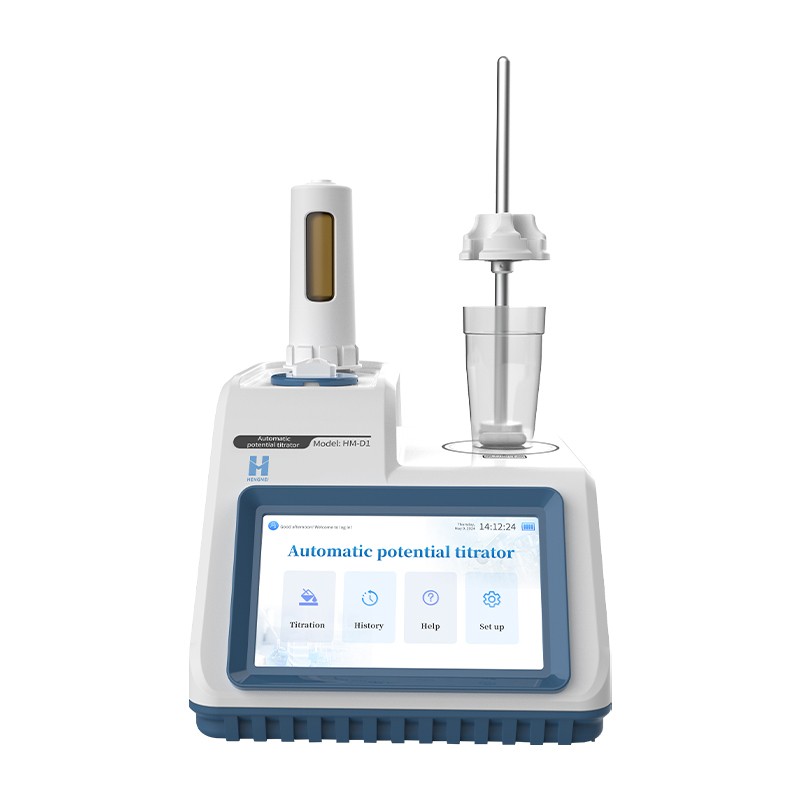
Choose a potentiometric titrator by the reaction chemistry, electrode, titrant and endpoint strategy. HM-D1 supports potentiometric and pH titration with several dosing and endpoint modes. Define the analytical method before comparing data storage or display features.
HM-D1 is part of the HENG MEI Intelligent Manufacturing range supplied by Shandong Hengmei Electronic Technology Co., Ltd.
How the measurement works
HM-D1 follows electrode potential as titrant is added and uses the selected dosing and endpoint method to calculate the result. It has one dosing line and supports stored methods and curve review. The electrode, titrant and reaction conditions must suit the chemistry.
Specify the full titration method
Choose the electrode and titrant for the reaction, then estimate titrant consumption to select an appropriate burette and dosing strategy. Plan standardization, blanks and cleaning when changing reagents on the single line. Evaluate the endpoint curve with the actual matrix, especially where buffering, slow reaction or multiple transitions affect interpretation.
Technical configuration
| Parameter | Specification |
|---|---|
| Dosing configuration | One dosing line / titration unit |
| Potential range | −2000 to +2000 mV |
| Data export | PDF and Excel |
Check the stoichiometry and blank correction
For a 1:1 reaction, a net titrant volume of 12.40 mL at 0.1000 mol/L corresponds to 0.001240 mol of analyte. Net volume is the method-corrected volume after the required blank treatment. Converting moles to sample content also requires molar mass, sample quantity and any dilution. Retain those factors with the curve.
Use the curve to review the endpoint
Dynamic, equal-increment and preset-endpoint modes provide different dosing arrangements. Select settings for the reaction behavior and review the accepted transition or setpoint. Record titrant standardization and electrode status so a change in calculated content can be investigated through its analytical inputs.
Transfer a titration from development to routine use
Define sample preparation, electrode, titrant, stirring and endpoint settings as one method. Evaluate representative samples and the required controls before saving the routine program. Record which calculation factors belong to each sample group and how titrant standardization is updated. During routine operation, retain the curve together with the final result so changes in reaction behavior can be reviewed. When a reagent or electrode changes, assess the effect through the laboratory procedure. A stored program becomes useful when its chemical conditions, operator steps and result calculation are sufficiently defined for repeatable use.
Put the selected method into practice
- Prepare the electrode and standardize the titrant according to the method.
- Record the sample quantity and perform the required blank determination.
- Run the chosen dosing and endpoint program while retaining the titration curve.
- Review the endpoint and calculation factors before exporting the result.
Plan support for common operating issues
| Operating issue | Checks and follow-up |
|---|---|
| The endpoint is unstable | Review electrode condition, stirring, reaction speed and dosing settings. |
| Titrant consumption shifts | Check standardization, blanks, reagent preparation and sample quantity. |
| Carryover appears after a method change | Review rinsing of the dosing path and reaction vessel. |
Plan the complete working configuration
List the reactions, sample matrices, titrants and electrodes required. Choose a burette size and dosing strategy that suit the endpoint behavior and expected titrant consumption. Include titrant standardization, blank measurements and electrode care in the workload. With one dosing line, plan reagent changes and rinsing when moving between methods.
Define the acceptance and reporting requirements
Agree on the following items when configuring HM-D1. They connect the equipment and consumables to the intended measurement and provide a basis for operator training and result review.
- Sample quantity and preparation
- Titrant concentration and standardization
- Electrode and method version
- Curve, endpoint and calculation factors
Questions from buyers and laboratory teams
Does HM-D1 have multiple independent dosing lines?
HM-D1 has a single dosing line and one titration unit.
Why retain the titration curve?
It allows the endpoint selection and reaction behavior to be reviewed alongside the final calculated result.
For a HM-D1 configuration enquiry, provide the sample type, required measurements, expected workload and reporting requirements. Include the consumables, preparation equipment and support arrangements needed at the installation site.
Address of this article:https://www.kjhm.net/news/choosing-an-automatic-potentiometric-titrator.html
 Related News
-
14 / 2024-09
How To Use Soil Rapid Detector To Optimize Farmland Fertilization Strategy.
Learn more
-
19 / 2024-12
High-precision infrared oil detector: an important tool to improve the efficiency of water quality detection.
Learn more
-
13 / 2026-11
HENG MEI Intelligent Manufacturing Choosing a 96-Channel Pipetting Workstation
Learn more
-
13 / 2026-11
HENG MEI Intelligent Manufacturing Choosing a Milk Analyzer for Collection Stations
Learn more