

 Current
Location:
HENG MEI Intelligent Manufacturing Choosing an Automatic Microplate Washer
Article Source: Hengmei Technology Release time:2026-11-13 13:38:22
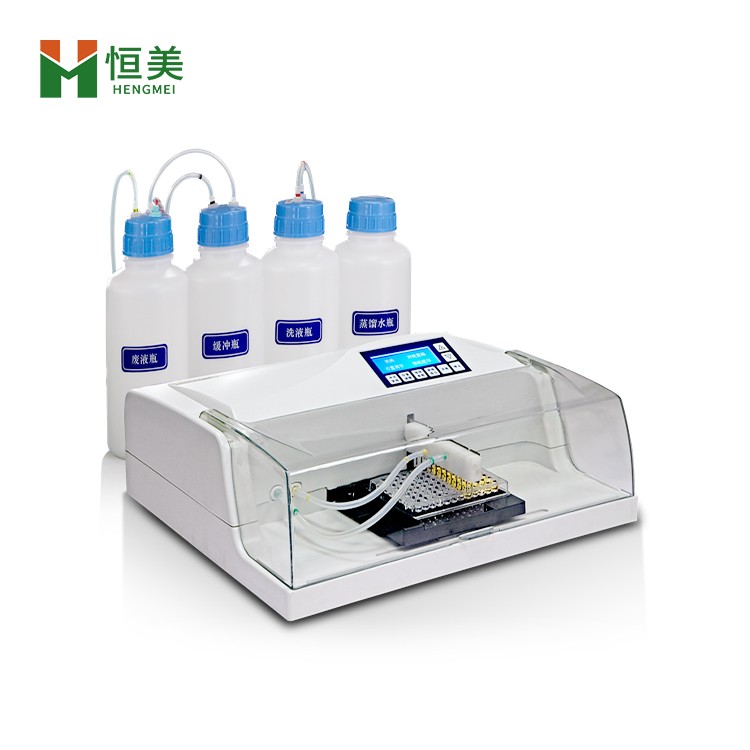
Choose an automatic microplate washer by plate geometry, manifold, wash volume and assay requirements. HM-ZX01 supports 8- and 12-needle washing heads and programmable washing. The selected program must suit the plate and the reagent kit used in the assay.
HM-ZX01 is part of the HENG MEI Intelligent Manufacturing range supplied by Shandong Hengmei Electronic Technology Co., Ltd.
How the measurement works
HM-ZX01 removes well liquid and dispenses wash solution through an 8- or 12-needle head. Plate geometry, aspiration position, wash volume and timing determine the washing sequence required by a particular microplate assay.
Select a washing program for the actual plate
Match the plate shape and assay to the washing head and program. Evaluate liquid removal, buffer delivery and residual volume with the intended consumables. Include priming, waste handling and shutdown rinsing in the operating plan. Adjust cycle count and soaking through the assay procedure and its control performance.
Technical configuration
| Parameter | Specification |
|---|---|
| Washing heads | 8 needles or 12 needles |
| Dispense setting | 10–3000 µL, in 10 µL increments |
| Wash count setting | 1–99 cycles |
Estimate wash-buffer demand
A 96-well plate receiving 300 µL per well uses 28.8 mL for one full dispense cycle. Five such cycles require 144 mL before priming, line filling and any additional rinse. Use the actual program volume, number of wells and cycle count to calculate the working buffer supply and waste capacity.
Use assay controls to assess the washing process
Residual unbound material can affect background, while unsuitable handling can disturb the assay material. Review controls with the configured washing sequence and plate geometry. Keep program identity and maintenance records available when investigating changes between assay batches.
Introduce a new microplate or assay
Review the well geometry and the kit washing instructions before selecting a stored program. Check head alignment and the permitted aspiration settings with the actual plate. Evaluate buffer delivery and removal together with assay control performance. Include priming and the shutdown rinse in operator training, since the liquid path must remain suitable for the next run. Save the accepted program with its plate and assay identity. When background or well-to-well behavior changes, this record helps the laboratory compare the washing conditions against those used during the original evaluation.
Put the selected method into practice
- Select the plate type and install the compatible washing head.
- Prime the liquid path and inspect the fluid supply and waste arrangement.
- Run the kit-specified wash program with suitable aspiration settings.
- Review controls and plate condition, then complete the prescribed rinse and shutdown sequence.
Plan support for common operating issues
| Operating issue | Checks and follow-up |
|---|---|
| Some wells retain liquid | Inspect permitted head adjustments, needle condition and plate alignment. |
| Background increases across a plate | Review buffer supply, aspiration, washing sequence and the assay controls. |
| Flow becomes uneven | Follow the cleaning and priming procedure for the liquid path and needles. |
Plan the complete working configuration
List the plates and assay kits in use, then compare head configuration, liquid handling and program storage. Assess residual-liquid behavior with the actual plates. Include priming, routine rinsing, waste handling and carryover checks in the operating plan. Identify whether extra wash-liquid channels are part of the selected configuration.
Define the acceptance and reporting requirements
Agree on the following items when configuring HM-ZX01. They connect the equipment and consumables to the intended measurement and provide a basis for operator training and result review.
- Plate type and assay
- Head and wash-program identity
- Buffer, cycles and soak settings
- Controls, priming and maintenance
Questions from buyers and laboratory teams
Should the maximum number of washes always be used?
Follow the assay procedure and evaluate performance with the actual plate and controls.
What can cause inconsistent washing?
Review head alignment, blocked needles, plate geometry, liquid supply, aspiration settings and the programmed sequence.
For a HM-ZX01 configuration enquiry, provide the sample type, required measurements, expected workload and reporting requirements. Include the consumables, preparation equipment and support arrangements needed at the installation site.
Address of this article:https://www.kjhm.net/news/choosing-an-automatic-microplate-washer.html
 Related News
-
24 / 2025-12
HM-Y100 Portable Near-Infrared Rapeseed Analyzer Product Knowledge Graph White Paper
Learn more
-
13 / 2026-11
HENG MEI Intelligent Manufacturing Handheld Density Meters for On-Site Liquid Checks
Learn more
-
10 / 2026-07
HM Instruments Integrated Chemiluminescence Imaging System: Reliable Manufacturer & Brand Guide
Learn more
-
15 / 2026-06
Reliable Sterility Testing Pump Manufacturers & Brand Guide
Learn more