

 Current
Location:
Airborne Microbial Sampler Selection Guide | HENG MEI Intelligent Manufacturing
Article Source: Hengmei Technology Release time:2026-11-16 17:48:29
Nearly every viable air sampler on the market quotes a flow rate of 100 litres per minute, which makes the specification look undifferentiated. It is not. The flow rate sets how long a sample takes; the impact velocity and the sieve geometry set whether the microorganisms in that sample arrive on the agar alive and in a countable distribution.
This article explains what the numbers in a sampler datasheet actually constrain, using the HM-KF1 as a reference point, and sets out how to size a sampling programme. It is written by the engineering team at HENG MEI Intelligent Manufacturing.
Impaction is a physical process with a physical limit
A sieve impactor draws air through a perforated head and accelerates it so that particles above a certain aerodynamic diameter leave the airstream and hit the agar surface. Two velocities matter.
The jet velocity at the sieve must be high enough to deposit particles but not so high that microorganisms are damaged or bounce off the plate. The velocity at the sampling orifice matters for a different reason: in a cleanroom with unidirectional airflow, an intake that draws air faster or slower than the surrounding flow disturbs the very environment being measured. That is what the 0.38 m/s figure on the HM-KF1 describes — an approach velocity intended to be close to cleanroom airflow, so the sampler does not create its own contamination plume.
Neither figure appears on marketing pages because neither can be marketed. They are engineering constraints, and a sampler that does not state them should be asked for them.
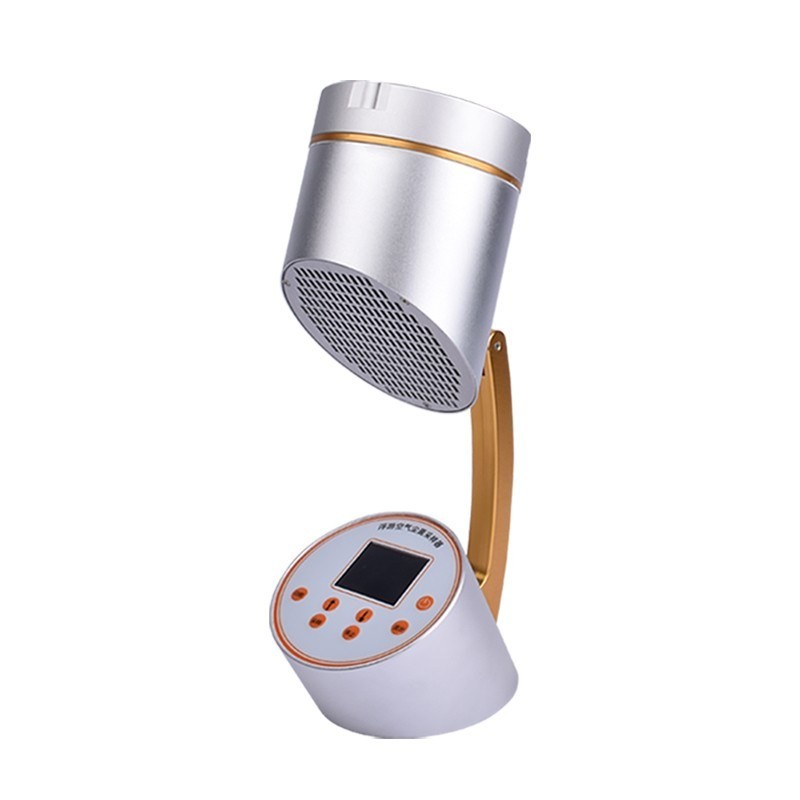
What the HM-KF1 specifies
| Parameter | HM-KF1 | Practical meaning |
|---|---|---|
| Sampling flow | 100 L/min | One cubic metre in ten minutes |
| Sampling period | User-set | Volume is chosen per location, not fixed by the instrument |
| Orifice velocity | 0.38 m/s | Isokinetic sampling in a cleanroom airflow |
| Plate format | 90 × 15 mm Petri dish | Standard agar plates; no proprietary consumable |
| Operating environment | 10–35 °C, 10–90% RH | Covers controlled production areas |
| Power | AC/DC dual supply | Mains or battery, so sampling can continue during a power interruption |
| Power consumption | 20 W | Negligible against a room's electrical load |
| Weight / size | 2 kg, 120 × 300 mm | One hand carries it between points |
Sizing a sampling programme
Sampling volume is a programme decision, not an instrument setting. Two approaches are in common use and they answer different questions.
| Approach | Typical volume | Strengths | Limits |
|---|---|---|---|
| Fixed volume | 500 L or 1,000 L per point | Comparable over time; simple to defend | Low bioburden rooms yield many zero counts |
| Graded volume | 200/500/1,000 L by grade | Matches expected counts per grade | Requires a written rationale per area class |
| Settle plate | Passive, 4 hours | No instrument; good for continuous background | Not volumetric; cannot be compared with active sampling |
The practical point is that a 100 L/min sampler turns volume into time: 1,000 L takes ten minutes. A monitoring plan with 20 points at 1,000 L each is three and a half hours of sampling before incubation, which is why monitoring is usually distributed across a shift rather than run as one sweep.
What the instrument cannot tell you
The sampler recovers organisms; it does not identify them and it does not count them. The plate is incubated for a defined period and the colonies are counted, then the result is expressed as CFU per cubic metre using the volume sampled. Two consequences follow.
- Incubation conditions decide what grows. Tryptic soy agar at 30–35 °C recovers bacteria; malt extract agar at 20–25 °C recovers fungi. Running one medium and reporting "total airborne microorganisms" overstates what was measured.
- A zero count is not proof of sterility. It is a result below the detection limit of that volume and that medium, and should be reported as such.
Where a basic sampler is enough
Not every cleanroom needs a programmable instrument with data export. A basic unit with a fixed 100 L/min flow, a user-set period and a 90 mm plate format covers routine monitoring in Grade C and D areas, in hospital pharmacies, in food production clean areas and in cosmetics manufacturing — environments where the monitoring plan is stable, the points are few, and the record is written on a batch sheet.
Where the programme needs programmed volumes, stored records and printed results, a programmable instrument is the better match; the specification differences are set out in the companion guide to programmable samplers.
Checks before purchase
- Ask for the orifice velocity and the jet velocity, not only the flow rate.
- Confirm the plate format is a standard 90 mm dish you can fill in-house.
- Check that the sampling period is adjustable; a fixed volume cannot serve different area grades.
- Confirm power arrangements for the way your site actually samples — mains, battery, or both.
- Verify calibration and service: flow calibration is the parameter that drifts, and a sampler with no calibration route is a liability in an audit.
How HENG MEI supports viable air monitoring
HENG MEI Intelligent Manufacturing supplies the HM-KF1 basic impactor and the HM-KF2 programmable sampler, both at 100 L/min with 90 mm plate formats, alongside surface and product microbial methods. A site can therefore use one plate supply and one incubation protocol across air and surface monitoring.
To match a sampler to a monitoring plan, tell our sales contact the area grades, the number of points, the volume per point your procedure specifies, and whether records must be printed or exported. Those four facts decide between a basic and a programmable instrument.
Contact: Kyra, Sales Contact, Kyra@hmdzkj.cn, +86 13792642016 (Tel / WhatsApp / WeChat).
Address of this article:https://www.kjhm.net/news/airborne-microbial-sampler-selection-100-lpm.html
 Related News
-
12 / 2026-05
HengMei Filter Integrity Tester Industry Application White Paper | HM-GL Multi-Scenario Solutions
Learn more
-
13 / 2026-11
HENG MEI Intelligent Manufacturing Food Safety Analyzer Selection for Routine Screening
Learn more
-
13 / 2026-11
HENG MEI Intelligent Manufacturing Handheld Density Meters for On-Site Liquid Checks
Learn more
-
11 / 2024-05
Photosynthesis meter: Revealing the mysteries of plant growth.
Learn more