

 Current
Location:
Poultry Disease PCR on Site: 8-Well Capacity Planning | HENG MEI Intelligent Manufacturing
Article Source: Hengmei Technology Release time:2026-11-16 17:55:43
An eight-well real-time PCR instrument is the smallest format that still supports proper controls, and that sentence contains both its value and its limit. With a positive control, a negative control and an internal control per sample, eight wells hold roughly four or five samples — enough for a farm checking a suspect flock today, not enough for a laboratory processing a hundred submissions a week.
This article sets out what an eight-well instrument can do in poultry work, what it cannot, and how to decide between eight, sixteen and thirty-two wells. It is written by the engineering team at HENG MEI Intelligent Manufacturing.
What poultry work actually requires
The targets that dominate are avian influenza, Newcastle disease, infectious bronchitis, and — depending on region — infectious bursal disease and Mycoplasma. Sample matrices are typically cloacal and tracheal swabs, and occasionally tissue from carcasses.
Three properties of that workload matter for instrument sizing.
- Samples arrive in batches, not singly. A suspect flock produces 10–30 swabs, not one.
- Controls consume capacity. A positive control, a no-template control and an extraction blank are the minimum for a defensible run.
- Results have a short useful life. A result that arrives after the flock has been moved has little biosecurity value.
The capacity arithmetic
| Run design | Wells used | Sample results | Typical use |
|---|---|---|---|
| 1 target, 3 controls | 8 | 5 | Single suspect bird, or small batch triage |
| 2 targets (duplex), 3 controls | 8 | 2–3 | Differential diagnosis on a few birds |
| 1 target, 2 controls | 8 | 6 | Minimum defensible for screening |
| Full flock of 20 swabs | 8-well × 4 runs | 20 | Workable but slow; 16 or 32 wells preferable |
That arithmetic is why eight wells suits a farm or a veterinary practice with a small number of suspect cases, while a regional laboratory should specify sixteen or thirty-two. The instrument is not less accurate at eight wells; it simply spends its capacity on controls sooner.
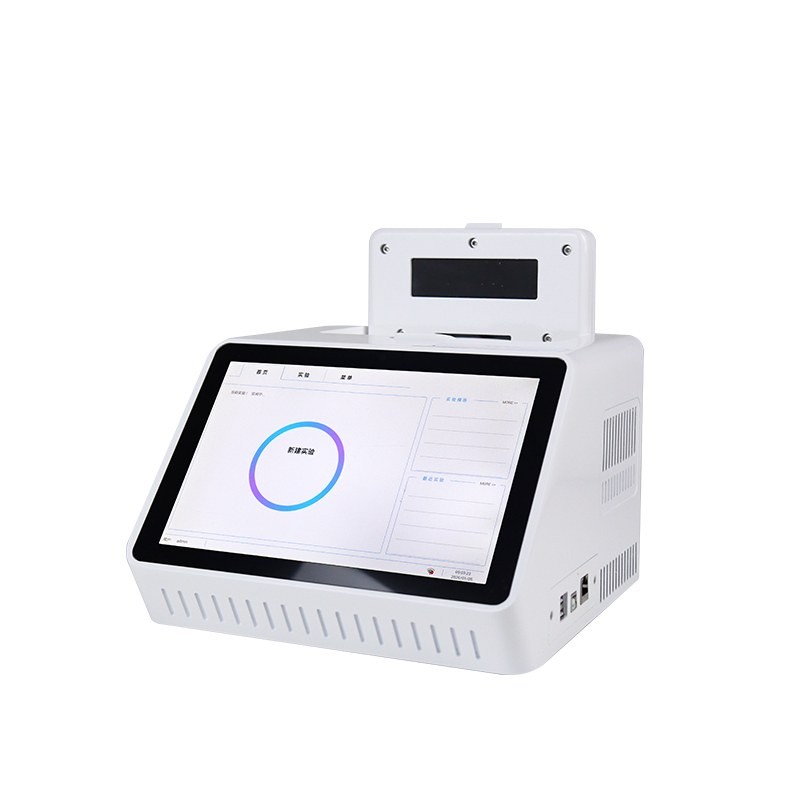
Specification of the HM-P08
| Parameter | HM-P08 | Practical meaning |
|---|---|---|
| Sample capacity | 8 × 0.2 mL, 8-strip compatible | Standard tubes and strips; no proprietary consumable |
| Reaction volume | 5–120 µL | Accommodates small elution volumes from swab extraction |
| Temperature range | 4–99 °C | Covers hot-start through amplification |
| Ramp rate | ≥2 °C/s average | Run time longer than larger instruments but acceptable for same-day results |
| Control accuracy | ≤±0.1 °C | Adequate for end-point interpretation |
| Well uniformity | ≤±0.2 °C | All eight positions usable |
| Excitation | LED, 400–700 nm | Covers FAM and, with the optional second channel, VIC/HEX |
| Channels | 1 (FAM) standard; 2 optional | Duplex assays require the second channel |
| Display | 7-inch HD screen | On-instrument operation without a PC |
| Noise | <45 dB | Usable in a room adjacent to the farm office |
The single-channel configuration is the specification most often misread. A duplex assay — target plus internal control in one tube — needs two channels. A buyer planning duplex work should specify the second channel at purchase; retrofitting is possible but changes the instrument.
What a farm-based PCR result can support
A positive result on a swab from a suspect bird supports a biosecurity decision: isolate the house, stop movement, notify the veterinary authority. A negative result on a small sample does not clear a flock — sampling coverage, not assay sensitivity, is the limiting factor.
That distinction should be written into the farm's procedure. A farm that treats one negative swab as a clearance will eventually move infected birds, and the instrument will be blamed for a failure that was a sampling decision.
Contamination control in a non-laboratory setting
PCR in a farm office introduces a risk a laboratory controls by design: amplicon contamination. Four practical measures substantially reduce it.
- Extract in a different room from amplification, even if the rooms are adjacent. Never open post-amplification tubes near the extraction bench.
- Use filter tips and change them between samples.
- Run a no-template control every run and stop if it amplifies.
- Keep a dedicated lab coat and gloves for the PCR area; do not carry them into the poultry house.
Choosing between 8, 16 and 32 wells
| Situation | Recommendation | Reason |
|---|---|---|
| Single farm, few suspect cases per month | 8 wells | Capacity sufficient; lowest cost |
| Veterinary practice serving several farms | 16 wells | Batch of 10–12 samples with controls in one run |
| Regional laboratory or integrator | 32 wells | Full flock sample sets without splitting runs |
| Any setting requiring duplex assays | Specify 2 channels | Single-channel formats cannot run duplex |
How HENG MEI supports poultry testing
HENG MEI Intelligent Manufacturing supplies the HM-P08 with 8 wells and a 7-inch touchscreen, and the same platform in 16-well and 32-well formats, so a practice can add capacity without changing protocols or training. Swab extraction reagents and assay kits are selected to the customer's target list.
To size a configuration, tell our sales contact the farms served, the suspect cases per month, the targets required and whether duplex assays are planned. Those four facts decide the well count and the channel configuration.
Contact: Grace, Sales Contact, graceliu@hmdzkj.cn, +86 17853698681 (Tel / WhatsApp / WeChat).
Address of this article:https://www.kjhm.net/news/poultry-disease-pcr-8-well-capacity.html
 Related News
-
08 / 2024-10
Revealing The Multifunctional Advantages And Applications Of High-precision Soil Detectors.
Learn more
-
12 / 2026-05
HengMei HM-GL Filter Integrity Tester — FAQ & Technical Q&A
Learn more
-
15 / 2026-06
Reliable Sterility Testing Pump Manufacturers & Brand Guide
Learn more
-
16 / 2026-11
Pigeon Flight Ability Genotyping with 7 Loci | HENG MEI Intelligent Manufacturing
Learn more