

 Current
Location:
Pigeon Flight Ability Genotyping with 7 Loci | HENG MEI Intelligent Manufacturing
Article Source: Hengmei Technology Release time:2026-11-16 17:55:33
Racing pigeon breeding has an unusual problem: performance is measured in races that take months to run, are heavily influenced by weather and management, and cannot be repeated with the same bird. A genotype offers something a race result does not — a reading that is fixed for the bird's life and available before it is trained. What it does not offer is a prediction of prize money, and any supplier who implies otherwise is overselling.
This article explains what the seven-locus panel used in the HM-P32 tests, how the workflow runs, and how to interpret the output honestly. It is written by the engineering team at HENG MEI Intelligent Manufacturing.
What the panel covers
The panel examines seven loci that research literature has associated with traits relevant to flight. The associations are population-level findings, and a genotype is a description of a variant, not a score.
| Marker | Trait area | How it is normally used |
|---|---|---|
| DRD4 | Homing tendency | Breeding pair selection within a line |
| LDHA | Flight endurance, anaerobic metabolism | Screen for endurance-associated variants |
| CRY1 | Circadian rhythm | Consider alongside race timing and training schedule |
| MSTN | Muscle development regulation | Body-type and muscle trait context |
| F-KER | Feather structure and strength | Feather quality context for long-distance work |
| CASK | Neural development, learning | Interpretive marker; weakest direct performance link |
| GSR | Orientation under overcast conditions | Consider for racing in variable weather |
Presenting these as a single "ability score" is where most misuse occurs. Each marker describes one variant; a bird with favourable variants at five loci and unfavourable at two is not averaged into a number that means anything. The useful output is the per-locus genotype, read alongside pedigree and race history.
Sample types and the practical workflow
Blood or feather pulp both yield usable DNA. Feather pulp is often preferred by breeders because it can be collected without handling the bird for long and without a needle.
- Collect and label. One sample per bird, identified by ring number at collection, not later.
- Extract DNA. A standard column or magnetic bead extraction is sufficient; the markers are not low-copy targets.
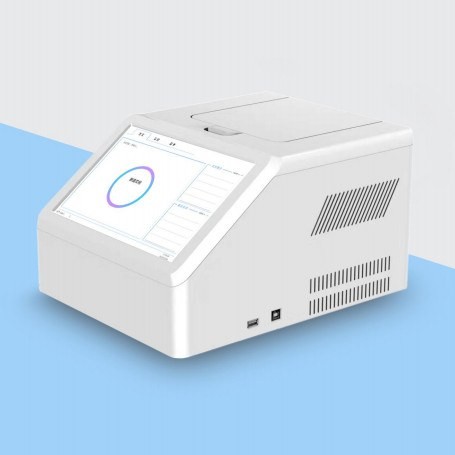
- Set up the reactions. Seven loci plus a control per bird. On a 32-well instrument that is four birds per run with controls; on a 16-well instrument two.
- Amplify and read. Real-time PCR with melt or probe-based discrimination depending on the assay design supplied.
- Report per locus. A table of genotypes, not a single rank.
Capacity planning follows directly: a breeder genotyping 100 birds needs 25 runs on a 32-well instrument. Runs can be batched, and samples can be stored refrigerated for short periods without affecting these assays.
Instrument specifications that matter
| Parameter | HM-P32 | Why it matters here |
|---|---|---|
| Sample capacity | 32 × 0.2 mL | Four birds per run with controls; fewer runs per flock |
| Reaction volume | 15–100 µL | Standard volumes; no specialised consumables |
| Temperature range | 4–99 °C | Covers hot-start through amplification and melt |
| Max ramp rate | ≤5.5 °C/s | Short protocol; results same day |
| Control accuracy | ≤±0.01 °C | Reproducible discrimination between genotypes |
| Well uniformity | ≤±0.3 °C | Edge wells usable, so the full block is capacity |
| Channels | 4 | Multiplex assays and internal controls in one tube |
| Footprint / weight | 235 × 385 × 175 mm, 5.8 kg | Bench instrument for a breeding operation |
Interpreting a result without over-claiming
Three cautions belong in every report a breeder receives.
- Association is not prediction. A marker associated with endurance in a studied population does not guarantee a bird wins a 600 km race. Training, health, weather and navigation all intervene.
- Genetic background matters. The same variant can behave differently in different lines. Breeders should build their own records correlating genotypes with their own race results before drawing conclusions.
- Selection reduces diversity. Selecting hard on a small set of markers narrows the gene pool. A responsible programme uses genotype as one input among pedigree, health screening and race performance.
The most defensible use is pair selection: identifying birds that carry variants a breeder wants to retain, then confirming over several seasons whether offspring performance supports the choice. That is a breeding programme, not a prediction service.
What the instrument does not do
It does not identify breed, sex or parentage unless those assays are added. It does not sequence the loci; it discriminates known variants. And it does not replace health screening — a bird with a respiratory infection will not race well regardless of genotype.
Breeders often ask for sex determination in the same run. That is a separate assay and can be added to the panel; it should be quoted as an addition rather than assumed.
How HENG MEI supports pigeon genotyping
HENG MEI Intelligent Manufacturing supplies the HM-P32 real-time PCR instrument, with 32 wells, four channels and 5.8 kg bench footprint, alongside 8-well and 16-well formats from the same platform for smaller breeders. Assay reagents are selected by the laboratory or supplied to the customer's specification.
To plan a genotyping service, tell our sales contact the birds per month, the loci required, whether sex determination or parentage is included, and the reporting format breeders expect. Those four facts set the instrument capacity and the assay panel.
Contact: Kyra, Sales Contact, Kyra@hmdzkj.cn, +86 13792642016 (Tel / WhatsApp / WeChat).
Address of this article:https://www.kjhm.net/news/pigeon-flight-ability-genotyping-7-locus.html
 Related News
-
13 / 2026-11
HENG MEI Intelligent Manufacturing Food Safety Analyzer Selection for Routine Screening
Learn more
-
21 / 2024-11
Multifunctional pesticide residue detectors can adapt to diverse detection needs.
Learn more
-
24 / 2025-12
HM-Y100 Portable Near-Infrared Rapeseed Analyzer Product Knowledge Graph White Paper
Learn more
-
09 / 2026-11
Animal Disease Tester Brands Compared: IDEXX, Bio-Rad, HENG MEI
Learn more