

 Current
Location:
HENG MEI Intelligent Manufacturing | Choosing an Aquatic Products Analyzer for Seafood Screening
Article Source: Hengmei Technology Release time:2026-11-18 10:33:29
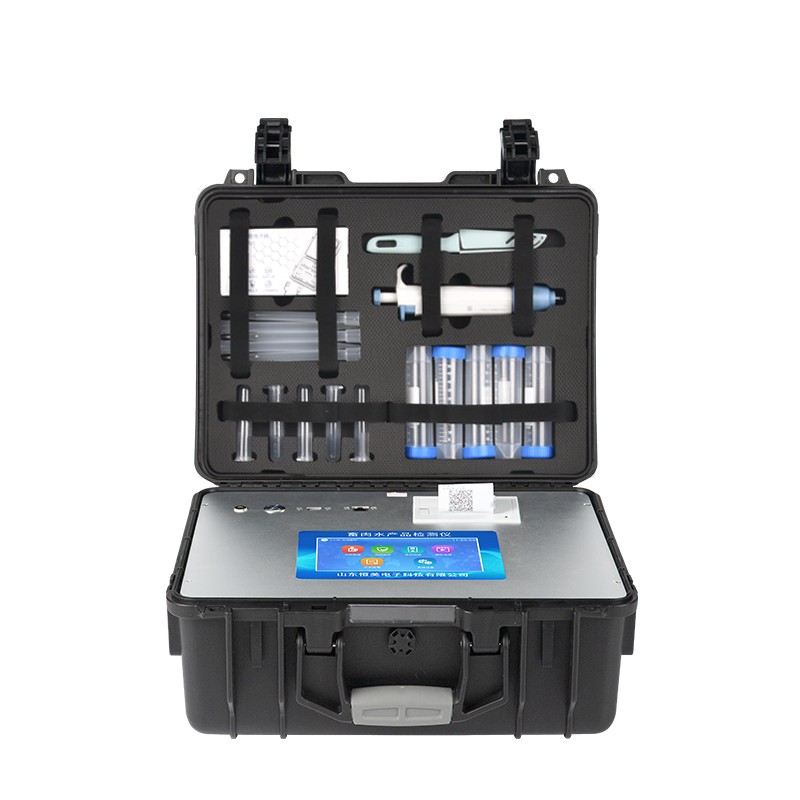
Select a seafood screening system by target substance, species and tissue or product form. A shrimp residue assay and a fish quality assay can require different extraction and interpretation. HM-SK from HENG MEI Intelligent Manufacturing is an aquatic products antibiotic screening option to evaluate against your actual menu.
Specify target, species and sample matrix
Create a table of the substances or properties required for each seafood product. Check the assay format and validation for the relevant species, as well as the evidence for use on raw, frozen or processed products. Request the consumable configuration and preparation steps for each planned assay. A broad category label does not establish that every assay applies to every species.
Build the workload from the actual test menu
If twelve seafood lots each require two separate target assays, count 24 sample-assay combinations before controls or repeats. Where a laboratory handles fish and shrimp on the same shift, check whether their preparation steps and reaction schedules can be grouped under the methods. Include refrigerated storage and chain-of-custody needs in the setup.
Agree on what happens after a finding
Define the decisions covered by rapid screening and the cases that require confirmation. Request a report format that links each test to the species, batch, target and assay lot. Review representative product samples before finalizing the configuration.
Shandong Hengmei Electronic Technology Co., Ltd.
Validate the menu species by species
Start with a target-by-species list for the seafood you buy. An antibiotic screen on one tissue and species cannot be assumed equivalent in a different matrix. Specify specimen form, preparation, working level and control programme for each planned assay. Ask for a demonstration on representative seafood and confirm which consumables operators can order for each method. For a procurement comparison, include time at receiving, cold storage and turnaround for laboratory follow-up.
Budget the measurement workload
Twelve lots screened for two targets require 24 sample reactions. If four more lots are tested for only one target, the total becomes 28 before controls and repeats. Plan consumables by target, not just by the total number of lots.
What to compare in a supplier demonstration
| Purchase criterion | What to examine |
|---|---|
| Sample and decision level | Ask for the target-by-species and sample-matrix menu. Check reagent availability and preparation requirements for each of the tests in the receiving programme. |
| Operating cost | Include reagents, batch controls, preparation labor and any confirmatory tests when calculating cost per reportable result. |
| Delivery and support | Ask for the quoted configuration, operator training options and written service terms for your installation location. |
Turn the purchasing brief into acceptance criteria
Start the procurement review with fish and shrimp intake lots, including frozen product. Ask the production, purchasing and quality teams to agree on the target-by-species and tissue screening requirement. Give suppliers the same sample list and tell them whether the instrument will support rapid intake screening, a process adjustment or a formal release decision. Those uses can require different evidence. A well-defined brief allows the demonstration to answer the operational question that prompted the purchase and gives each supplier the same basis for a quotation.
For seafood antibiotic residues, review target coverage and reagent supply for the actual assortment of species before ordering. Ask for the complete equipment and consumable list for the proposed method, including accessories used before a sample reaches the reader. Confirm whether the quotation includes the preparation items used in the demonstration and which items need separate ordering. Ask the supplier to show a completed report as well as the onscreen result. Agree who will review unexpected findings and how the result will be associated with an incoming lot or production batch.
Run a supplier demonstration with a small challenge set
Use the same sample identifiers, preparation basis and decision criteria for every proposal. Include material within the normal working range, material close to the decision point and at least one challenging product type when available. Plan for controls suitable for each seafood matrix and target assay. Define the outcome to be reviewed before the demonstration, such as usable repeat agreement, an acceptable control response or alignment with a suitable comparison method. Keep raw readings and record species, tissue, thawing history and extract identity. Those details allow results to be reviewed after the demonstration rather than relying on a single value shown at the bench.
| Check | Evidence to retain |
|---|---|
| Representative samples | Use material such as fish and shrimp intake lots, including frozen product; record the lot and how each portion was prepared. |
| Decision and control | Use the target-by-species and tissue screening requirement. Arrange controls suitable for each seafood matrix and target assay. |
| Exception handling | Ask the operator to show how to handle an unacceptable assay control or an unexpected result in a different species and preserve the original record. |
| Configuration fit | Check species, tissue, thawing history and extract identity and request the report and equipment configuration used during the demonstration. |
Review agreement one sample at a time before comparing averages. Identify whether differences arise in sample preparation, acquisition, calibration or interpretation. For a qualitative screen, compare the number of valid results and the handling of borderline or presumptive findings. For a quantitative application, examine repeatability and the size and direction of differences at the working decision level. If the programme requires an independent method, use matched portions so that sampling variation does not dominate the comparison.
Compare recurring cost and usable capacity
Build the operating estimate from the complete workflow. For this application, list target-specific cards, preparation, cold storage and confirmation. Estimate how many sample determinations, control reactions and repeats a typical shift needs. Add time for cleaning, startup checks, review and external testing where applicable. Quote an annual consumable quantity for each recurring item and separate it from the equipment investment. The useful cost denominator is the number of reportable samples or lots that reach a decision. Separate any one-time operator training, installation and verification expenses from recurring usage costs.
Estimate capacity using the slowest step in the normal work sequence. A reader can complete its measurement quickly while operators are waiting for preparation, reaction timing, consumable replacement or control review. Time the actual sequence with the staff and bench layout you intend to use. When testing is concentrated at receiving, use the busiest reasonable shift to estimate staffing and sample storage. Ask how the system retrieves original records during a repeat or a supplier dispute. Include that review time when comparing competing workflows.
Plan installation, training and handover
Agree on the installation checklist and nominate the staff who will run seafood antibiotic residues tests. Training should include a representative sample, correct handling of species, tissue, thawing history and extract identity and an example showing an unacceptable assay control or an unexpected result in a different species. Request the current operator instructions and confirm how the supplier handles consumable availability, maintenance requests and reference checks. Document the configured method and the outputs accepted at handover so the team can identify a change after switching a reagent, product matrix or instrument setting.
Before using a new configuration for routine decisions, make sure the quality team can explain the response to matrix interference, thawing differences or an assay applied outside its intended scope. Schedule a demonstration with samples from your own operation and bring the expected workload, decision levels, required record fields and intended installation location. These details give HENG MEI Intelligent Manufacturing a basis for matching the equipment, preparation tools and consumables to the job.
Address of this article:https://www.kjhm.net/news/choosing-an-aquatic-products-analyzer-for-seafood-screening.html
 Related News
-
09 / 2026-11
Animal Disease Tester Brands Compared: IDEXX, Bio-Rad, HENG MEI
Learn more
-
15 / 2024-10
Intelligent Environmental Monitoring: Analysis Of The Advantages Of The New Air Planktonic Bacteria Sampler.
Learn more
-
10 / 2026-07
HM Instruments Integrated Chemiluminescence Imaging System: Reliable Manufacturer & Brand Guide
Learn more
-
13 / 2026-11
HENG MEI Intelligent Manufacturing Choosing a Chemiluminescence Imaging System
Learn more